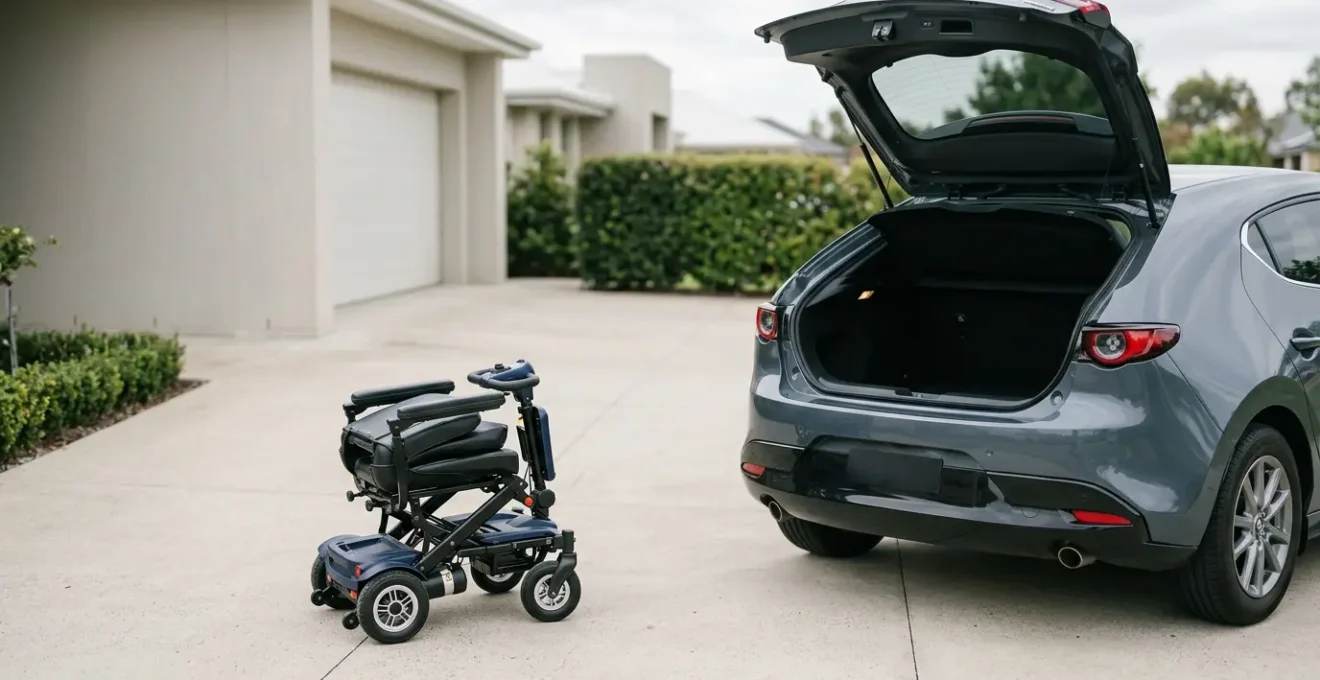
In summary:
- Focus on your « destination lifestyle »—how you get the scooter from your car to the pavement is the most critical factor.
- Prioritise an airline-approved lithium battery (under 300Wh) for hassle-free travel and lighter lifting.
- Don’t trust brochure specs; perform a real-world « 30-second test » in a showroom to check folding speed and lifting weight.
- Measure your boot’s aperture (opening) and lip height, not just the litre capacity, to guarantee a fit.
- For frequent flyers, understanding gate-check procedures is more important than having the lightest scooter.
For the active retiree, the car is a gateway to freedom. It opens up day trips to national parks, visits to sprawling shopping centres, and easy journeys to the airport for that well-deserved holiday. But there’s often a gap in that freedom: mobility at the destination itself. A boot scooter promises to bridge that gap, offering independence once you’ve parked. However, the market is flooded with options, and most advice boils down to generic tips like « check the weight » or « measure your boot. »
This approach misses the point entirely. The challenge isn’t just about the scooter’s features in isolation; it’s about the seamlessness of your entire journey. It’s about the « transition point »—that moment in a rainy car park when you need to get the scooter out of the boot and ready to go, quickly and without straining your back. The real question isn’t which scooter is ‘best’, but which one perfectly matches your specific destination lifestyle.
What if the key wasn’t the scooter’s maximum range, but how easily it unfolds? What if the debate between 3 and 4 wheels was less about stability and more about fitting through a cruise ship cabin door? This guide re-frames the decision process. We’ll move beyond generic specifications to focus on the practical realities of using a boot scooter, from the ergonomic tax of a clumsy fold to the non-negotiable rules of air travel. We will analyse the critical trade-offs between convenience, cost, and on-site performance so you can choose a scooter that truly enhances your freedom, rather than becoming a burden.
This article provides a comprehensive framework to guide your choice. By exploring the key decisions you’ll face, you can confidently select a compact folding scooter that integrates perfectly with your car and your active life.
Summary: Your Guide to Choosing a Compact Boot Scooter
- Automatic Fold vs Manual: Is the Electronic Key Fob Worth the Extra £500?
- Lithium vs Lead-Acid: Which Battery Lets You Fly Without Hassle?
- The 5-Step Test: Can You Really Unfold It in 30 Seconds in the Rain?
- The 4-Wheel vs 3-Wheel Debate for Compact Models
- Hatchback or Saloon: Will It Fit Without Folding the Back Seats?
- Carbon Fiber Frames: The Future of Ultra-Light Mobility Aids
- Drive to the Door: Why You Should Keep Your Scooter Until the Plane Door?
- Flying with a Scooter: Essential Airline-Approved Cases and Battery Rules
Automatic Fold vs Manual: Is the Electronic Key Fob Worth the Extra £500?
The first major decision you’ll face is the folding mechanism. A manual folding scooter requires you to operate latches and levers, while an automatic model folds and unfolds at the press of a button on a key fob. The convenience of an automatic fold is undeniable, especially on a cold, rainy day. It transforms a multi-step physical process into a single, effortless action. For users with arthritis, limited dexterity, or back pain, this feature alone can be the difference between a spontaneous outing and staying home.
However, this convenience comes at a significant cost—often a premium of £500 or more. Beyond the initial price, automatic systems introduce electronic components like motors and remote controls, which can be more complex and costly to diagnose and repair than a simple mechanical latch. A manual scooter, while requiring more physical effort, is mechanically simpler and often more reliable in the long run. The « ergonomic tax » of a manual model is paid with every use, whereas the financial tax of an automatic one is paid upfront.
Your choice depends on your priorities and physical capabilities. If the extra cost removes a significant barrier to you using the scooter, it’s a worthwhile investment in your lifestyle. If you are comfortable with light physical action and prefer mechanical simplicity, the savings from a manual model can be better invested elsewhere, perhaps in a lighter battery or better accessories.
This table breaks down the core trade-offs to help you decide if the added cost is justified for your personal needs, as detailed in a cost-benefit analysis by scooter specialists.
| Feature | Manual Folding | Automatic Folding |
|---|---|---|
| Typical Price Range | £750 – £2,000 | £1,250 – £5,000+ |
| Price Premium | Baseline | +£500 to £1,500 |
| Folding Time | 10-25 seconds | 8-12 seconds |
| Physical Effort | Manual latch operation required | Push-button activation |
| Reliability Concern | Mechanical latches (low failure rate) | Electronic components (remote, motor) |
| Maintenance | Simple latch lubrication | Electronic system diagnostics |
| Ideal User | Occasional traveler, good dexterity | Daily user, arthritis, caregiver assistance |
Lithium vs Lead-Acid: Which Battery Lets You Fly Without Hassle?
The battery is the heart of your boot scooter, impacting its weight, charging time, and, most critically, its « airport-readiness. » The choice is almost always between traditional Sealed Lead-Acid (SLA) and modern Lithium-Ion (Li-ion) batteries. While SLA batteries have a lower upfront cost, they are heavy, slow to charge (8-12 hours), and have a much shorter lifespan of only a few hundred charge cycles. For a scooter designed for portability, their weight is a significant drawback.

Lithium-ion batteries are the clear winner for any travel-focused user. They are 50-75% lighter than their SLA counterparts, which makes a huge difference when lifting the scooter into a car boot. They charge significantly faster (2-4 hours) and support « opportunity charging »—quick top-ups without damaging the battery’s health. While their initial cost is higher, their vastly superior lifespan of over 2,000 charge cycles often makes them cheaper in the long run on a cost-per-cycle basis.
Most importantly for the travelling retiree, lithium batteries are the key to hassle-free air travel. Airlines have strict rules, and lead-acid batteries can be problematic. For lithium batteries, the rules are clear: they must be removed from the scooter and carried into the cabin. International Air Transport Association (IATA) regulations generally permit a maximum of 300 Watt-hours (Wh) for a single-battery mobility device. If your scooter uses two batteries, each must be under 160Wh. Always check your battery’s Wh rating before you buy if flying is part of your plan.
The long-term value and practicality of lithium are undeniable for a portable scooter, as this deep dive on total cost of ownership demonstrates.
| Battery Type | Upfront Cost | Charge Cycles | Typical Lifespan | Cost per Cycle | Charging Speed |
|---|---|---|---|---|---|
| Sealed Lead-Acid (SLA) | £80 – £150 per battery | 200-500 cycles | 12-18 months | £0.30 – £0.75 | 8-12 hours |
| Lithium-Ion (LiFePO4) | £300 – £600+ per battery | 2,000+ cycles | 3-5 years (up to 10 years) | £0.15 – £0.30 | 2-4 hours (1C charging) |
The 5-Step Test: Can You Really Unfold It in 30 Seconds in the Rain?
Brochures and online videos can make any folding scooter look effortless. They are filmed in perfect conditions by people who have practised the manoeuvre dozens of times. But the real test comes at the « transition point »—getting it out of your car boot on your own, possibly in bad weather, when you’re in a hurry. A scooter that is theoretically « lightweight » can feel impossibly heavy and awkward if its balance is off or the grip points are poorly designed. An industry overview confirms that most lightweight scooters weigh less than 70 lbs, but this number means little without a real-world test.
The only way to know if a scooter is right for you is to simulate this real-world scenario. Don’t just fold and unfold it on the showroom floor. Ask the salesperson to let you perform « The 5-Step Showroom Challenge. » This test moves beyond specifications and tells you everything you need to know about the scooter’s day-to-day usability for your destination lifestyle. It measures the real ergonomic tax of handling the scooter.
If you can’t comfortably complete these steps in the controlled environment of a showroom, the scooter will only become more difficult and frustrating to use in the real world. A 30-second target for the unfolding process is a good benchmark for a truly convenient model.
The 5-Step Showroom Challenge: Testing Real-World Folding Speed
- Lift from Boot: Place the folded scooter in your car boot before leaving for the showroom, then lift it out on arrival. Note the effort required and if you can manage it solo without strain.
- Carry 5 Paces: Walk five steps while carrying the scooter. This simulates moving from the car to the pavement or navigating a tight garage. Assess its balance and comfort.
- Place on Ground: Set the scooter down gently on a flat surface. Can you control the descent without dropping it or fumbling?
- Execute Fold/Unfold: Use a stopwatch. Time the complete unfolding process from its compact state to being ride-ready. Aim for under 30 seconds.
- Lock into Place: Ensure all latches, pins, or electronic locks engage fully with a satisfying click. Test stability by gently pushing the handlebars and seat—there should be absolutely zero wobble.
The 4-Wheel vs 3-Wheel Debate for Compact Models
Once you’ve managed the « transition point » and have the scooter on the pavement, its on-site performance becomes the priority. The most fundamental design choice here is whether to opt for a 3-wheel or 4-wheel model. The traditional wisdom holds that 3-wheelers offer superior manoeuvrability, while 4-wheelers provide greater stability. This is broadly true, but the nuances are what matter for your specific destination lifestyle.

A 3-wheel scooter’s key advantage is its tighter turning radius. This makes it a champion of indoor environments like crowded shopping aisles, narrow cruise ship corridors, or navigating around furniture in a café. They also typically offer more legroom, as there is no front axle with two wheels to frame your feet. However, their stability can be compromised on uneven surfaces or when mounting small curbs, requiring more caution during outdoor use.
A 4-wheel scooter, with its wider base of support, is inherently more stable on varied terrain. This makes it a better choice for days out in the park, exploring village pavements, or any situation where the ground might be uneven. While traditionally less agile, many modern compact 4-wheelers have excellent engineering that gives them a « zero turn » capability, rivalling the agility of their 3-wheel counterparts. The folded shape is also often a more predictable rectangle, which can be easier to pack in a car boot than the sometimes awkward triangular shape of a folded 3-wheeler.
The choice depends entirely on where you plan to use your scooter most often. The following table, based on scenario-based recommendations from mobility experts, can help guide your decision.
| Scenario | 3-Wheel Scooter | 4-Wheel Scooter |
|---|---|---|
| Indoor Maneuverability | Excellent — tighter turning radius, ideal for narrow hallways and tight cruise ship cabins | Good — modern ‘zero turn’ models offer comparable agility |
| Outdoor Stability | Moderate — requires anti-tip wheels and low center of gravity for curbs and uneven paths | Superior — inherently stable on uneven park paths and small curbs |
| Folded Shape | Often triangular, can be awkward to fit in saloon boots | Typically rectangular, predictable fit in hatchbacks and saloons |
| Legroom | More spacious — no front crossbar between wheels | Slightly restricted by front axle width |
| Best For | Cruise ships, indoor shopping centers, smooth pavements | Mixed terrain, park walks, users prioritizing stability |
Hatchback or Saloon: Will It Fit Without Folding the Back Seats?
A « boot scooter » that doesn’t fit in your boot is worse than useless. The single biggest mistake buyers make is trusting the manufacturer’s quoted boot capacity in litres. That number is irrelevant. What matters is the usable geometry of your specific boot space and the folded dimensions of the scooter. A hatchback with a large, square opening and low lip is generally easier to load than a saloon with a smaller aperture and a higher boot lip you must lift over.
Before you even visit a showroom, you must become an expert on your own car. Forget the brochure; grab a tape measure. There are three critical dimensions that will determine whether a scooter will fit. Measuring these beforehand will save you immense time and frustration, allowing you to instantly disqualify models that simply won’t work with your vehicle.
Lifting weight is the other half of the equation. While you test the scooter’s weight in the showroom, know what you’re aiming for. The very lightest models weigh as little as 14.7kg, but a more typical weight for a robust folding scooter is between 20-28kg. Can you comfortably and repeatedly lift that weight up to the height of your boot lip? Honesty here is crucial for your long-term comfort and safety. Here’s how to measure your car like a pro:
- Dimension 1: Aperture Height & Width — Measure the actual opening of your boot lid or tailgate. This is the bottleneck; the scooter must pass through here, no matter how large the space inside is.
- Dimension 2: Boot Lip Height — Measure from the ground to the top of the boot floor. This determines the lifting height, a critical ergonomic factor. A lower lip significantly reduces the strain of loading.
- Dimension 3: Usable Floor Depth — Measure the flat floor space from the boot lip straight back to the rear seats. This linear measurement is far more useful than a volume in litres.
- Pro Tip: Create a Cardboard Template — Once you have a scooter’s folded dimensions (L x W x H), cut a piece of cardboard to match. Trying to fit this simple template into your boot is the ultimate, no-risk test.
Carbon Fiber Frames: The Future of Ultra-Light Mobility Aids
For those seeking the ultimate in portability and willing to invest in cutting-edge technology, carbon fibre represents the future of boot scooters. Traditionally used in aerospace and elite sports equipment, this advanced composite material is making its way into mobility aids, offering transformative benefits. Its primary advantage is its incredible strength-to-weight ratio. According to specifications for models like the VOCIC D71, carbon fiber frames are approximately 40% lighter than their aluminum equivalents. This can shave several kilograms off the total weight, making the scooter significantly easier to lift into a car.
This weight reduction dramatically lowers the « ergonomic tax » of handling the scooter, making the entire process of loading and unloading feel almost effortless. For many retirees, this can be the single factor that makes a boot scooter a viable, everyday tool rather than a heavy object reserved for special occasions. But the benefits of carbon fibre go beyond just weight.
The material has natural vibration-damping properties. This means it absorbs the small bumps and imperfections from pavements and paths, leading to a much smoother and more comfortable ride. As experts in mobility materials have noted, this is a crucial benefit for users with chronic pain or sensitivity.
Carbon fiber absorbs road vibrations better than aluminum, resulting in a smoother, more comfortable ride, especially for users with chronic pain or sensitivity.
– Mobility scooter material analysis, Mobility Frontiers — Aluminum vs Carbon Fiber comparison
While the cost is currently at the premium end of the market, the price of carbon fibre models is steadily decreasing. They represent a significant leap forward in designing scooters that are not only portable but also a genuine pleasure to use, combining featherlight handling with a supremely comfortable ride quality. For the discerning user, they are a glimpse into a future where mobility aids are no longer a compromise.
Key takeaways
- The decision between manual and automatic folding is a direct trade-off between upfront cost and daily convenience.
- A lithium-ion battery is a must for travelers due to its light weight and compliance with airline regulations (under 300Wh).
- Real-world testing in a showroom is non-negotiable; you must be able to lift and unfold the scooter yourself in under 30 seconds.
Drive to the Door: Why You Should Keep Your Scooter Until the Plane Door?
Navigating an airport can be one of the most draining parts of travel. The long walks between check-in, security, and the departure gate can exhaust you before your holiday has even begun. While all airports offer a wheelchair assistance service, relying on it means sacrificing your independence. You move on their schedule, dependent on staff availability. This is where your own boot scooter becomes an invaluable travel companion, allowing you to maintain complete autonomy.
The key to this freedom is a procedure called « gate-checking. » This allows you to use your own scooter all the way from the terminal entrance to the door of the aircraft. Instead of checking it in with your main luggage, where it could be damaged, you ride it through the airport, preserving your energy and moving at your own pace. At the gate, airline staff will take the scooter at the jet bridge to be stowed in the hold. Upon arrival at your destination, it will be brought back up to the aircraft door, ready for you to use immediately. This eliminates the often-long wait for assistance or for your equipment to appear at baggage reclaim.
This process gives you the best of both worlds: the comfort and familiarity of your own equipment and the convenience of not having to worry about it during the flight. For the frequent traveller, mastering the gate-check process is essential for a smooth and dignified airport experience.
This table from a guide for airport travelers highlights the difference in experience.
| Aspect | Your Own Scooter (Gate Check) | Airport Wheelchair Service |
|---|---|---|
| Independence | Complete autonomy—move at your own pace | Dependent on staff availability and schedule |
| Comfort & Fit | Perfectly adjusted to your body and needs | Generic wheelchair may not suit your comfort |
| Equipment Hassle | Must manage scooter, battery removal, gate check | Zero equipment responsibility—staff handle everything |
| Wait Times | None—immediate mobility | Potential delays if service is busy |
| Pre-Boarding Access | Guaranteed access to pre-boarding | Also qualifies for pre-boarding assistance |
| Best For | Frequent travelers, those who value independence | Occasional flyers, those preferring simplicity |
The Gate Check Masterclass: Step-by-Step Procedure
- Notify at Check-In: When you arrive at the check-in counter, inform the agent you have a mobility scooter and wish to gate-check it. Confirm your pre-arranged wheelchair assistance if needed.
- Request the Correct Tag: Ask for a ‘gate check’ tag specifically for mobility aids. This bright pink or green tag ensures your scooter is loaded last and unloaded first at your destination.
- Remove and Carry Battery: If your scooter has a removable lithium battery (under 300Wh), remove it before handing over the scooter. Carry it in your hand luggage, with terminals protected by tape or a pouch.
- Ride to the Gate: Use your scooter to navigate through security and to the departure gate, conserving your energy for the journey itself.
- Hand Over at Jet Bridge: At the gate, staff will direct you to leave your scooter at the aircraft door. Upon landing, it will be returned to you at the same spot, not at baggage claim.
Flying with a Scooter: Essential Airline-Approved Cases and Battery Rules
Once you’ve decided to travel with your scooter, protecting it becomes paramount. While gate-checking minimises risk compared to standard baggage handling, your scooter is still subject to being moved and stowed. A protective cover is a wise investment. The choice is between a lightweight padded bag and a rigid hard case. A padded bag offers good protection against scratches and minor bumps, is lightweight, and is relatively inexpensive. A hard case provides maximum protection against impacts but is heavy, bulky, and can be expensive, potentially even incurring excess baggage fees.

For most occasional travellers using a robust boot scooter, a high-quality padded bag is sufficient. For those with premium, expensive models (especially carbon fibre) or who fly very frequently, the peace of mind offered by a hard case may be worth the extra cost and weight. As this comparison from a comprehensive air travel guide shows, the decision is a balance of risk and cost.
| Feature | Hard Case | Padded Bag |
|---|---|---|
| Protection Level | Maximum — rigid shell prevents impact damage | Moderate — soft padding absorbs light impacts |
| Weight | Heavy (adds 3-5kg to total luggage weight) | Lightweight (adds 0.5-1kg only) |
| Bulk | Large and rigid, may incur excess baggage fees | Compact and flexible, easy to store |
| Cost | £150 – £400 | £40 – £100 |
| Risk of Damage | Very low — scooter well-protected from baggage handlers | Moderate — risk of damage from rough handling |
Finally, consider insurance. Your scooter is a valuable asset. It is crucial to verify if your travel insurance or home insurance covers your mobility aid during transit. Many standard policies have low single-item limits. It’s often the case that standard travel insurance may not cover the full value of a £2,000+ mobility scooter, making specialist mobility equipment insurance a necessity for complete peace of mind. Protecting your investment ensures your travels remain stress-free.
By framing your purchase around your destination lifestyle, you move beyond simple specs to find a boot scooter that truly integrates into your life. The right choice is the one that makes the entire journey, from your driveway to the park path or the departure gate, feel effortless and empowering. Evaluate your needs against these practical realities to find the perfect travel companion for your next adventure.