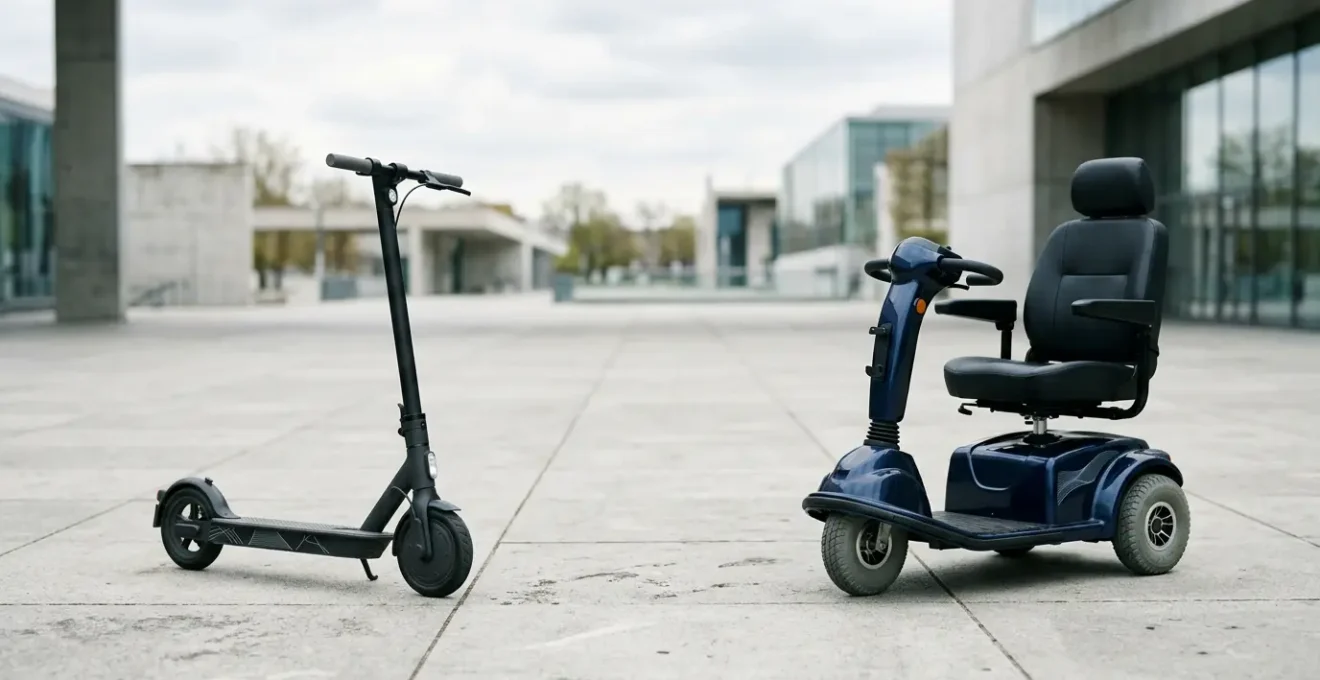
The rise of e-scooters doesn’t signal the end for traditional mobility scooters; instead, it’s forcing a technological convergence that benefits users.
- Traditional mobility scooters are adopting the best features of e-scooters, like lightweight carbon fiber frames and smart GPS technology.
- Safety and stability remain non-negotiable, making two-wheeled standing e-scooters unsuitable for most mobility users, a fact supported by rising injury rates.
Recommendation: Look beyond the trend. The future is a new category of hybrid, three-wheeled devices that offer the stability you need with the modern technology you want.
The urban landscape is changing. Sleek, two-wheeled e-scooters zip along city streets, representing a modern, minimalist approach to personal transport. On the other hand, the familiar, sturdy mobility scooter remains a bastion of independence for millions. For seniors and users with mobility challenges, a question naturally arises: are these trendy new gadgets a viable replacement for the trusted three or four-wheeled companions we’ve relied on for years? The common assumption is a simple generational divide—one is for the young and agile, the other for those needing support.
This view, however, misses the bigger picture. The conversation shouldn’t be about replacement, but about evolution. The real story isn’t a battle between two distinct product categories; it’s a fascinating tale of technological convergence. The most innovative aspects of e-scooter technology—ultra-lightweight materials, smart connectivity, and automated functions—are not making mobility scooters obsolete. Instead, they are being selectively absorbed and integrated, creating a new generation of smarter, lighter, and more secure mobility aids designed specifically for safety and independence.
This article moves beyond a simple « A vs. B » comparison. We will explore why the fundamental design of standing e-scooters presents inherent risks, examine the legal hurdles that limit their use, and then dive into the exciting innovations they have inspired. From revolutionary carbon fiber frames and anti-theft GPS tracking to the rise of hybrid « trikes, » we will map out the true future of personal mobility. This is about understanding how to get the best of both worlds: the proven stability you need and the cutting-edge technology you deserve.
To help you navigate this evolving landscape, this guide breaks down the key factors you need to consider. The following sections will provide a clear, forward-looking analysis of where assistive mobility technology is headed.
Summary: The Evolving World of Personal Mobility Aids
- Three Wheels vs Two: Why E-Scooters Are a Fall Risk for Seniors?
- Pavement Legalities: Why You Can’t Ride an E-Scooter to the Shops Yet?
- Carbon Fiber Frames: The Future of Ultra-Light Mobility Aids
- GPS and Apps: Tracking Your Scooter Theft via Smartphone
- The Trike Revolution: Sitting E-Scooters Bridging the Gap
- Automatic Fold vs Manual: Is the Electronic Key Fob Worth the Extra £500?
- New vs Used: Which Form Do You Actually Need to Fill Out?
- Boot Scooters: How to Choose a Compact Folding Model That Fits Your Car?
Three Wheels vs Two: Why E-Scooters Are a Fall Risk for Seniors?
The primary appeal of a standing e-scooter is its minimalist design, but this is also its greatest weakness for mobility-impaired users. A traditional mobility scooter is built on a foundation of stability-first design, typically using three or four wheels to create a wide, secure base that requires no balancing from the rider. A two-wheeled e-scooter operates on the opposite principle; it demands constant, active balance adjustments from the user, engaging core muscles and requiring quick reflexes to navigate even minor surface imperfections. This difference isn’t trivial; it’s a fundamental issue of safety.
The cognitive load is also significantly higher. While a mobility scooter user can focus entirely on steering and speed control, an e-scooter rider must simultaneously manage balance, acceleration, and braking while scanning for hazards. This continuous mental and physical effort increases the risk of falls, especially for individuals with reduced strength, slower reaction times, or balance-related medical conditions. In fact, data on e-scooter usage in the general population shows a concerning trend, with one report highlighting a 22% increase in injuries between 2021 and 2022. For a user whose primary need is safe and stress-free mobility, the inherent instability of a two-wheeled design makes it a fundamentally inappropriate choice.

As the image suggests, maintaining equilibrium on a narrow, two-wheeled platform is a complex task. It’s a continuous act of correcting and re-correcting, a stark contrast to the passive stability offered by a purpose-built mobility aid. The allure of a sleek design cannot and should not override the non-negotiable requirement for safety and user confidence.
Pavement Legalities: Why You Can’t Ride an E-Scooter to the Shops Yet?
Beyond the physical risks, a significant practical barrier prevents e-scooters from replacing mobility scooters for everyday errands: the law. Unlike mobility scooters, which are generally classified as a specific class of « invalid carriage » or « powered wheelchair » with clear rights to use pavements and enter shops, e-scooters occupy a confusing legal grey area. In many jurisdictions, they are treated not as mobility aids but as motor vehicles.
This classification has profound implications for their use. As one legal guide on the topic explains, this often means they are restricted to roads and bike lanes, making them illegal to ride on pavements. This effectively defeats the purpose for a user wanting to travel from their front door directly to a shop entrance or navigate a pedestrianised town centre.
In many places, electric scooters are classified as motor vehicles, meaning they must follow the same rules as cars and motorcycles. This often restricts them to roads and bike lanes, prohibiting pavement use.
– Gyroor Board, Electric Scooter Road or Pavement: The Ultimate Guide to Safe and Legal Riding
The situation is further complicated by a patchwork of local and national laws that vary dramatically. While some regions are running trial schemes for rented e-scooters, privately owned ones often remain prohibited from public spaces. This inconsistency means that what is legal in one city may result in a fine or confiscation in the next. In contrast, mobility scooters have a well-established legal framework that ensures users can rely on them for essential journeys. Until legislation evolves to create a clear and permissive category for these devices, their practical utility for essential errands remains severely limited.
Carbon Fiber Frames: The Future of Ultra-Light Mobility Aids
While standing e-scooters may not be the answer, the technology behind them is revolutionising mobility aids. The most significant innovation being borrowed is the use of advanced materials, particularly carbon fiber. For decades, a major drawback of mobility scooters has been their weight. Steel and aluminum frames, while strong, are heavy, making scooters difficult to lift into a car boot without assistance or a dedicated hoist. This is where the e-scooter industry’s focus on portability provides a valuable lesson.
Carbon fiber offers an exceptional strength-to-weight ratio, allowing for the construction of frames that are just as robust as their metal counterparts but drastically lighter. This isn’t a minor improvement; it’s a paradigm shift. A scooter frame that once weighed 20kg or more can now be engineered to be a fraction of that, making it genuinely portable for a wider range of users or their caregivers. This breakthrough directly addresses one of the biggest pain points of scooter ownership: transportability.

However, this advanced material is not without its trade-offs. It is more expensive to produce, and its structural properties are different from metal. As experts in wheelchair design point out, it behaves differently under stress and impact.
Due to the fabrication process, when a wheelchair suffers a direct or recurrent frame impact, the carbon fiber may crack. For this reason, when matching the chair to the individual, we must consider that person’s overall lifestyle and maintenance of the chair.
– TiLite/Permobil, Manual wheelchair frame materials: Carbon Fiber
This means that while carbon fiber makes a scooter incredibly light, it may be less forgiving of rough handling or impacts than a traditional aluminum frame. This consideration is crucial when choosing a device that must withstand the rigours of daily use, from navigating bumpy pavements to being loaded in and out of a vehicle.
GPS and Apps: Tracking Your Scooter Theft via Smartphone
Another area where mobility scooters are benefiting from e-scooter technology is connectivity. The shared e-scooter market, which relies on locating and managing thousands of devices via smartphone, has perfected the use of integrated GPS and cellular technology. This concept, which we can call Assistive Intelligence, is now being adapted to provide a powerful new layer of security for privately owned mobility aids.
A mobility scooter is a significant investment and a lifeline for its owner, making it a devastating loss if stolen. Traditional security methods like keys and alarms are a deterrent, but they do little to help recover the scooter once it’s gone. Modern, discreet GPS trackers, often small enough to be hidden within the scooter’s frame, change this dynamic completely. By connecting to a smartphone app, these trackers offer real-time location data, allowing an owner or the police to track and recover the stolen vehicle.
The most advanced systems go beyond simple recovery and offer proactive theft prevention. They combine motion sensors with geofencing capabilities to create a virtual security perimeter around the scooter. If the device is moved without authorization, it can trigger an instant alert on the owner’s phone, often preventing the theft before it’s even completed.
Case Study: Proactive Theft Prevention with Smart GPS
Monimoto’s scooter GPS tracker system demonstrates a practical anti-theft implementation. The device uses motion detection combined with GPS tracking to call the owner’s phone immediately when unauthorized movement is detected. The waterproof tracker is hidden on the scooter and works with a key fob that automatically disarms when the owner is nearby. This real-time alert system enables owners to react immediately and prevent theft in progress, transforming GPS from a recovery tool into an active prevention system.
This convergence of physical hardware with smart, connected software represents a major step forward in protecting a user’s independence. It provides peace of mind, knowing that a vital piece of equipment is not only secure but also recoverable.
The Trike Revolution: Sitting E-Scooters Bridging the Gap
Perhaps the most direct evidence of technological convergence is the emergence of a new category of device: the seated, three-wheeled e-scooter, or « trike. » These hybrids represent the perfect middle ground, capturing the modern aesthetic and electric efficiency of an e-scooter while retaining the essential stability of a traditional mobility scooter. They directly address the core safety concerns of two-wheeled models by adding a third wheel, creating a stable platform that doesn’t require active balancing from the rider.
These trikes often feature a more minimalist, open design than bulky, fully-shrouded mobility scooters, appealing to users who want a modern look without compromising on safety. They are designed for seated operation, providing the comfort necessary for longer journeys that a standing e-scooter cannot offer. This hybrid design acknowledges a fundamental truth that mobility experts consistently emphasize: the primary design goal for a mobility aid must be stability and comfort.
Mobility scooters are designed with comfort and stability in mind, making them an excellent choice for ones with limited mobility. Their larger frames provide a stable base, making them suitable for various terrains, including uneven sidewalks and gentle inclines.
– Velobike, What is the difference between a mobility scooter and an electric scooter?
The trike revolution takes this core principle and wraps it in a 21st-century package. By combining a stable three-wheeled base with a seat, lightweight frames, and efficient electric motors, these devices bridge the gap between the two worlds. They offer a compelling alternative for users who feel a traditional mobility scooter is too cumbersome but find a two-wheeled e-scooter too risky. This growing category is a clear sign that the future isn’t about one device replacing the other, but about creating new solutions that incorporate the best of both.
Automatic Fold vs Manual: Is the Electronic Key Fob Worth the Extra £500?
The drive for portability, inspired by the e-scooter market, has led to another futuristic feature becoming available on high-end mobility scooters: automatic folding. Manually folding or disassembling a scooter, even a lightweight one, can be a strenuous task involving bending, lifting, and securing latches. An automatic folding mechanism eliminates this process entirely. With the simple press of a button on a remote key fob, the scooter folds itself into a compact, transportable package.
This is the pinnacle of convenience, transforming a multi-step physical process into a single, effortless action. For users with limited strength, arthritis, or back problems, this feature can be the deciding factor that makes a scooter truly usable and independent. However, this convenience comes at a significant cost, often adding £500 or more to the purchase price. Is it worth it?
The decision hinges on the « usability delta »—the gap between a feature’s potential and its practical value to you. If manually folding a scooter is a genuine barrier that would prevent you from using it, then the extra cost is an investment in your freedom. If you can comfortably manage a manual fold, the money might be better spent on a longer-range battery or other accessories. It’s also worth noting that this technology is most common on advanced models, where modern carbon fiber folding electric wheelchairs weigh between 26 and 44 pounds, a weight that is already significantly lower than older, heavier designs.
Ultimately, the value of the key fob is deeply personal. It represents the trade-off between budget and an almost magical level of convenience. It’s a prime example of assistive technology moving beyond basic function to actively reduce the physical burdens of daily life.
New vs Used: Which Form Do You Actually Need to Fill Out?
As advanced technologies like carbon fiber frames and automatic folding mechanisms enter the market, the decision between buying a new or used mobility scooter becomes more complex. The « forms » you need to consider are not just paperwork, but the different forms of value, risk, and documentation associated with each choice.
Buying new offers the primary advantage of a manufacturer’s warranty. This is particularly important for high-tech models. If the complex electronics of an auto-fold system fail, or if a defect is found in a carbon fiber frame, the warranty is your safety net. You are also guaranteed a brand-new battery, ensuring you get the maximum advertised range from day one. With a new purchase, you receive all the official documentation, including the certificate of conformity and user manuals, which can be essential for insurance and future servicing. These are devices where a combination of advanced materials and electronics results in ultra-lightweight and convenient packages.
Buying used, on the other hand, offers a significantly lower initial cost. However, this comes with risks that require careful assessment. The most critical component to check is the battery. A used scooter’s battery may have a greatly reduced capacity, and a replacement can cost hundreds of pounds, eroding much of the initial saving. For scooters with advanced frames, you must meticulously inspect for any signs of cracking or stress, especially around the joints, as carbon fiber damage is not always easy to spot. Ask the seller for the original purchase documents and service history. A lack of paperwork could be a red flag. This due diligence is your « form » to fill out—a checklist of inspections to mitigate the risks of a second-hand purchase.
Key Takeaways
- Safety First: The inherent instability of two-wheeled standing e-scooters makes them a poor choice for most mobility users. Three- and four-wheeled designs remain the gold standard for safety.
- Technology is Being Borrowed, Not Replacing: The future is not a takeover by e-scooters, but the integration of their best tech (lightweight carbon fiber, GPS) into proven, stable mobility scooter platforms.
- The Rise of the Hybrid: Seated, three-wheeled « trikes » are bridging the gap, offering a modern look and feel without sacrificing the essential stability required for a mobility aid.
Boot Scooters: How to Choose a Compact Folding Model That Fits Your Car?
The ultimate expression of this technological convergence is the modern « boot scooter »—a compact, folding model designed to be easily transported in a vehicle. Choosing the right one brings together every factor we’ve discussed: weight, folding mechanism, materials, and practical dimensions. The goal is to find a scooter that not only meets your mobility needs but also fits seamlessly into your lifestyle, which for many, means fitting into the boot of a car.
Weight is the most critical factor. Thanks to materials like carbon fiber, frame weights have plummeted. For instance, some advanced manual wheelchair frames, which use similar technology, boast incredibly low numbers. A prime example is how the Motion Composites APEX C achieves a frame weight of just 9.7 lb (4.4 kg). While a full scooter will weigh more due to the motor and battery, this demonstrates the potential of modern materials to make lifting manageable. However, you must look beyond the « total weight » advertised by manufacturers. The crucial specification is the « weight of the heaviest part » you will need to lift after disassembly.
The folding mechanism is the second consideration. Is a manual, multi-part disassembly feasible for you, or is the effortless convenience of an automatic one-piece fold a necessity? Finally, don’t forget the physical dimensions. Measure your car boot—including the height of the lip you’ll have to lift over—and compare it to the scooter’s folded dimensions. A scooter is useless if it’s dimensionally too large or too heavy to lift into your vehicle. The following checklist provides a practical framework for your assessment.
Action Plan: Verifying a Boot Scooter’s True Portability
- Heaviest Part Weight: Find the ‘weight of heaviest part’ spec. Ignore total weight and focus on the maximum single component you’ll need to lift.
- Battery Removal: Check if the batteries are easily removable. Many users remove them before lifting to significantly reduce the load (e.g., from 44 lbs to under 30 lbs).
- Frame-Only Weight: Confirm the frame-only weight. This tells you how much benefit you’re getting from advanced materials like carbon fiber.
- Boot Lip Height Test: Measure the lift-over height of your car boot. A scooter might fit dimensionally but be impossible to lift safely over a high boot lip.
- Weight Distribution: Consider how weight is distributed. A scooter that breaks into several smaller pieces may be easier to handle than a single, heavier folding unit, even if the total weight is the same.
Ultimately, making the right choice in this new era of personal mobility is not about chasing the latest trend. It’s about conducting an honest assessment of your individual needs for stability, portability, and convenience, and then finding the device—whether it’s a trusted classic, a lightweight carbon fiber model, or a smart hybrid trike—that empowers you to live with the greatest degree of freedom.