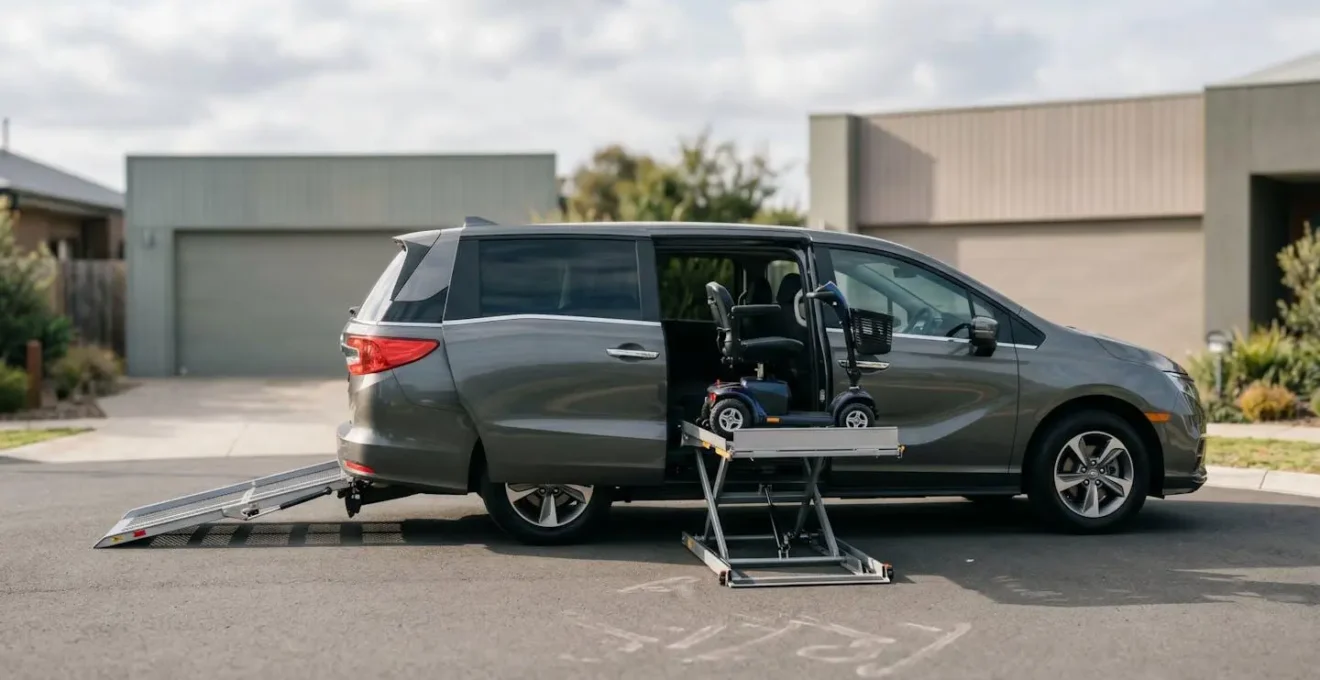
Choosing between a lift and a ramp is less about the hardware and more about designing your long-term independence and safety.
- Powered lifts (hoists and platforms) offer superior convenience and safety for heavy scooters, but demand a clear understanding of their mechanics and maintenance needs.
- Ramps are mechanically simple but often impractical for vehicle access due to steep gradients and the large physical space they require to be used safely.
Recommendation: Focus on the system’s operational reliability and how it fits your daily routine—not just the initial price tag.
Choosing the right access solution for your wheelchair accessible vehicle (WAV) is a critical decision that extends far beyond a simple comparison of price tags. While many discussions boil down to « ramps are simple, lifts are for heavy chairs, » this oversimplification misses the point. The real goal is to engineer your daily independence. This means selecting a system that is not only functional but also reliable, safe, and seamlessly integrated into your life. It’s a choice that impacts everything from spontaneous family trips to routine solo outings.
This guide moves beyond the surface-level debate. We will delve into the crucial operational details that truly define a system’s worth. We’ll explore the mechanics of car hoists designed to handle significant weight, the physics of ramp gradients that often make them impractical for vehicles, and the sophisticated features of modern platform lifts—from space-saving designs to essential safety mechanisms. Understanding these technical aspects is not about becoming an engineer; it’s about empowering yourself to make an informed choice that guarantees freedom and peace of mind for years to come.
By examining the why and how behind each technology, you’ll gain a deeper appreciation for the nuances of operational reliability and daily use ergonomics. We’ll address common concerns like maintenance, potential points of failure, and the emergency procedures that provide a crucial safety net. The right solution for you is the one that answers these questions satisfactorily, creating a predictable and stress-free experience every time you load your scooter. This article will provide the technical clarity needed to navigate this important decision with confidence.
To help you navigate the complexities of vehicle access, this article breaks down the key considerations for hoists, ramps, and platform lifts. The following sections explore the technical specifications, safety features, and maintenance realities that should inform your choice.
Summary: Platform Lifts vs Ramps: A Technical Comparison
- Car Hoists for Scooters: How to Lift 100kg Without Breaking Your Back?
- Powered Swing: Do You Need the Hoist to Bring the Scooter to the Pavement?
- How to Choose the Right Ramp Gradient for Victorian Terrace Doorways?
- Saving Space: Why Under-Floor Lifts Are Better for Family Trips?
- Wireless Remotes: Loading the Scooter Without Being Inside It
- Roll-Off Stops: Ensuring the Scooter Doesn’t Fall Off Mid-Lift
- Oil Leaks and Creaks: Signs Your Lift Needs Urgent Servicing
- Pump Failure: How to Manually Lower the Lift If Electronics Die?
Car Hoists for Scooters: How to Lift 100kg Without Breaking Your Back?
The fundamental challenge of transporting a mobility scooter is its weight. A scooter weighing 100kg or more is impossible to lift manually without significant risk of injury. This is where car hoists, or interior lifts, become an essential tool for many WAV users. These powered cranes are mounted inside the vehicle’s cargo area and use a motorized arm to lift the scooter from the ground and swing it into the vehicle. The primary benefit is the complete elimination of manual lifting, preserving your physical well-being and ensuring consistent access.
The market for these solutions is growing, driven by an aging population and a preference for more capable mobility devices. In fact, the global mobility scooter market is expected to grow from USD 2.31 billion in 2025 to USD 3.66 billion by 2034. This growth fuels innovation in hoist technology, leading to stronger, more efficient, and more compact designs. When selecting a hoist, the most critical specification is its lifting capacity. It must comfortably exceed the total weight of your scooter, including its batteries, to ensure safe and strain-free operation over the long term.
A common misconception is that all hoists are large and consume the entire boot space. While they do require a dedicated area, modern designs are increasingly compact. The choice of hoist depends on a combination of factors: your scooter’s weight and dimensions, your vehicle’s internal space, and your own physical needs. A professional WAV converter can assess these variables to recommend a hoist that provides the necessary power without unnecessarily compromising your vehicle’s storage capacity.
Powered Swing: Do You Need the Hoist to Bring the Scooter to the Pavement?
While lifting capacity is the headline feature of any car hoist, the « powered swing » function is what truly defines its day-to-day usability. A basic hoist might lift the scooter vertically, but still require you to manually push or pull the arm to swing it into the vehicle. A model with a powered swing function automates this entire process. With the push of a button, the hoist not only lifts the scooter but also smoothly rotates it from the pavement into the cargo bay, and vice-versa.
This feature is a matter of ergonomics and independence. For users with limited upper body strength or reach, manually guiding a heavy, suspended scooter can be challenging and potentially unsafe. The powered swing eliminates this physical strain, making the loading and unloading process effortless and predictable. It allows you to stand clear of the vehicle and operate the entire sequence from a safe distance, typically with a simple handheld remote. This is especially valuable in tight parking spaces or on uneven ground where maneuvering the scooter by hand would be difficult.
Modern interior hoists are engineered to handle substantial loads, with some models offering a lift capacity up to 350 pounds for scooters and power wheelchairs. This capability ensures that even heavy-duty mobility devices can be managed by a powered swing system. When considering a hoist, ask yourself: do you want a tool that just lifts, or a system that manages the entire transfer process for you? For many, the added convenience and safety of a powered swing is not a luxury, but a necessity for true independence.
How to Choose the Right Ramp Gradient for Victorian Terrace Doorways?
Before diving deeper into powered lifts, it is essential to understand the alternative: the ramp. While simple and reliable, a ramp’s effectiveness is dictated entirely by physics, specifically the gradient or slope. A slope that is too steep is both difficult and dangerous to navigate. This issue is particularly pronounced in contexts like older homes, such as Victorian terraces, which often feature steps and narrow entryways, making them a perfect case study for the limitations of ramps.
The standard for safe, unassisted wheelchair access is a gentle slope. For example, the U.S. Access Board ADA guidelines recommend a 1:12 maximum slope ratio, meaning for every 1 inch of vertical rise, you need 12 inches (1 foot) of ramp length. A typical vehicle floor might be 24 inches off the ground, which would require a 24-foot-long ramp—a length that is completely impractical for most public parking or home garage situations. Even with assistance, steeper slopes become challenging and increase the risk of tipping or losing control.
The suitability of a ramp’s gradient is directly tied to the user’s ability and the power of their mobility device. The following table, based on common accessibility standards, illustrates how different slope ratios are recommended for different scenarios.
| Ramp Type | Slope Ratio | Recommended Use | Maximum Rise |
|---|---|---|---|
| ADA Commercial Standard | 1:12 (8.33%) | Public facilities, independent wheelchair users | 30 inches per run |
| Residential Assisted | 1:8 (12.5%) | Home use with caregiver assistance | Varies by local code |
| Home Independent Use | 2:12 (16.7%) | Powered wheelchairs/scooters, strong users | Not ADA compliant |
| Temporary Portable | 3:12 (25%) | Short-term access, emergency only | Under 6 inches |
As this data shows, achieving a safe and usable ramp for vehicle access is a significant spatial challenge. This physical limitation is precisely why many users turn to powered lift systems, which solve the problem of vertical height without demanding a huge horizontal footprint.
Saving Space: Why Under-Floor Lifts Are Better for Family Trips?
For families and users who need to maximize their vehicle’s interior, the under-floor lift (UFL) or under-vehicle lift (UVL) presents a game-changing solution. Unlike hoists or internal platform lifts that occupy valuable cargo or passenger space, a UFL is mounted in a weathertight enclosure beneath the vehicle’s frame. This design keeps the lift completely out of sight and out of the way until it is needed, preserving the vehicle’s original interior layout.
This space-saving advantage is not trivial. It means that passenger seating is not compromised, and the view out of side windows remains unobstructed. For family trips, this translates to more room for passengers, luggage, and pets. According to specifications for leading models like the BraunAbility Under Vehicle Lift, a key benefit is that maximum interior space and a clear side view are retained. This makes the vehicle feel less like a conversion and more like a standard MPV or van, which is a significant psychological and practical benefit for the whole family.
With the lift mounted underneath the vehicle, it remains out of sight and out of your way until needed. This means easy access, a clear side view and maximum interior space—something your friends and family will appreciate on every trip.
– BraunAbility UVL product description, United Access – Platform Wheelchair Lifts
The UFL platform deploys horizontally from under the vehicle and then lowers to the ground, providing a stable and secure bridge for loading a scooter or wheelchair. When not in use, it retracts completely, protecting it from the elements and leaving the vehicle’s interior pristine. This « out of sight, out of mind » approach is the ultimate expression of integrated accessibility, making it an ideal choice for users who prioritize interior space and a factory-finish appearance.
Wireless Remotes: Loading the Scooter Without Being Inside It
The true measure of a vehicle lift’s convenience lies in its operation. Modern platform lifts have largely moved away from fixed, wired controls toward sophisticated wireless remote systems. This technology fundamentally changes the loading process for the better, enhancing both safety and ease of use. A wireless remote allows the user or a caregiver to operate the lift from a comfortable and safe distance, providing a clear, unobstructed view of the entire operation.
Imagine this: instead of being tethered to the vehicle by a coiled cord, you can stand on the pavement, several feet away, and manage the deployment, lowering, and raising of the platform. This vantage point allows you to ensure the scooter is perfectly positioned, that no obstacles are in the way, and that the user is ready. It transforms the loading process from a close-quarters maneuver into a carefully supervised and controlled event. For an independent user, it means they can position themselves on the lift and control their own ascent without needing to be inside the vehicle to reach a control panel.
This remote operation is a core component of daily use ergonomics. It reduces physical strain and awkward positioning, making the system accessible to a wider range of users. Furthermore, it adds a layer of safety. In the event of an issue, the operator is not on the platform or leaning into the vehicle, but is standing clear and can immediately stop the lift. This freedom of movement and enhanced situational awareness is a defining feature of a modern, user-centric lift system.
Roll-Off Stops: Ensuring the Scooter Doesn’t Fall Off Mid-Lift
Among the most critical components in a platform lift’s safety ecosystem are the roll-off stops. These are mechanical barriers, typically at the front (inboard) and rear (outboard) of the lift platform, that automatically deploy to prevent the scooter or wheelchair from accidentally rolling off during operation. They are a non-negotiable safety feature and a key indicator of a well-engineered lift. The outboard stop rises as the platform begins to lift, creating a solid barrier at the edge.
The inboard roll-off stop serves a dual purpose. It acts as a barrier when the lift is in motion, but it also functions as the bridge that connects the platform to the vehicle floor when the lift is fully raised. As a crucial safety interlock, the lift is designed to be inoperable if this inboard stop is occupied by anything, preventing the lift from moving if the scooter is not positioned correctly. According to BraunAbility’s safety specifications for their UVL series, this feature ensures that the platform cannot operate unless the path is clear, preventing potential accidents and damage to the user, scooter, or vehicle.
When evaluating a platform lift, pay close attention to the construction and operation of these stops. They should be robust, made of high-strength material, and their automatic deployment should be smooth and reliable every single time. A failing or flimsy roll-stop is a major red flag. The security they provide is absolute; they are the physical guarantee that the platform is a secure, enclosed space from the moment it leaves the ground until it docks safely with the vehicle floor.
Key Takeaways
- The choice between a lift and a ramp is a strategic decision about engineering your long-term independence, focusing on reliability and daily ergonomics.
- Powered solutions like hoists and platform lifts eliminate the physical strain of lifting heavy scooters, but require an understanding of their mechanics, safety systems, and maintenance needs.
- Key features like powered swing on hoists, wireless remotes, and automatic roll-off stops on platform lifts are not luxuries; they are critical components of a safe and user-friendly access system.
Oil Leaks and Creaks: Signs Your Lift Needs Urgent Servicing
A powered lift is a complex piece of hydraulic and electrical machinery, and like any vehicle component, it requires regular inspection and maintenance to ensure its long-term operational reliability. Ignoring small warning signs can lead to bigger, more expensive failures and, most importantly, can compromise the safety of the system. Being attuned to the sights, sounds, and smells of your lift is the first line of defense in preventative maintenance.
Hydraulic systems, which power the lifting action in most platform lifts, are the primary area to monitor. A small oil leak, often seen as a rainbow sheen on a hydraulic ram or a small puddle on the garage floor, is a clear indicator that a seal or hose is failing. Similarly, the sounds of operation provide crucial feedback. A smooth, consistent hum is normal; a sudden grinding, creaking, or popping sound indicates metal-on-metal contact, air in the hydraulic lines, or a failing motor. These are not issues that will fix themselves; they are early warnings that demand immediate attention from a qualified technician.
As guidance from maintenance experts like Rotary Solutions suggests, watching for crucial warning signs between scheduled inspections is paramount. If you notice any operational irregularities, such as jerky movements or a platform that won’t hold its position, cease using the lift and contact your service provider. Proactive maintenance is the key to a long and safe service life.
Your Sensory Diagnostic Checklist: Spotting Lift Problems Early
- Look for visible fluid leaks: a sheen on hydraulic rams, pooling beneath cylinders, or frayed electrical wiring.
- Listen for abnormal sounds: grinding or popping noises during operation versus the normal motor hum.
- Smell for warning odors: the scent of hot electronics or burnt hydraulic fluid can indicate overheating components.
- Check for operational irregularities: jerky movements, a slow response time, or a platform that drifts downward when stationary.
- Inspect safety features: regularly test that roll-stops deploy correctly and that any audible or visual warning systems are functional.
Pump Failure: How to Manually Lower the Lift If Electronics Die?
Perhaps the single greatest concern for any user of a powered accessibility device is « What happens if the power fails? » A well-engineered platform lift is designed with this exact scenario in mind. In the event of a total vehicle electrical failure—such as a dead battery—you will not be left stranded. Every quality lift is equipped with a manual override or backup system that allows you to safely lower the platform without electrical power.
This procedure is a critical piece of safety knowledge for any lift owner. As noted in the technical documentation for BraunAbility lifts, a manual backup pump is a standard feature. The process typically involves locating a specific release valve on the hydraulic pump unit and using a provided tool or a standard hand pump to control the descent. It is designed to be straightforward, but it’s essential that you have a technician demonstrate the procedure on your specific model and that you keep the necessary tools accessible within the vehicle.
Knowing how to perform this emergency lowering provides immense peace of mind. It transforms a potentially stressful situation into a manageable inconvenience. Before you ever need it, you should familiarize yourself with the basic steps for your lift model:
- Check the Obvious First: Before resorting to the manual override, always verify the vehicle’s battery and check the fuse box for any blown fuses related to the lift’s power supply.
- Locate the Manual Release: Find the manual release valve or lever on the hydraulic power unit. It is often colored red or clearly marked for emergency access.
- Engage the Release: Follow the manufacturer’s specific instructions. This usually involves turning a hex valve or pulling a lever to release hydraulic pressure slowly.
- Operate the Backup Pump: If your model has a manual hand pump, use it in steady, controlled strokes to gradually lower the platform.
- Ensure a Clear Area: Before and during the manual descent, confirm the area below and around the platform is completely clear to ensure a safe landing.
This manual override is your ultimate safety net. It ensures that no matter the electrical circumstances, you always have a reliable way to exit or enter the vehicle, solidifying the operational reliability of your access system. To put these principles into practice, the next logical step is to have this procedure demonstrated by a professional during your vehicle handover.