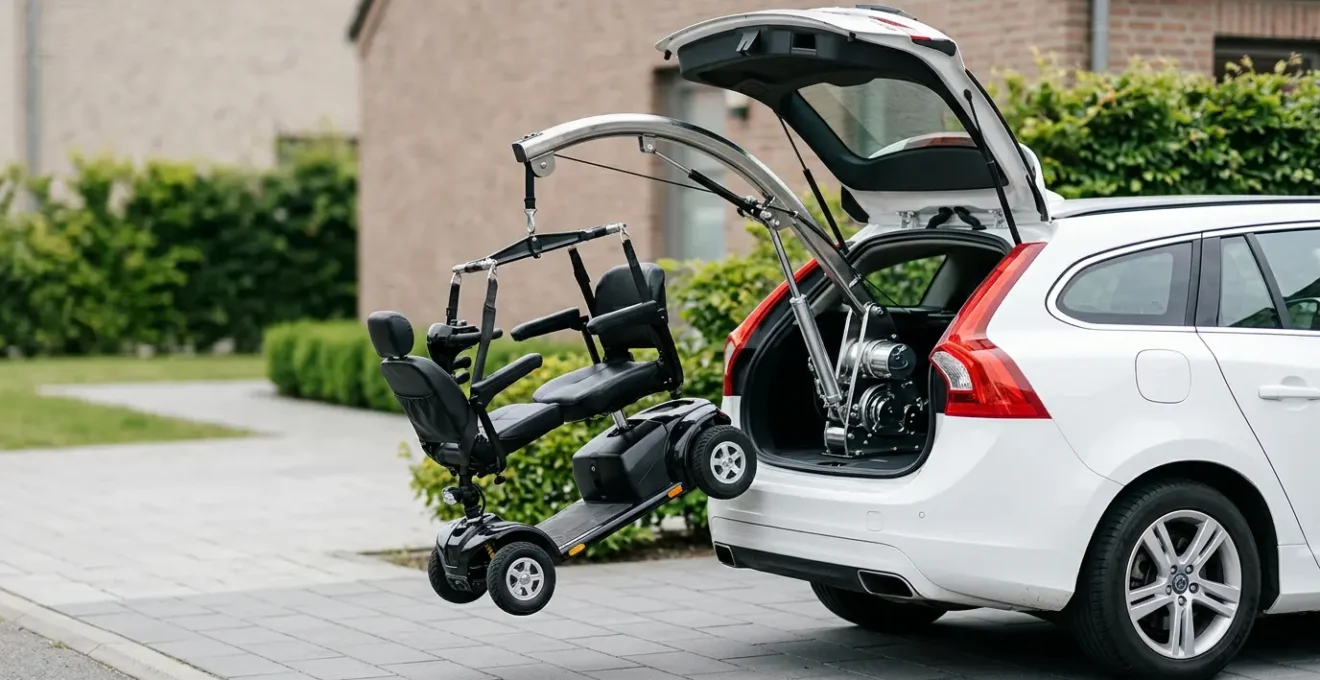
Successfully transporting a heavy mobility scooter is not a matter of brute force, but of precise engineering that matches the hoist to your specific vehicle and scooter.
- The vehicle’s boot opening—its height, width, and angle—is the single most critical factor, often more important than the scooter’s weight.
- A hoist’s « clearance arc » (the path it swings through) must be calculated to avoid collision with the roof lining or rear window, a commonly overlooked measurement.
Recommendation: Before purchasing any hoist, perform a detailed measurement of your vehicle’s boot geometry, as a mismatch is the most common and costly point of failure.
The dead weight of a 100kg mobility scooter is an immovable object for most people. The strain on your back, the risk of injury, and the sheer awkwardness of the task can turn the freedom a scooter provides into a logistical nightmare. Many users find themselves trapped, unable to transport the very device meant to give them independence. The common advice often falls short: « get a lighter, foldable scooter » isn’t an option for those needing the range and stability of a larger model, and basic ramps can be just as physically demanding and dangerous.
The challenge of lifting a heavy scooter isn’t a problem of strength; it’s a problem of mechanics and geometry. The solution lies not in more effort, but in better engineering. But if the key isn’t just buying the ‘strongest’ hoist, what is it? The true answer is found by approaching the problem like an automotive adaptation specialist: treating it as a precise calculation where the scooter’s dimensions, the hoist’s movement, and your car’s specific architecture must perfectly align. It’s about understanding the « lift geometry » before you ever consider drilling a single hole.
This guide will deconstruct the process, moving beyond simple product lists to explain the critical mechanical and spatial factors you must evaluate. We will analyze how your vehicle type dictates your options, the engineering trade-offs between different hoist capacities, and why sometimes the best solution involves avoiding modifications to your car’s interior altogether. By understanding these core principles, you can make an informed, mechanically sound decision.
This article breaks down the essential engineering considerations for choosing and installing a scooter hoist. Follow this structured guide to understand the critical measurements and mechanical choices that ensure a successful installation.
Summary: Car Hoists for Scooters: A Technical Decision Guide
- Estate vs SUV: Measuring Vertical Clearance for Hoist Cranes
- Powered Swing: Do You Need the Hoist to Bring the Scooter to the Pavement?
- Drilling Holes: Will Installing a Hoist Ruin Your Car’s Resale Value?
- 80kg vs 150kg: Choosing the Right Crane for Your Heavy Scooter
- Towbar Mounted Lifts: Avoiding Interior Damage and Loss of Seats
- Hatchback or Saloon: Will It Fit Without Folding the Back Seats?
- Sliding and Swiveling: Why Fixed Seats Are a Nightmare for Transfers?
- Platform Lifts vs Ramps: Which Vehicle Lift Suits Your Van or MPV?
Estate vs SUV: Measuring Vertical Clearance for Hoist Cranes
The first point of failure in a hoist installation is a miscalculation of vehicle geometry. While an Estate (or wagon) and an SUV may have similar internal boot volumes, their boot opening architecture presents entirely different mechanical challenges. An Estate typically features a low, flat boot lip, which simplifies the initial lift. In contrast, an SUV’s high boot lip creates a significant « secondary lift »—the physical effort required to get the scooter from the ground to the level of the boot floor before the hoist can even take over. This can defeat the purpose of the hoist for users with limited strength.
Beyond the lip height, the most critical and often-missed measurement is the clearance arc. A hoist does not lift vertically; it swings the scooter inward in an arc. You must measure the path the highest point of your scooter (usually the tiller or seatback) will travel from the boot lip to its final resting place. A sloped rear window on a hatchback or the curved roof lining of a compact SUV can obstruct this path, even if the scooter fits when stationary. This is a non-negotiable measurement that determines feasibility.
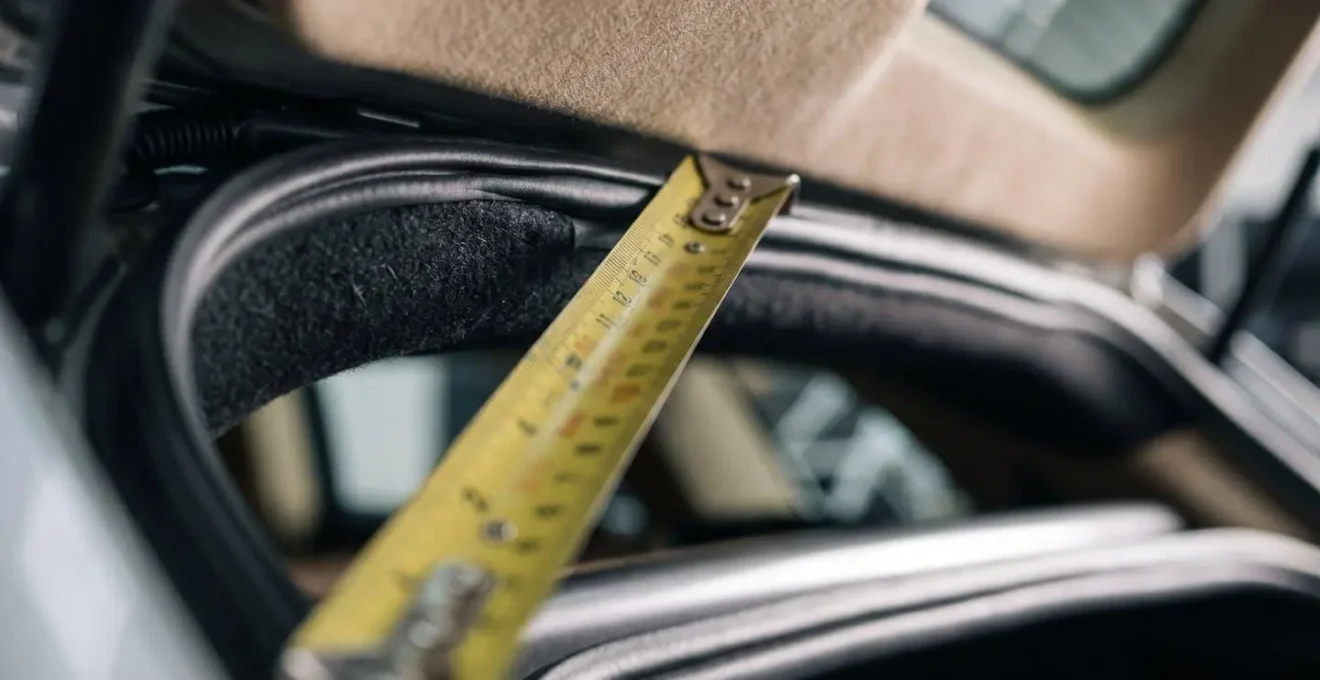
As the illustration suggests, this clearance arc is a three-dimensional problem. It involves checking not just the vertical height but the entire sweeping motion against the car’s interior. A successful installation depends entirely on these precise, preliminary calculations.
Action Plan: How to Measure Your Vehicle’s Hoist Compatibility
- Ground to Lip Height: Measure the vertical distance from the ground to the boot lip. This defines the ‘secondary lift’ effort required.
- Internal Boot Height: Measure from the boot floor to the roof lining at the rearmost point where the scooter will sit. This is your static vertical clearance.
- Simulate the Arc: Hold a tape measure from the boot lip and sweep it in an arc towards the back seats. This checks for interference with the rear window slope and roof interior.
- Floor Length: Check the boot floor length from the lip to the back of the rear seats to ensure the scooter fits longitudinally once loaded.
- Boot Lip Geometry: For SUVs, measure the boot lip’s thickness and angle. Steep or thick lips can require additional manual tilting of the scooter, even with a hoist.
Powered Swing: Do You Need the Hoist to Bring the Scooter to the Pavement?
Once the vertical lift is handled, the next mechanical consideration is the horizontal movement. Hoists come in two primary configurations: manual swing and powered swing. A manual swing hoist requires you to physically guide the crane arm, with the scooter suspended, from the boot out over the pavement. While mechanically simpler, this demands a degree of upper body strength and control, especially on uneven ground or in windy conditions where the suspended scooter can act like a pendulum.
A powered swing function automates this entire process. With the press of a button, the hoist not only lifts the scooter but also swings it out of the vehicle and lowers it to the ground. This eliminates the need for any manual handling of the heavy, suspended load. The primary benefit is not just convenience, but control and safety. An uncontrolled swing or a sudden drop can damage the scooter or, more importantly, cause injury. The powered function ensures a smooth, predictable motion from start to finish.
As experts from Mobility Innovations point out in their guide, the focus should be on the complete cycle of movement. As their product specialists note in the Mobility Innovations Wheelchair & Mobility Scooter Hoists Guide:
The key benefit isn’t just moving the scooter out, but controlling its descent.
– Mobility Innovations Product Specialists, Mobility Innovations Wheelchair & Mobility Scooter Hoists Guide
This insight is crucial. The choice between manual and powered swing is a trade-off between cost and ergonomic safety. For users who can comfortably guide a suspended load, a manual system may suffice. However, for those seeking a completely effort-free and maximally safe transfer, the powered swing is a non-negotiable feature.
Drilling Holes: Will Installing a Hoist Ruin Your Car’s Resale Value?
The installation of a boot hoist is not a temporary modification; it requires creating a permanent structural interface with your vehicle. This almost always involves drilling holes through the boot floor to bolt the hoist’s base plate directly to the car’s chassis or a reinforced section of the bodywork. This is a primary concern for many owners worried about their vehicle’s future resale value. The straightforward answer is that any non-standard modification has the potential to affect what a future buyer is willing to pay.
However, the impact is not always negative and depends heavily on two factors: the quality of the installation and the target market for the used vehicle. A professionally installed hoist, using high-grade fittings, rust-proofing on all drilled holes, and with wiring neatly integrated into the vehicle’s electrical system, will be viewed very differently from a shoddy DIY job. Furthermore, when selling to a private buyer who also has mobility needs, the hoist becomes a significant value-add, not a detriment.
The key is to view the installation as a professional automotive adaptation, not just an accessory. If removed, the holes can be professionally plugged and sealed, though evidence of the installation will likely remain. As industry experts at CarOracle wisely note, there is no simple formula. As they state in their analysis on « Vehicle Modifications: Do They Increase or Decrease Car Value? »:
Assessing the impact of modifications on car value is complex and subjective due to the lack of consistent data.
– CarOracle Industry Experts, Vehicle Modifications: Do They Increase or Decrease Car Value?
Ultimately, the decision to install a hoist should be driven by necessity. The gain in personal mobility and independence typically far outweighs the potential, and often marginal, impact on the car’s final resale price, especially if the installation is performed to a high engineering standard.
80kg vs 150kg: Choosing the Right Crane for Your Heavy Scooter
Selecting a hoist’s lifting capacity is not as simple as matching it to your scooter’s listed weight. The choice between an 80kg, 100kg, or 150kg model is a decision about engineering tolerances, safety margins, and future-proofing. Always start with your scooter’s « kerb weight »—its total weight including batteries. Then, add a safety margin of at least 20%. This accounts for any accessories you might add later (baskets, oxygen tank holders) and ensures the hoist motor and structure are not operating at their absolute limit, which reduces wear and tear over time.
An 80kg hoist might seem adequate for a 75kg scooter, but it leaves no margin for error or future additions. Stepping up to a 100kg or 150kg model provides a more robust structural frame, a more powerful motor, and stronger lifting straps. This is not just about lifting the weight today, but ensuring reliable performance for thousands of lift cycles. While the trend towards lighter batteries is notable, as recent industry data indicates that over 58% of mobility scooters sold are equipped with lighter lithium-ion batteries, many heavy-duty or older models still rely on heavier sealed lead-acid (SLA) batteries.
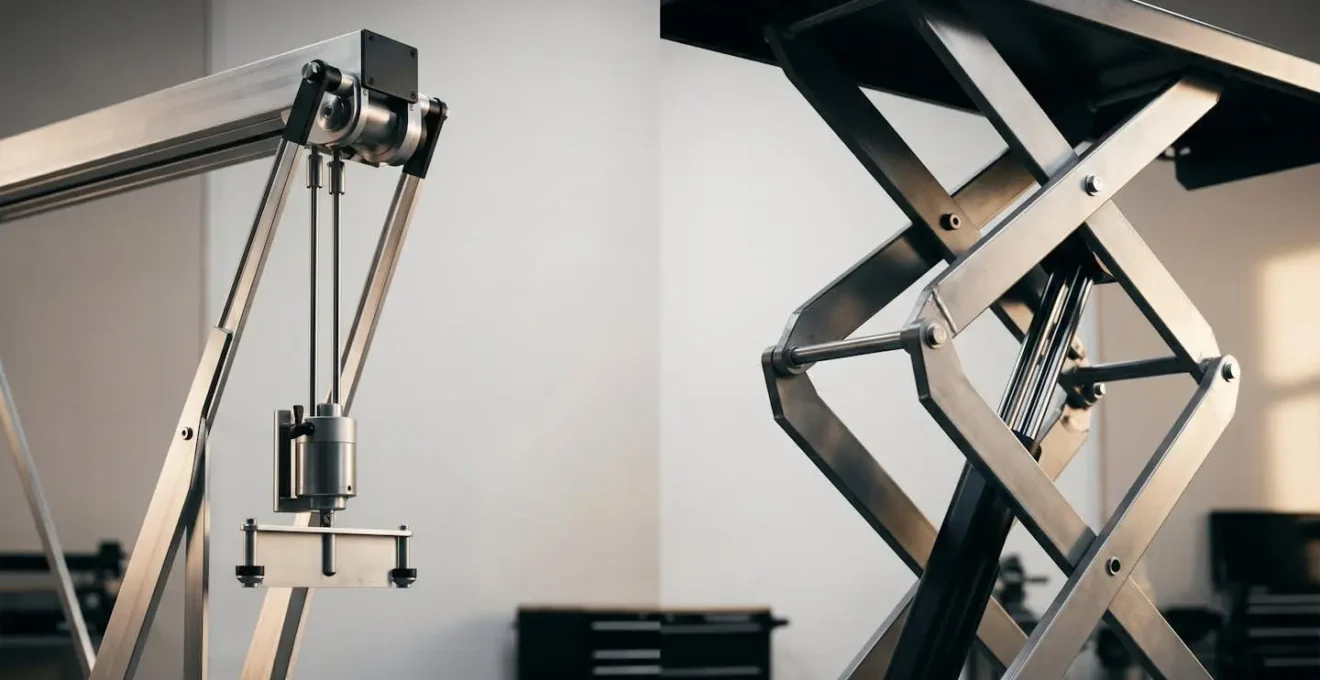
As this comparison implies, the difference is not just a number on a spec sheet; it’s visible in the physical construction and robustness of the entire mechanism. A higher-capacity hoist is built to handle greater dynamic loads, which occur as the scooter swings and moves during the lifting process. Over-specifying your hoist’s capacity is a wise investment in safety and long-term durability. Never choose a hoist rated at the exact weight of your scooter.
Towbar Mounted Lifts: Avoiding Interior Damage and Loss of Seats
For some users, the prospect of permanently modifying their vehicle’s interior by drilling into the chassis is a non-starter. This could be due to having a leased vehicle, concerns over resale value, or simply the need to preserve all available boot space and seating. In these scenarios, an external, towbar-mounted lift presents a compelling alternative. These systems attach directly to a standard towbar receiver, keeping the entire lifting mechanism—and the scooter itself—outside of the car.
The primary advantage is the complete avoidance of interior modification. There is no drilling, no loss of boot space for the hoist’s mast, and no need to fold down rear seats to accommodate the scooter. The scooter is simply rolled onto a platform behind the car, secured, and then lifted electronically. This solution is particularly effective for vehicles with small boot openings, like saloons, where an internal hoist is not feasible regardless of boot volume.
However, this approach has its own set of mechanical trade-offs. The lift and scooter will extend the overall length of your vehicle, which requires more care when parking and maneuvering. The scooter is also exposed to the elements during transport, which may necessitate a weather-proof cover. Finally, the total weight on the towbar (lift + scooter) must be within the vehicle’s specified maximum tongue weight, an important structural limitation. Despite these considerations, for those prioritizing the preservation of their vehicle’s interior and utility, a towbar-mounted lift is often the most logical and mechanically sound solution.
Hatchback or Saloon: Will It Fit Without Folding the Back Seats?
The body style of your car is the single most dominant factor in determining hoist compatibility. It’s a simple question of aperture geometry. A Saloon (or Sedan) is almost universally unsuitable for a scooter hoist. While it may have a large boot, its ‘letterbox’ style opening is too small to pass a scooter through, regardless of the hoist’s lifting power. The problem is the fixed rear window and C-pillars, which create a rigid, unchangeable aperture.
Hatchbacks and Estates (Wagons) are far better candidates because their tailgates create a full-height opening. This provides the necessary vertical clearance for a scooter to be lifted and maneuvered inside. However, « fitting » is more than just clearing the opening. You must also consider the interior space. In many hatchbacks, the parcel shelf must be permanently removed. More critically, the scooter’s tiller (handlebars) may need to be folded down to clear the rear headrests, and sometimes even the rear seats themselves must be folded forward to provide enough length for the scooter to lie flat.
The following comparison breaks down the fundamental differences in vehicle architecture, which is a critical starting point for any hoist consideration. The data highlights why some vehicle types are immediately more suitable than others.
| Vehicle Type | Boot Opening Style | Typical Opening Height | Scooter Compatibility | Key Limitation |
|---|---|---|---|---|
| Saloon/Sedan | Fixed ‘letterbox’ opening | 30-40cm | Unsuitable for hoists | Small fixed aperture prevents scooter entry regardless of internal volume |
| Hatchback | Full-height tailgate | 70-90cm | Compatible with modifications | Requires parcel shelf removal and possible tiller folding for headrest clearance |
| Estate/Wagon | Full-height tailgate with low lip | 80-100cm | Optimal compatibility | Low boot lip and flat entry provide easiest hoist installation |
| SUV | High tailgate opening | 75-95cm | Variable compatibility | High boot lip creates secondary lift challenge even with hoist assistance |
As this table from a comparative analysis by mobility specialists shows, an Estate is often the optimal choice due to its combination of a large aperture and a low, flat entry point, minimizing the physical effort required from the user.
Sliding and Swiveling: Why Fixed Seats Are a Nightmare for Transfers?
Solving the problem of scooter transport is only one part of the mobility equation. The other, equally critical part is the ergonomic transfer: the user’s ability to get in and out of the vehicle safely and with minimal strain. A car with a perfectly installed hoist is of little use if the driver or passenger cannot comfortably move from their wheelchair or scooter into the car seat. This is why fixed front seats, standard in most vehicles, can be a nightmare for transfers.
A fixed seat forces the user to perform a difficult side-transfer over a wide sill and often up into a bucket-style seat. This requires significant upper body strength and flexibility. A swiveling seat base, which can be retrofitted to many vehicles, revolutionizes this process. The seat rotates outwards to face the door opening, allowing the user to sit down on it directly from their scooter or wheelchair outside the car. The seat is then rotated back into the driving or passenger position. This eliminates the need for twisting, lifting, and contorting the body, dramatically reducing the risk of falls or strain. This is a vital consideration for the more than 3 million Americans who use a wheelchair and millions more who rely on mobility aids.
The connection between scooter stowage and passenger transfer cannot be overstated. As accessibility specialists at Mobility Innovations articulate, the goal is to reduce physical struggle across the board.
Wheelchair users already experience reduced mobility, so having to lift the heavy parts in and out of a vehicle is a struggle and in some instances, impossible.
– Mobility Innovations Accessibility Specialists, Wheelchair and Mobility Scooter Hoists Product Information
This same logic applies to lifting one’s own body. A holistic vehicle adaptation considers both stowing the device and seating the person. A swiveling seat is often as important as the hoist itself for achieving true independence.
Key Takeaways
- Geometry Over Weight: The success of a hoist installation depends more on the vehicle’s boot opening geometry (aperture, clearance arc) than the scooter’s raw weight.
- Vehicle Architecture is Primary: The car’s body style (e.g., Estate vs. Saloon) is the first and most rigid constraint, determining if an internal hoist is even feasible.
- External Lifts are a Valid Alternative: Towbar or platform lifts are mechanically sound solutions to avoid interior modifications, loss of seats, or issues with small boot openings.
Platform Lifts vs Ramps: Which Vehicle Lift Suits Your Van or MPV?
For larger vehicles like vans and MPVs (Multi-Purpose Vehicles), the choice is often not about an internal crane-style hoist, but between a platform lift and a ramp. While a ramp may seem like a simpler, cheaper solution, it presents significant mechanical and physical disadvantages. The primary issue is the required slope. To be safe and manageable, a ramp must have a gentle incline. For example, according to the Americans with Disabilities Act (ADA) guidelines for buildings, a ramp must have a slope ratio of 1:12, meaning one foot of ramp for every inch of rise. A van floor that is 24 inches high would require a 24-foot-long ramp—a length that is completely impractical for a vehicle.
Even with shorter, steeper vehicle ramps, the physical effort required to push a scooter up the incline can be immense. For three-wheeled scooters, ramps also introduce a high risk of tipping due to their inherent instability on uneven surfaces. A vertical platform lift (VPL) solves all these problems. It is a compact, button-operated platform that lifts the scooter and user straight up and into the vehicle. It requires minimal physical effort and has a small footprint, typically needing only a 5×5 foot space next to the vehicle.
The decision between these two systems comes down to a clear comparison of physical requirements and safety, especially when dealing with heavy scooters or users with limited strength.
| Criteria | Wheelchair Ramp | Vertical Platform Lift (VPL) |
|---|---|---|
| User Actions Required | Unfold ramp, position securely, manually push/drive scooter up incline, secure at top | Unfold platform gate, roll scooter onto platform, press button, automatic lifting |
| Physical Effort | High – requires upper body strength for manual wheelchair users on inclines | Minimal – button-operated with no physical exertion |
| Space Requirements | 1:12 slope ratio: 12 feet of ramp per 1 foot of rise (e.g., 24 inches rise = 24 feet ramp) | Compact 5×5 foot footprint regardless of vertical rise |
| Safety for 3-Wheel Scooters | High tipping risk on inclines due to stability issues | Stable enclosed platform eliminates tipping risk |
| Weather Exposure | User exposed to elements during entire loading process | Reduced exposure time with automated lifting |
| Cost-Effectiveness | More economical for rises under 30 inches | More cost-effective for rises 36 inches or higher |
As the data clearly shows, while a ramp might seem like a simple tool, a platform lift is a piece of engineered machinery designed for safety and ease of use. For the specific application of loading a heavy scooter into a high-floored vehicle like a van, the platform lift is almost always the superior mechanical solution.
To ensure a safe, reliable, and functional transport solution for your scooter, the next logical step is to consult with a certified vehicle adaptation specialist who can perform these crucial measurements and recommend the correct engineered system for your specific car and scooter combination.