
In summary:
- Your primary role is to act as a « mobility logistics manager, » proactively preparing your scooter and documents.
- Always carry the battery’s Material Safety Data Sheet (MSDS) and know its watt-hour (Wh) rating.
- Protect vulnerable parts like the tiller, remove the key, and keep your scooter with you until the aircraft door.
- Standard airline compensation is insufficient; understand your rights under regulations like the ACAA.
- Choose a scooter with a flight-friendly, removable lithium battery and a robust, simple folding mechanism.
The thought of your essential mobility scooter being mishandled, damaged, or even rejected at check-in can cast a shadow over any holiday plan. Many travelers simply hope for the best, relying on generic advice like « arrive early » or « check with your airline. » This passive approach, however, leaves you vulnerable to logistical failures, turning a dream trip into a logistical nightmare.
As an Airport Special Assistance Manager, I see this anxiety daily. The common wisdom often focuses on what airlines *should* do, not on what you, the traveler, can *control*. The focus is on bubble wrap and good faith, but rarely on the specific mechanical failure points or the procedural checklists that ground staff actually use.
But what if the key wasn’t just hoping for a careful baggage handler, but proactively « handler-proofing » your device? This guide shifts your perspective from that of an anxious passenger to a proactive Mobility Logistics Manager. We will not just list rules; we will explain the logistical reasoning behind them. This is your procedural playbook for taking control of the process, mitigating specific, known risks, and ensuring your scooter arrives ready to roll.
We’ll walk through the critical documentation you must have on hand, the best methods for physical protection, the strategic importance of gate-checking, the realities of airline compensation, and how to choose the right equipment from the start. This is your comprehensive plan for a stress-free journey.
Summary: Your Procedural Playbook for Flying with a Mobility Scooter
- The Paperwork You Must Carry: Material Safety Data Sheets for Lithium
- Bubble Wrap vs Hard Case: Preventing the Dreaded ‘Snapped Tiller’
- Drive to the Door: Why You Should Keep Your Scooter Until the Plane Door?
- The Montreal Convention: Why Airline Compensation Limits Won’t Cover Your Scooter?
- The ‘Lost Key’ Nightmare: Why You Must Secure or Remove the Key Before Loading?
- Lithium vs Lead-Acid: Which Battery Lets You Fly Without Hassle?
- Coach Trips vs Cruises: Which Holiday Option Suits Limited Mobility Best?
- Boot Scooters: How to Choose a Compact Folding Model That Fits Your Car?
The Paperwork You Must Carry: Material Safety Data Sheets for Lithium
Before you even think about packing, your first task as a mobility logistics manager is to assemble a complete documentation package. Arriving at check-in without the correct paperwork is the fastest way to have your scooter denied carriage. Airline staff are not battery experts; they are trained to follow a strict procedural checklist, and your job is to provide them with every document they need to tick their boxes confidently. This is not about negotiation; it is about procedural compliance.
The most critical document is the Material Safety Data Sheet (MSDS) for your lithium battery. You can obtain this from your scooter’s manufacturer. This sheet provides officials with technical information about the battery’s chemistry and safety testing. Alongside the MSDS, you must know your battery’s watt-hour (Wh) rating. For mobility devices, the maximum capacity allowed is 300 watt-hours (Wh) per battery. If this isn’t printed on the battery, calculate it yourself (Volts × Amp-hours = Watt-hours) and have that calculation ready. Keep both digital and physical copies of all documents in your carry-on for easy access at every checkpoint.
Your Action Plan: Assembling the Essential Documentation
- Gather Manuals: Carry the scooter’s user manual, which contains full specifications and battery details for staff reference.
- Obtain Data Sheets: Contact the manufacturer to get and print the battery’s Material Safety Data Sheet (MSDS).
- Collect Certifications: Include any documents that prove your battery complies with IATA regulations, such as the UN38.3 Test Summary.
- Prepare Specifications: Have a clear photo of the battery’s specification label or a pre-filled worksheet with the watt-hour calculation.
- Organize for Access: Keep all documents together in both digital (on your phone) and physical (in a folder) formats for quick verification.
By presenting a complete and organized file, you immediately signal to airline staff that you are a prepared and knowledgeable traveler, streamlining the entire approval process.
Bubble Wrap vs Hard Case: Preventing the Dreaded ‘Snapped Tiller’
Protecting your scooter goes far beyond a simple layer of bubble wrap. From a logistical standpoint, you must assume your device will be subjected to significant forces. Baggage is stacked, shifts during flight, and is moved quickly. The single most common and catastrophic point of failure is a snapped tiller—the steering column. This component is simply not designed to bear the weight of other luggage. A hard case offers the ultimate protection but is often expensive and cumbersome. The more practical strategy is to « handler-proof » your scooter by reinforcing its most vulnerable points.
Focus your efforts on the tiller joint, control panel, and any exposed wiring. Use dense foam padding (like pool noodles) slit open and taped securely around the tiller. Remove any detachable parts like baskets, armrests, and seat cushions; these should travel with you as carry-on items. This pre-emptive disassembly minimizes the scooter’s profile and removes fragile components from the equation entirely.
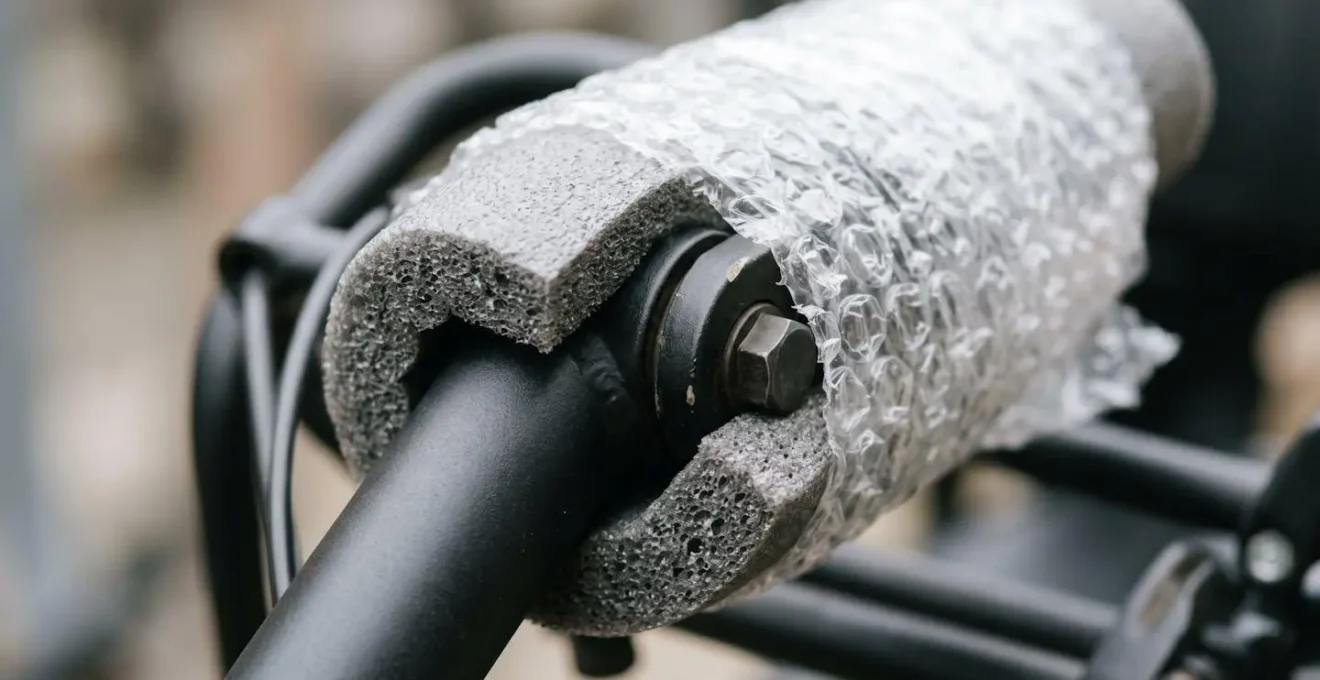
As the image above illustrates, targeted padding on critical joints is more effective than a generic wrap. This approach shows you have considered the specific stresses of air travel. Your goal is to leave only the most robust parts of the chassis for the baggage handlers.
Case Study: The ATTO Pre-emptive Disassembly Strategy
The design of the ATTO folding mobility scooter exemplifies this proactive approach. Instead of being checked as a single, vulnerable unit, it is engineered to break into two simple, more robust parts in seconds. This allows users to carry the most fragile elements (like the controller and seat) as carry-on items, with some components even fitting in overhead compartments. This strategy of pre-emptive disassembly drastically reduces the risk profile, leaving only the sturdy main chassis for baggage handling and demonstrating a design that anticipates the realities of air travel.
Drive to the Door: Why You Should Keep Your Scooter Until the Plane Door?
One of the most critical logistical decisions you will make at the airport is choosing to « gate-check » your scooter. This means you use your scooter all the way through the airport, right to the door of the aircraft. Checking your device at the main ticket counter introduces it into the general baggage system, where it will be transferred multiple times between conveyor belts and vehicles. This significantly increases the risk of damage.
By maintaining control of your scooter until the last possible moment, you establish a clear and short chain of custody. It goes directly from your hands to the ground crew who load it onto the plane. Research shows that keeping your mobility device until the aircraft door achieves a 50% reduction in handover points, which directly correlates to a lower risk of mishandling. You also have the opportunity to speak directly with the staff who will be stowing your device, reminding them of its fragility.
Under regulations like the Air Carrier Access Act (ACAA) in the United States, you have the right to do this. You are not asking for a favor; you are using your mobility aid as intended. Be prepared to advocate for yourself clearly and calmly. Having a prepared script can be incredibly empowering, as noted by travel experts at Scootaround:
As this is my mobility device, I will need to use it to the aircraft door and have it returned to me there. What is the process for that on this flight?
– Self-advocacy script based on Air Carrier Access Act, Scootaround – The Ultimate Guide to Flying With a Mobility Scooter
This simple, firm statement communicates your need and your knowledge of the process. It transforms the interaction from a request into a procedural confirmation.
The Montreal Convention: Why Airline Compensation Limits Won’t Cover Your Scooter?
Even with the best preparation, damage can occur. This is where many travelers face a harsh reality: standard airline liability for damaged baggage will not come close to covering the replacement cost of a quality mobility scooter. For most international flights, airline liability is governed by the Montreal Convention, an international treaty that sets firm limits on compensation. These limits are not based on the value of your item, but on a standardized currency called Special Drawing Rights (SDR).
Currently, the Montreal Convention increased the maximum liability for lost, damaged, or delayed baggage to 1,519 SDR, which translates to approximately $2,000 USD. With many mobility scooters costing $3,000, $5,000, or more, this leaves a significant financial gap. Relying on the airline’s standard compensation is a losing strategy. You must have a backup plan.
Fortunately, there are ways to secure better protection. On domestic flights within the United States, the Air Carrier Access Act (ACAA) overrides the Montreal Convention. The ACAA requires carriers to fully compensate for damage to wheelchairs and scooters, based on the original purchase price. For this to work, you must have proof of the scooter’s value, such as the original receipt. For international travel, your best options are to either declare « excess value » at check-in (which comes with a fee) or, more practically, ensure you have supplemental insurance. Check if your homeowner’s or renter’s insurance policy includes a rider for durable medical equipment during travel, or purchase a specific travel insurance policy that explicitly covers your scooter for its full replacement value.
Regardless of the flight, if you discover damage, you must file a claim immediately at the airport, before leaving the arrivals area. Document everything with photos and get a copy of the damage report. Acting quickly is crucial for any potential claim.
The ‘Lost Key’ Nightmare: Why You Must Secure or Remove the Key Before Loading?
A simple, yet surprisingly common, logistical failure is the lost ignition key. A key left in the ignition is easily knocked out and lost during loading, rendering your scooter useless upon arrival. Even worse, if the power is not properly disengaged, a jolt in the cargo hold could theoretically activate the scooter, creating a safety hazard. Preventing this is a simple but non-negotiable step in your pre-flight procedure.
Your primary action should always be to remove the ignition key before the scooter is taken from you at the gate. Do not simply turn it to the « off » position. The physical key must be in your possession. To prevent losing it, store your primary key and your spare key in two separate carry-on bags. Never keep them together. If one bag is misplaced, you still have a backup.
In addition to removing the key, you must ensure the scooter’s power is completely cut off. Follow this security protocol:
- Engage the Kill Switch: Locate and engage the main circuit breaker or physical kill-switch on your scooter. This is a manual override that physically disconnects the power.
- Secure Throttle for Keyless Models: If your scooter has a keyless fob system, use a simple zip-tie to lock the throttle lever in the « off » or neutral position as a physical failsafe.
- Communicate Status Clearly: Attach a large, clear label over the control panel that reads « POWER IS OFF & KEY REMOVED ». This communicates your diligence to the ground crew and prevents them from trying to start it.
These actions prevent accidental activation and ensure you are the only one who can power up the scooter at your destination. It’s a small detail that prevents a trip-ruining « lost key » nightmare.
Lithium vs Lead-Acid: Which Battery Lets You Fly Without Hassle?
The type of battery in your scooter is the single most important technical factor for airline approval. While both Lithium-ion (Li-ion) and Sealed Lead-Acid (SLA) batteries can be flown, they are governed by entirely different sets of rules and procedures. From a pure travel convenience perspective, the choice has significant logistical implications at the airport.
Sealed Lead-Acid batteries are generally classified as « non-spillable » and are seen by airlines as less of a hazard. In most cases, they can remain installed in the scooter during transport. This makes the gate-check process simpler, as there is no need for battery removal. However, they are significantly heavier and bulkier, which impacts the scooter’s overall portability.
Lithium-ion batteries, by contrast, are subject to much stricter regulations due to their higher energy density. As a rule, any lithium battery for a mobility device must be removed from the scooter and carried by the passenger in the cabin. The terminals must be protected from short-circuiting (e.g., by taping over them or placing the battery in a protective pouch). While this adds a step to your gate-check process, modern travel scooters are designed for this. Their lithium batteries are lightweight (often under 5 lbs), easily removable, and offer a superior weight-to-range ratio. This table breaks down the key differences for air travel.
This comparative data, based on common airline regulations, highlights the trade-offs between the two main battery types for travelers.
| Criteria | Lithium-Ion Batteries | Sealed Lead-Acid (SLA) Batteries |
|---|---|---|
| Airline Compliance | Maximum 300Wh per battery for mobility devices; must be removed and carried in cabin | Generally remain installed; classified as ‘non-spillable’ with no watt-hour limit |
| Weight-to-Range Ratio | Superior: lighter weight for equivalent capacity | Heavier: lower energy density |
| Charging Speed | Faster charging (critical for multi-leg trips) | Slower charging cycles |
| Ease of Removal | Designed for easy removal; typically 5 lbs or less | Often permanently installed; heavier to handle |
| Required Documentation | MSDS, UN38.3 certification, watt-hour label required | Minimal documentation; easier airline approval |
| Handling Requirements | Must be carried in protective pouch in cabin; terminals protected | Can remain in scooter during cargo transport |
| Travel Convenience | Requires battery removal at gate; extra steps | Easiest to travel with; minimal handling |
For the modern traveler, a scooter with a compliant, easily removable lithium battery is the superior choice, despite the extra handling step. The benefits in weight, performance, and charging speed far outweigh the minor inconvenience at the gate.
Coach Trips vs Cruises: Which Holiday Option Suits Limited Mobility Best?
Your choice of holiday has a profound impact on the day-to-day logistics of using a mobility scooter. While both coach tours and cruises offer fantastic travel opportunities, their inherent structures present vastly different challenges and conveniences for scooter users. Analyzing these logistical factors before booking can be the difference between a relaxing vacation and a frustrating ordeal.
A coach tour often involves changing hotels frequently, fast-paced itineraries, and navigating varied, unpredictable terrain. This environment demands a scooter that is not only compact but can be folded and lifted into the coach’s luggage bay every single day. The constant disassembly and reassembly can be taxing. Furthermore, historic European hotels and city centers may feature narrow doorways, cobblestone streets, and limited charging outlets, adding layers of complexity.
Cruises, in contrast, offer a much more controlled and predictable environment. Your cabin becomes your home base for the entire trip, eliminating the need for daily scooter disassembly. Modern cruise ships are built with accessibility in mind, featuring standardized wide doorways and reliable 24/7 in-cabin charging. The « terrain » is smooth ship decks, and while gangways at port can be steep, many cruise lines offer scooter-friendly shore excursions. The pace is generally more flexible, allowing for self-directed exploration.
The following table provides a scooter-centric logistical comparison to help guide your decision.
| Logistical Factor | Coach Tours | Cruise Ships |
|---|---|---|
| Daily Folding Requirement | High: scooter must fold daily for luggage bay storage | Low: scooter remains in cabin; no daily disassembly |
| Doorway Width | Variable: historic European hotels may have narrow doors | Standardized: modern cruise cabin doors typically 24-28 inches |
| Charging Access | Limited: dependent on hotel room outlets | Reliable: in-cabin charging available 24/7 |
| Terrain Variability | High: cobblestone streets, hills, uneven surfaces | Low: smooth ship decks, controlled environments |
| Tour Pace | Fast-paced: group moves together, time-sensitive | Flexible: self-paced exploration at port stops |
| Luggage Bay Height | High lift required: accessing undercarriage storage | Direct cabin access: no lifting to storage areas |
| Shore Excursions | N/A | Scooter-friendly excursions available; gangway steepness consideration |
| Best Scooter Type | Ultra-compact travel scooter (under 25kg); consider local rentals for rugged terrain | Bring your own familiar scooter; cabin storage adequate |
Ultimately, for travelers prioritizing ease of use and minimal daily handling of their scooter, a cruise is often the more suitable option. A coach tour remains possible but requires a highly specialized, ultra-lightweight travel scooter and a greater tolerance for daily logistical challenges.
Key takeaways
- Proactive Management is Key: Success depends on your preparation—documentation, scooter protection, and knowing your rights—not on luck.
- Lithium is the Travel Standard: Despite needing removal, an IATA-compliant, removable lithium battery is the hallmark of a modern, flight-ready scooter.
- Gate-Check is Non-Negotiable: Drastically reduce damage risk by keeping your scooter with you to the aircraft door, minimizing handover points.
Boot Scooters: How to Choose a Compact Folding Model That Fits Your Car?
The ideal travel scooter is one that excels not just in the air, but on the ground. A « boot scooter » is a category of compact, folding models designed specifically for easy transport, primarily to fit into the boot (trunk) of a car. However, the same features that make them great for daily errands—lightweight construction, simple folding mechanisms, and compact dimensions—also make them perfect for navigating the rigors of air travel.
When selecting a flight-ready boot scooter, you must prioritize travel-first features over raw power or range. The primary consideration should be a simple and robust folding mechanism. You will likely have to fold the scooter under pressure at the gate, so a complex, multi-step process is a liability. Look for models that fold in one or two intuitive movements without the need for tools. The scooter’s total weight is also critical. Aim for a total weight under 25kg (55 lbs), which is a common one-person lifting limit for airline staff and makes handling easier for everyone involved.

The most important travel-specific feature is an IATA-compliant, easily removable lithium battery. Verify that the battery is clearly marked with its watt-hour rating and that the manufacturer can provide the UN38.3 test certification. A durable frame, with a reinforced tiller joint and protected wiring, is also essential to withstand the treatment it may receive from baggage handlers.
Before purchasing, consider this travel-first feature checklist:
- Compliant Battery: IATA-compliant, easily removable lithium battery with clear Wh rating and UN38.3 certification.
- Manageable Weight: Total weight under 25kg (55 lbs) for easier lifting by you and airline staff.
- Simple Folding: A robust and quick folding mechanism that can be operated without tools.
- Durable Frame: Reinforced construction, especially at the tiller joint, to withstand baggage handling.
- Compact Dimensions: Folded dimensions that are verified to fit within airline cargo hold specifications.
Choosing a scooter with these features in mind transforms it from a simple mobility aid into a piece of reliable travel equipment, designed for the logistical realities of modern travel.
By adopting the mindset of a Mobility Logistics Manager and following these procedural steps, you can confidently navigate the complexities of air travel and ensure your scooter is a source of freedom on your holiday, not a source of stress.