Buying guides
Regaining independence through mobility is a significant milestone, but the marketplace can feel overwhelming for first-time buyers. A mobility scooter is not merely a purchase; it is an investment in your daily freedom and safety. However, with specifications varying wildly between manufacturers and specific regulations in the UK, making an informed choice requires looking beyond the glossy brochures.
This comprehensive guide connects the critical technical aspects of scooter ownership—from legal classifications to chassis metallurgy—to help you navigate the process. Whether you are considering a lightweight model for shopping trips or a heavy-duty beast for rural terrain, understanding the mechanics and regulations will prevent costly mistakes and ensure your vehicle matches your lifestyle perfectly.
Understanding UK Legal Classes and Funding Options
Before analysing batteries or suspension, it is vital to understand the legal framework governed by the Department for Transport. Choosing the wrong category for your needs can lead to legal complications or simply purchasing a machine that is unfit for purpose.
Class 2 vs Class 3: Avoiding DVLA Fines
In the UK, scooters are strictly divided. Class 2 scooters are limited to 4mph and are designed exclusively for pavement use (except when crossing roads). They do not require registration. Conversely, Class 3 scooters are road-legal vehicles capable of 8mph. They must be registered with the DVLA, equipped with lights, indicators, and a horn. Driving an unregistered Class 3 vehicle on public roads is a legal offence. Furthermore, parking a large Class 3 vehicle requires a garage or secure shed, as they rarely fit through standard doorways.
NHS Services vs Motability Scheme
Funding your mobility aid is another primary consideration. The NHS Wheelchair Services route is often cost-free but can be slow and offers a very limited selection of models, prioritising clinical need over comfort. Alternatively, the Motability Scheme allows you to use your mobility allowance to lease a higher-specification scooter. This route often includes insurance and breakdown cover, providing a faster track to a modern vehicle, though it requires eligible benefit payments.
Weight Capacity and the Mechanics of Overloading
One of the most dangerous misconceptions in buying a scooter is treating the ‘Maximum Weight Capacity’ as a target rather than an absolute limit. Exceeding or consistently nearing this limit does not just void the warranty; it fundamentally alters the vehicle’s physics.
The 10% Rule and Range Reduction
Experts recommend the ‘10% Rule’: always buy a scooter where your weight (including shopping and clothing) is at least 10% below the maximum capacity. Operating at the limit forces the motor to draw maximum current continuously. This can reduce your expected range by up to 40% and cause the motor to overheat rapidly, especially on inclines. If you are a heavy user, ignoring this buffer significantly shortens the lifespan of the electronics.
Structural Integrity: Chassis Cracks
Overloading has invisible consequences. On a Class 2 scooter designed for lighter loads, excess weight places undue stress on the welds and the front fork. Over time, this causes fatigue cracks, particularly if you frequently mount kerbs. A cracked chassis is often irreparable and poses a severe safety risk.
Chassis Material and Durability for UK Pavements
The British climate and road conditions dictate that the build material of your scooter is as important as the engine. The debate between steel and aluminum is not just about weight; it is about longevity.
- Steel Chassis: Offers superior strength and natural vibration absorption, making it ideal for rural use or heavy-duty Class 3 models. However, it is susceptible to rust from road salt and rain if the powder coating is scratched.
- Aluminum Frames: Essential for lightweight, transportable boot scooters. Modern alloys are incredibly strong and rust-resistant, but they can be more brittle than steel under heavy impact.
When buying used, always perform the ‘Welds Check’. Inspect the joints where the tiller meets the deck, as this is the most common failure point due to the leverage applied during steering and braking.
Real-World Testing and Logistics
A specification sheet cannot tell you how a scooter feels on a cambered pavement or if it will fit in your home. Practical testing is non-negotiable.
Why Car Park Tests Fail
Testing a scooter on a flat, smooth car park surface gives a false sense of security. UK pavements are uneven, have dropped kerbs, and steep gradients. A thorough test drive must involve simulating these conditions to test the torque (climbing power) and suspension (coil vs hydraulic). Hydraulic suspension is generally superior for absorbing the shock of cobblestones, whereas simple coil springs may bounce uncomfortably.
Measuring for Storage and Access
Finally, logistics are crucial. Before purchase, measure the narrowest point of your hallway or shed door. Class 3 scooters are often wider than standard internal doors. Additionally, consider the ‘Supermarket Test’: can the scooter navigate a standard aisle and turn 180 degrees without multiple manoeuvres? Understanding these physical constraints prevents the frustration of buying a vehicle you cannot park or use effectively.
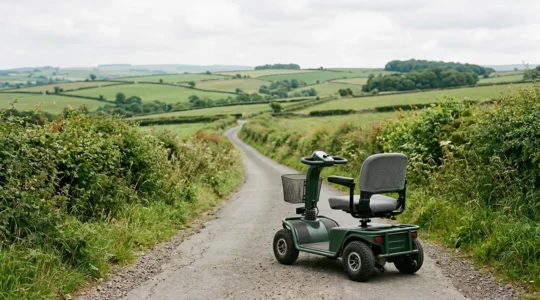
Class 3 Scooters: Is a Heavy-Duty Model Worth the Extra Cost for Rural Living?
A heavy-duty Class 3 scooter is more than a vehicle; it’s a practical engineering solution to the unique mobility challenges of a rural lifestyle. Their true value lies in high-torque motors for steep inclines and advanced suspension for unpaved tracks,…
Lire la suite
Steel vs. Aluminum: Which Chassis Durability Do You Need for UK Pavements?
The belief that steel is simply ‘strong but heavy’ and aluminium ‘light but weak’ is a dangerous oversimplification for UK scooter buyers. True durability is a balance of a material’s resistance to impact (flex), its fatigue life under constant vibration,…
Lire la suite
Exceeding Your Scooter’s Weight Limit: The Cascade of Failures That Voids Your Warranty and Risks Your Safety
Pushing your scooter’s weight limit isn’t a minor issue; it’s the start of a predictable cascade of mechanical failures that compromises your safety. Overloading doesn’t just slow you down; it causes motors to overheat, batteries to drain up to 40%…
Lire la suite
A BHTA Expert’s Guide: Choosing Your First UK Mobility Scooter Without Costly Mistakes
Choosing your first mobility scooter is a major financial and logistical decision, where the biggest risks—DVLA fines, un-claimable VAT, and a scooter that won’t fit your home—are rarely discussed by retailers. The legal difference between a Class 2 (pavement) and…
Lire la suite