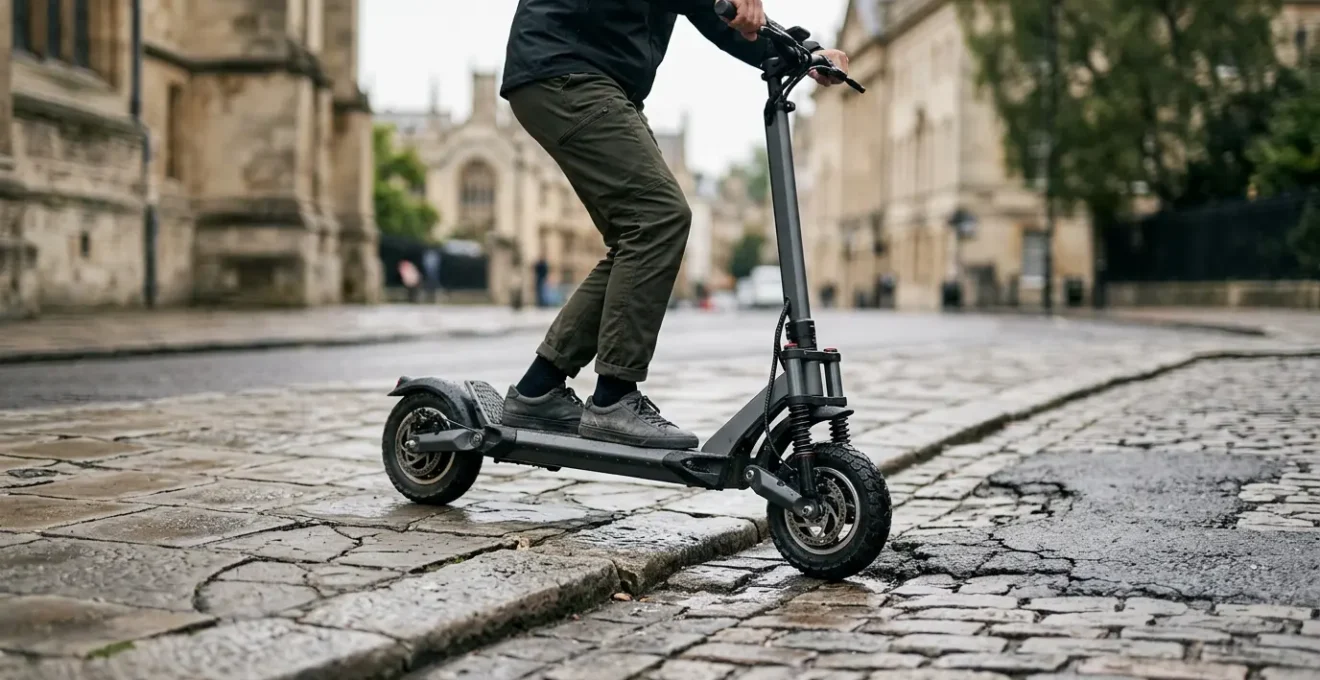
For anyone with back pain, a scooter’s suspension is not about comfort; it’s a critical medical device to prevent further spinal injury from constant road vibration.
- High-frequency vibrations from uneven pavements directly aggravate nerve pain like sciatica and can weaken bone structure in conditions like osteoporosis.
- Cheap, unsuspended scooters can vibrate at frequencies that match your spine’s natural resonance, actively amplifying damage with every ride.
Recommendation: Prioritise a scooter with a fully adjustable, dual-suspension system as a non-negotiable feature for managing your spinal health and maintaining your mobility.
That familiar, jarring shock travelling up your spine as your scooter hits a cracked paving stone. For someone with sciatica or osteoporosis, this isn’t just an uncomfortable moment; it’s a trigger for pain, a source of anxiety, and a genuine threat to your mobility. The common advice is often simplistic: « get a scooter with suspension. » But this statement barely scratches the surface of what’s truly at stake for your spinal health. It frames suspension as a luxury, a feature for a « smoother ride, » when the reality is far more critical.
The true enemy isn’t the occasional large bump, but the relentless, high-frequency chatter that defines so many of Britain’s pavements. This insidious force is known as Whole Body Vibration (WBV), and its cumulative effect on a compromised spine can be devastating. It causes micro-trauma, increases muscle fatigue as your body fights to stay stable, and can directly compress already sensitive nerves. Understanding this changes the entire conversation. We are no longer discussing a simple comfort upgrade.
This guide moves beyond the generic advice. As a physiotherapist focused on spinal health, my goal is to deconstruct this issue from a biomechanical perspective. We will not just talk about suspension; we will explore precisely *how* it functions as a protective barrier for your vertebrae. We will look at why the type of suspension matters, how to tune it specifically for your body and condition, and why even the best suspension is useless without the right wheels. This is not about buying a better scooter; it’s about investing in a tool that allows you to maintain your freedom and mobility without sacrificing your long-term spinal health.
To navigate this crucial topic, we will break down the essential components you need to understand. The following sections will guide you through the mechanics of suspension, the science of vibration, and the practical considerations for making an informed choice that truly protects your back.
Summary: Why Suspension is a Medical Necessity for Back Pain
- Front vs Rear vs All-Round: Where Do You Need the Cushioning Most?
- Softening the Ride: How to Tweak Your Springs for Your Body Weight?
- Why Suspension Means Nothing If You Have Tiny Solid Wheels?
- How Vibration Dampening Lets You Ride for an Extra Hour Without Pain?
- Is Suspension Worth the £400 Premium for Occasional Use?
- The Vibration Test: Comparing Solid vs Air on Cobblestones
- Whole Body Vibration (WBV): The Hidden Risk of Cheap Scooters
- Is Shock-Absorbing Suspension Essential for UK Pavements or a Luxury?
Front vs Rear vs All-Round: Where Do You Need the Cushioning Most?
When we talk about suspension, it’s not a single entity. The location of the shock absorbers on your scooter determines which forces they are designed to mitigate. For a person with a sensitive back, understanding this distinction is crucial. Your spine experiences two primary types of jarring forces during a ride: vertical impacts from bumps and horizontal forces from deceleration and acceleration. A front suspension system is primarily designed to handle the forces of braking and hitting obstacles head-on, preventing the handlebars from transmitting that jolt directly to your arms and upper back. A rear suspension, conversely, is focused on absorbing the impacts that come up through the deck, directly protecting your lower back and pelvis from vertical shocks.
From a physiotherapy standpoint, the lumbar spine (your lower back) is the most vulnerable area during a ride, as it bears the majority of your upper body weight and acts as a central pivot. Therefore, a scooter without rear suspension is fundamentally failing to protect the most critical area for back pain sufferers. While front suspension adds control and comfort for your arms, rear suspension is the primary barrier defending your spinal column. This is why all-round, or dual, suspension is the clinical gold standard. It creates a complete protective ‘cushion’ that addresses both vertical and horizontal forces.
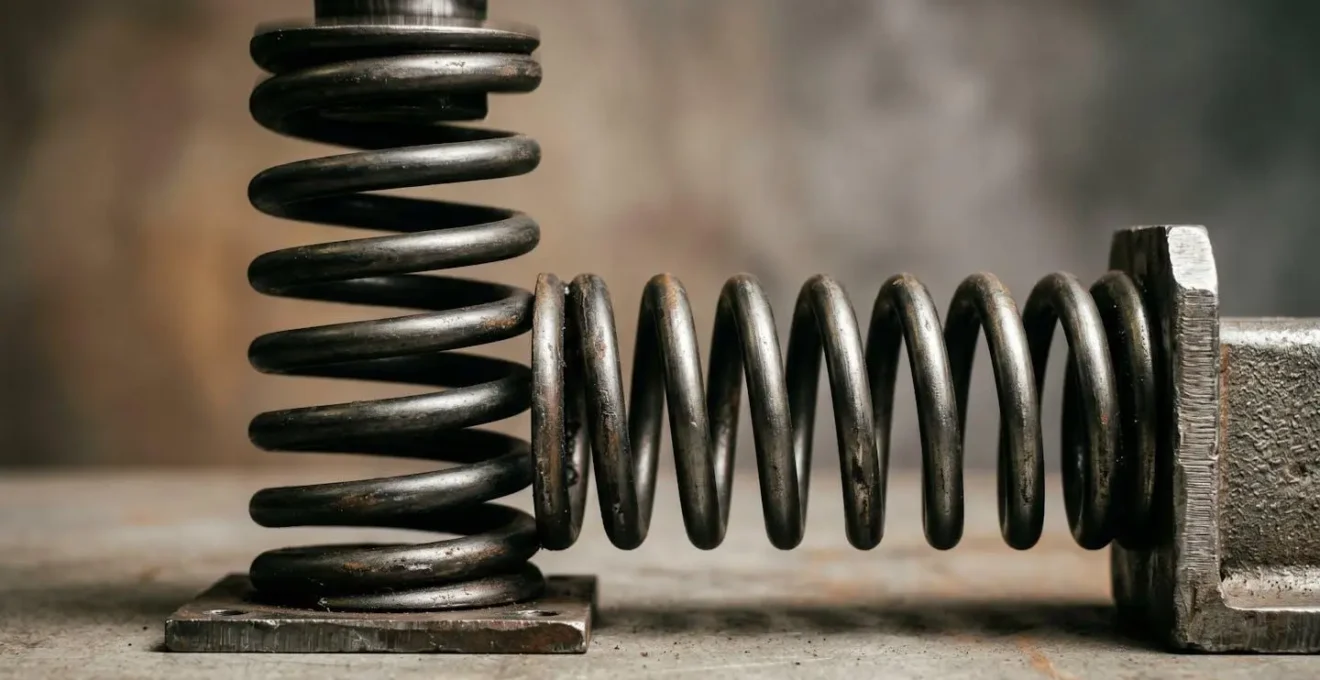
The evidence for suspension’s effectiveness is clear. To give a parallel, specific research on in-wheel suspension systems for wheelchairs demonstrates a tangible reduction in vibrations felt by the user. While a scooter is different, the principle is identical: interrupting the path of vibration before it reaches the body. For someone with sciatica, where nerve compression is the issue, or osteoporosis, where bones are brittle, minimising every possible impact is not a luxury—it’s an essential part of managing the condition.
Softening the Ride: How to Tweak Your Springs for Your Body Weight?
A high-quality suspension system is only half the solution. If it’s not adjusted for your specific body weight and riding style, it can be ineffective or, in some cases, even make the ride worse. Think of it like a prescription: the right medication at the wrong dosage is ineffective. Most premium scooters with spring-based suspension offer « preload » adjustment. This doesn’t change the stiffness of the spring itself, but rather how much it’s compressed at rest. This adjustment is what allows you to personalise the ride for your body.
The goal is to set the « SAG, » which is the amount the suspension compresses under your static weight. The ideal SAG is typically 25-30% of the total suspension travel. If the SAG is too low (<25%), the suspension will be too rigid, failing to absorb small bumps and transmitting harsh vibrations to your spine. This is a common issue for lighter riders on factory settings. Conversely, if the SAG is too high (>30%), the suspension will be too soft. It may feel plush on small bumps but will « bottom out » on larger impacts—hitting the end of its travel with a harsh thud that sends a direct shockwave up your spine. Both scenarios defeat the purpose of having suspension in the first place.
Tuning your suspension is the single most important step you can take after purchasing a scooter. It’s a process that turns a generic product into a personalised piece of medical equipment tailored to protect you. Taking 20 minutes to perform these adjustments can be the difference between a painful, jarring commute and a ride that feels genuinely therapeutic and supportive.
Your Personalised Suspension Prescription: A 5-Step Guide
- Measure static SAG: Place a zip tie on the suspension shaft, sit on the scooter in your normal riding position, then get off carefully. Measure the distance the zip tie moved. This is your SAG. Your goal is 25-30% of the suspension’s total travel distance.
- Adjust preload: If your SAG is less than 25% (too firm), reduce the preload by loosening the spring tension adjuster. If your SAG is over 30% (too soft), increase the preload by tightening the adjuster.
- Test rebound damping: Ride slowly off a small curb. If you feel bounced upwards after the impact, your rebound is too fast. If the suspension feels sluggish and doesn’t return to its normal position quickly, it’s too slow. Adjust the rebound knob (if available) accordingly.
- Verify bottoming resistance: Ride over a larger bump, like a speed hump, at a moderate speed. If you feel a harsh metal-on-metal impact, the suspension has bottomed out. You need to increase your preload or, if available, your compression damping.
- Fine-tune with the ‘feel test’: Ultimately, the suspension should feel active but controlled. It should absorb impacts smoothly without harsh feedback and return to its neutral position without bouncing, keeping you stable and comfortable.
Why Suspension Means Nothing If You Have Tiny Solid Wheels?
Imagine investing in an expensive, state-of-the-art home sound system but connecting it to tiny, tinny speakers from a 1990s desktop computer. The result would be terrible, and it’s a perfect analogy for pairing great suspension with small, solid tyres. Your scooter’s ability to isolate you from the road is a two-part system: the tyres are the first line of defence, and the suspension is the second. If the first line fails completely, the second is quickly overwhelmed.
Solid, or « honeycomb, » tyres are often marketed as a puncture-proof convenience. However, from a spinal health perspective, they are a disaster. Made from solid rubber or polyurethane, they have almost zero natural damping properties. They are incapable of compressing and absorbing impact energy. Instead, they transmit every tiny crack, every piece of gravel, and every high-frequency vibration directly into the scooter’s frame. This is not an opinion; it’s physics. As one engineering analysis reveals that solid tires transfer every single vibration, it’s this constant, unfiltered « chatter » that is particularly aggravating for conditions like sciatica.
Pneumatic tires absorb and dissipate impact energy through air compression. Solid tires transfer every single vibration directly into your scooter’s frame.
– EScooter testing analysis, Solid vs Pneumatic Tires for Electric Scooters comparative study
Pneumatic (air-filled) tyres, by contrast, act as a primary, low-pressure shock absorber. The air inside them compresses to swallow small, high-frequency bumps before they even reach the suspension. For effective protection, you need both systems working in harmony. The pneumatic tyres handle the constant « road buzz, » while the mechanical suspension handles the larger hits—dips, curbs, and potholes. A scooter with suspension and solid tyres is a fundamental contradiction. The suspension is constantly battling a firehose of vibration that the tyres should have absorbed. For a user with back pain, the choice is clear: large, pneumatic tyres are a non-negotiable component of a truly comfortable and safe ride.
How Vibration Dampening Lets You Ride for an Extra Hour Without Pain?
The pain you feel after a long, bumpy ride isn’t just from the big jolts. It’s often the result of something more insidious: the cumulative effect of thousands of micro-vibrations. When you ride on an unsuspended or poorly suspended scooter, your body becomes the suspension system. Your muscles, particularly the deep stabilising muscles around your spine (like the multifidus and erector spinae), are forced to constantly contract and adjust to counteract the incoming vibrations and maintain your posture. This is an exhausting, subconscious effort.
Think of it as holding a light weight with your arm outstretched. For the first minute, it’s easy. After ten minutes, your arm is shaking and sore. This is what’s happening to your spinal muscles on a micro-level. This process of cumulative muscle fatigue is a major contributor to post-ride pain. Your muscles become overworked, stiff, and are less able to protect your spinal joints and nerves, leading to inflammation and increased sensitivity. This is why a ride that felt fine for the first 15 minutes can leave you in agony an hour later.

Effective vibration dampening from a good suspension and pneumatic tyre system breaks this cycle. By absorbing the vast majority of these micro-vibrations, the suspension allows your core muscles to relax. Instead of being in a constant state of reactive tension, they can do their job of providing stable, controlled support. This dramatically reduces fatigue and, in turn, post-ride pain and stiffness. It’s the difference between your body acting as a rigid, stressed shock absorber and it being carried along smoothly. This is what allows you to extend your ride time not just in comfort, but in a way that doesn’t force you to « pay for it » with pain later on.
Is Suspension Worth the £400 Premium for Occasional Use?
The £400 question. It’s often the price difference between a basic, unsuspended scooter and a mid-range model with a full suspension system. For a healthy, 20-year-old student, this might be a genuine debate about comfort versus cost. But for you, someone managing osteoporosis or sciatica, the question needs to be reframed entirely. It’s not a £400 premium for comfort; it’s a £400 investment in your ongoing health and mobility. You are not an « occasional user » in the same way. Every single ride, no matter how short, exposes your spine to potentially damaging forces.
From a clinical perspective, we must consider the cost of *not* having suspension. What is the cost of a sciatica flare-up that leaves you unable to work for a week? What is the cost of medications, physiotherapy appointments, or simply the mental toll of being in chronic pain? When you look at it this way, the £400 premium is not an expense, but an insurance policy. It’s a proactive measure to prevent the very outcomes you work so hard to avoid in your daily life. The term « occasional use » is misleading; for a compromised spine, there is no « safe » amount of unfiltered vibration.
The medical community has long recognised the dangers of prolonged vibration in occupational settings. Conditions like Hand-Arm Vibration Syndrome (HAVS) show the devastating long-term effects. A quote from a study on this topic is chillingly relevant, as highlighted in the Journal of Occupational Medicine and Toxicology, it states that for those with advanced conditions, there is « great personal suffering with difficulties to use their hands. » We must apply the same level of seriousness to Whole Body Vibration and the spine. The premium for suspension isn’t a luxury; it’s a preventative health measure that is arguably priceless.
The Vibration Test: Comparing Solid vs Air on Cobblestones
To truly understand the difference a good tyre and suspension system makes, you don’t need complex lab equipment. You just need to listen to your own body and observe the raw physics in action. Imagine a simple comparison test: riding a scooter with hard, solid tyres over a stretch of classic British cobblestones, and then repeating the exact same route on a scooter with large pneumatic tyres and a tuned dual suspension. The difference is not subtle; it is night and day.
With the solid tyres, the experience is immediately violent. A high-frequency, tooth-rattling vibration travels instantly up the scooter’s frame and stem, into your hands, arms, and most critically, up your spinal column. This is what riders and testers refer to as « chatter. » It’s a deeply unpleasant and, for someone with nerve pain, an acutely painful sensation. The scooter feels unstable, your vision may even blur slightly from the intensity of the vibration, and every muscle in your back and core tenses up in a futile attempt to brace against the assault.
The moment you leave the asphalt, the sensation is violent. The high-frequency vibration travels instantly up the stem to the handlebars. Riders often experience ‘chatter,’ where the vibration is so intense that it creates a blurring effect in their vision.
– Geekbuying scooter tire testing, Solid vs Pneumatic Scooter Tires comparative analysis
Now, switch to the properly equipped scooter. As you move onto the same cobblestones, the pneumatic tyres immediately absorb the sharpest edges and the high-frequency buzz. The suspension then activates to swallow the larger, rolling bumps between the stones. There is no violent chatter. You can feel the texture of the road, but it’s a muted, distant sensation, not an attack. Your hands are relaxed on the handlebars, your vision is clear, and your back remains relaxed and upright. The scooter feels planted, stable, and compliant. This simple test reveals the truth: one setup transmits energy *into* your body, while the other actively works to dissipate it *away* from your body.
Whole Body Vibration (WBV): The Hidden Risk of Cheap Scooters
We’ve mentioned Whole Body Vibration (WBV) throughout this guide, but it’s time to define it from a scientific, clinical standpoint. WBV refers to the transmission of mechanical vibrations through a supporting surface into the human body. International standards exist to measure and limit exposure to WBV in workplaces, precisely because it is a known health risk. The most important of these is ISO 2631-1, which sets safety thresholds for vibration exposure. It’s a stark warning that what feels like a « bumpy ride » is, in fact, a measurable physical hazard.
The standard is complex, but the key takeaway is that both the intensity (amplitude) and the duration of vibration exposure matter. A short burst of high-intensity vibration can be as damaging as a long period of lower-intensity vibration. Crucially, as the ISO 2631-1 standard establishes that safe exposure limits are often exceeded by vehicles without adequate suspension. The health guidance caution zone for an 8-hour exposure lies between 0.45 m/s² and 0.9 m/s². It is frighteningly easy for a cheap, unsuspended scooter on an uneven pavement to produce vibrations that fall within or exceed this range, putting the rider in a state of continuous, low-grade physical damage.
Even more concerning is the concept of resonance. Every physical object has a natural frequency at which it prefers to vibrate. For the human spine, this resonant frequency is in the 4-8 Hz range. If your scooter vibrates at a frequency within this range, your spine doesn’t just shake; it resonates. The vibrations are amplified, dramatically increasing the mechanical stress on your vertebrae, intervertebral discs, and surrounding nerves. The standard ISO 2631-1:1997 specifies a frequency range of 0.5 Hz to 80 Hz for health evaluation, highlighting this 4-8 Hz band as particularly harmful. Cheap scooters, with their rigid frames and hard wheels, are notorious for producing exactly this kind of dangerous, low-frequency vibration. A good suspension system is designed specifically to damp these frequencies, keeping them away from your body.
Key takeaways
- For spinal health, suspension is not a comfort feature; it is a medical necessity to prevent injury.
- Whole Body Vibration (WBV), especially at the spine’s resonant frequency (4-8 Hz), is the primary risk, and suspension is the primary defence.
- An effective system combines large pneumatic tyres (first defence) with a dual, fully adjustable suspension system (second defence) tuned to your body weight.
Is Shock-Absorbing Suspension Essential for UK Pavements or a Luxury?
After dissecting the biomechanics, the physics, and the medical science, the conclusion becomes inescapable. For the general population, a healthy young rider commuting on smooth cycle lanes, the debate over suspension as a « luxury » might have some merit. For them, the consequences of a bumpy ride are transient discomfort. But for anyone with a pre-existing spinal condition—be it chronic lower back pain, sciatica, osteoporosis, or a history of disc issues—that debate is entirely irrelevant. The goalposts are in a completely different place.
For you, the question is not about comfort. It is about capability, safety, and the preservation of long-term health. A scooter is a tool of freedom and mobility. But if that tool is actively causing micro-trauma, aggravating your nerve pain, and contributing to the degeneration of your spinal structures with every use, it has failed in its primary purpose. It becomes a source of injury, not liberation. On the varied, cracked, and often poorly maintained pavements of the UK, an unsuspended scooter presents a clear and present danger to a vulnerable spine.
Therefore, shock-absorbing suspension is not a luxury. It is an essential, non-negotiable component of a mobility device intended for a user with spinal health concerns. It is the single most important feature to prioritise, above top speed, range, or gadgetry. Choosing to forgo it is not a savvy cost-saving measure; it is an unwitting acceptance of physical risk. The investment in a quality suspension system is a direct investment in your own body, allowing you to stay active and mobile while protecting yourself from the very real, and very preventable, harm of Whole Body Vibration.
To protect your long-term spinal health, your next step should be to prioritise scooters with adjustable, dual-suspension systems in your search, viewing it as the most critical medical and safety feature for your continued mobility.