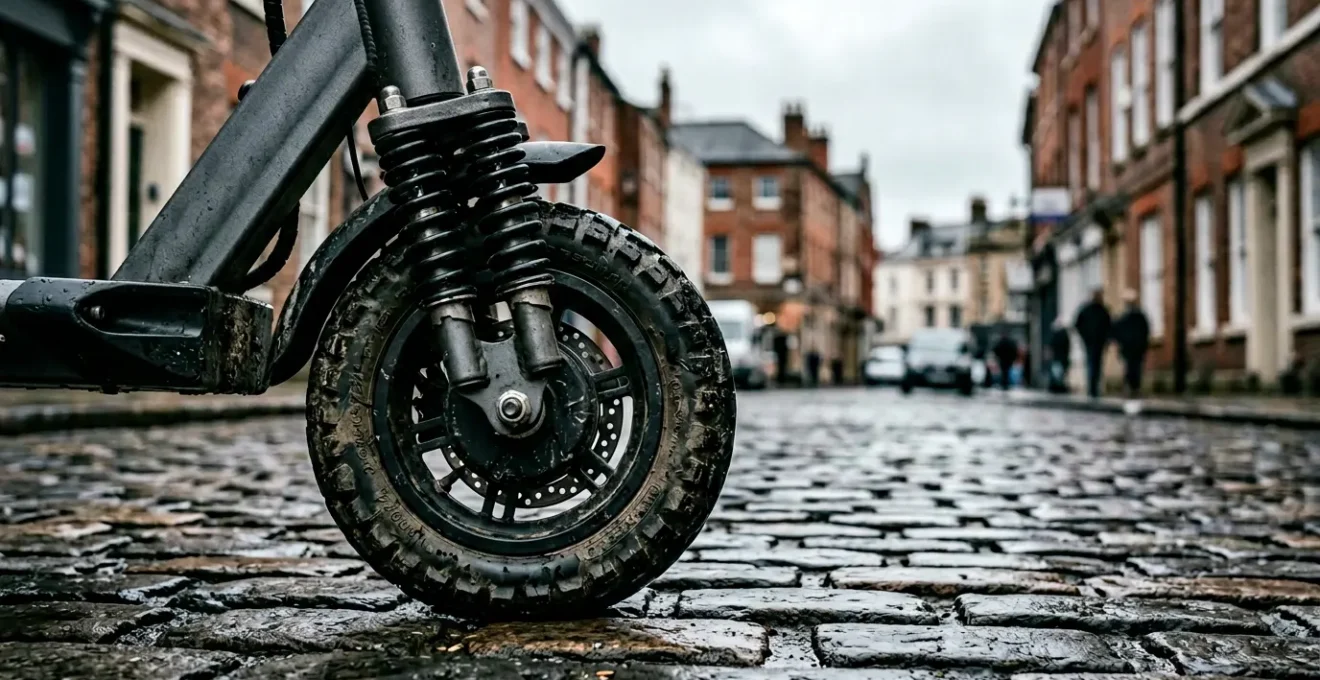
Contrary to the belief that suspension is a luxury for comfort, it is an essential engineering system that dictates a scooter’s structural lifespan and your long-term health on varied UK surfaces.
- Suspension is not just about a smooth ride; it’s a critical mechanism for reducing peak impact forces that damage the scooter’s frame, welds, and electronics.
- The type and tuning of suspension directly influence safety, control, and the cumulative impact of whole-body vibration, a significant health concern for regular riders.
Recommendation: For any regular use on British pavements, view suspension not as an optional extra, but as a primary factor in your purchasing decision, balancing upfront cost against the inevitable long-term costs of repair and physical well-being.
The debate around electric scooter features often centres on range and speed. Yet for the budget-conscious UK rider, navigating a patchwork of pristine tarmac, broken paving slabs, and the occasional jarring dropped kerb, a more fundamental question arises: is suspension a genuinely necessary investment, or an expensive luxury? Many assume it’s merely a « nice-to-have » for a bit of extra comfort. This view, however, overlooks the fundamental physics at play and the engineering reality of daily urban travel.
The common advice is to simply get pneumatic tyres and hope for the best. But this fails to account for the high-frequency vibrations that even air-filled tyres can’t erase, or the sharp, high-impact forces from a pothole or kerb edge. This article moves beyond the surface-level discussion of comfort. Adopting the practical perspective of a mechanical engineer, we will dissect suspension not as a feature, but as a critical system. We will analyse its role in preserving the scooter’s structural integrity, its direct impact on rider health and safety, and the long-term cost of failure when it’s absent or inadequate.
We’ll examine why solid tyres make suspension non-negotiable, how to properly tune it for your own weight, and the real-world costs of repairing different systems when they fail. This is not a simple ‘yes’ or ‘no’ answer; it’s a cost-benefit analysis of mechanics, money, and your own well-being on the uniquely challenging terrain of British towns.
This comprehensive guide breaks down the critical engineering and financial aspects of e-scooter suspension, allowing you to make an informed decision based on your specific needs and the realities of UK pavements.
Summary: A Practical Guide to E-Scooter Suspension for UK Riders
- Why Solid Tires Need Suspension to Avoid Rattling Your Teeth?
- Front vs Rear vs All-Round: Where Do You Need the Cushioning Most?
- The Vibration Test: Comparing Solid vs Air on Cobblestones
- Pre-Load Springs: How to Tune Your Suspension for Your Weight?
- How Suspension Protects Your Chassis When Mounting Dropped Kerbs?
- Why Full Suspension Is Critical for Users with Back Pain on Uneven Pavements?
- Squeaking Springs: When to Lubricate and When to Replace?
- Hydraulic vs Coil: Which System Costs More to Fix When It Leaks?
Why Solid Tires Need Suspension to Avoid Rattling Your Teeth?
Solid tyres are often marketed as a zero-maintenance dream: no punctures, no pressure checks. However, from a mechanical standpoint, this convenience comes at a significant cost in vibration transmission. Solid rubber or polyurethane has virtually zero damping properties. This means every imperfection in the pavement—every crack, pebble, and manhole cover—is transferred directly into the scooter’s frame, and subsequently, into you. This isn’t just about comfort; it’s about a barrage of high-frequency vibrations that create fatigue and compromise control.
A scooter with solid tyres but no suspension is mechanically incomplete. The suspension is not an add-on; it is the essential component that compensates for the tyre’s inability to absorb impacts. Without it, the ride is harsh and punishing. As a technical team from YUME Scooters notes in their guide, « Electric scooters with solid tires absolutely require robust shock absorbing suspension since solid tires provide zero impact absorption, making mechanical suspension critical for ride comfort. » This statement underscores the symbiotic relationship between tyre type and suspension necessity.
The scale of this vibration is not trivial. Scientific analysis confirms the dramatic effect. In fact, research published in the MDPI Machines journal reveals that over 87.54% of undesirable vibrations on pavers and up to 95.47% on asphalt can be transmitted to the rider on improperly suspended scooters. This constant, tooth-rattling feedback is what makes suspension a fundamental requirement, not a luxury, if you opt for the puncture-proof convenience of solid tyres. It’s the only thing standing between you and every single bump in the road.
Front vs Rear vs All-Round: Where Do You Need the Cushioning Most?
Once you accept the need for suspension, the next question is configuration. Is front-only enough, or is dual suspension essential? The answer depends entirely on your primary use-case, weight, and the terrain you frequent. There is no single « best » setup; there is only the most appropriate for the job. A practical, engineering-led approach is to match the suspension to the expected forces and desired outcomes.
Here is a breakdown based on common UK urban scenarios:
- Budget Urban Commuter (Smooth Pavements): For light riders (under 80kg) on well-maintained roads, a front-only suspension system is often sufficient. Its main job is to absorb impacts that would otherwise jolt your arms and wrists, improving steering control and comfort on the front wheel, which leads into impacts.
- Seated Riders or Heavy Cargo: If you use a seat or frequently carry a heavy backpack or groceries, rear-only or dual suspension becomes critical. The rear suspension supports the load-bearing part of the scooter, improving traction and, most importantly, reducing the jarring impacts that would otherwise travel directly up your spine.
- Mixed Terrain or Daily Commuters: For anyone riding more than a few miles a day on typical UK pavements—a mix of good, bad, and ugly—dual suspension (front and rear) is the gold standard. The front handles initial impacts and steering, while the rear maintains traction during braking and absorbs what the front misses. This creates a stable, predictable ride.
- High-Performance or Health-Conscious Riders: For those on faster scooters (20mph+) or anyone with pre-existing back issues, all-round adjustable suspension is a necessity. The ability to fine-tune the system for a ‘plusher’ ride actively protects joints and the spine from repetitive shock.
The decision isn’t just about comfort, but about control and safety. A front wheel that hits an unexpected pothole without suspension can lose traction or even cause a loss of steering control. Similarly, a rear wheel can skip during hard braking on an uneven surface if it’s not kept in contact with the ground by a suspension system. Choosing the right configuration is a balance of cost, performance, and risk management.
The Vibration Test: Comparing Solid vs Air on Cobblestones
Theoretical discussions are useful, but how do these combinations perform on the actual surfaces you’ll encounter? Data from vibration analysis provides a clear picture. The goal of any suspension system is twofold: to absorb large, single impacts (like a dropped kerb) and to dampen the high-frequency ‘buzz’ from textured surfaces (like broken tarmac or paving slabs). It’s this latter capability that often separates a tolerable ride from a truly comfortable and safe one, directly impacting the rider’s cognitive load—how much mental energy is spent « surviving » the ride rather than observing traffic.
A comparative analysis, often presented in a matrix, shows the synergistic effect of tyres and suspension. Consider the performance across typical UK surfaces:
| Configuration | Smooth Tarmac | Broken Tarmac | Paving Slabs | Cobblestones | Cognitive Load |
|---|---|---|---|---|---|
| Solid Tires / No Suspension | Acceptable | Harsh – high-frequency buzz transmitted to hands | Very Uncomfortable – every joint felt | Extremely Uncomfortable – constant impact, loss of control risk | Very High – 90% focus on survival |
| Pneumatic Tires / No Suspension | Comfortable | Generally Good – tires absorb texture | Moderate – larger impacts still transmitted | Uncomfortable – sustained vibration causes fatigue | Medium – 60% focus on surface |
| Solid Tires / With Suspension | Good | Good – suspension handles impacts, buzz remains | Acceptable – major impacts absorbed | Acceptable – suspension essential for control | Medium – 50% focus on terrain |
| Pneumatic Tires / With Suspension (Optimal) | Excellent | Excellent – synergistic dampening | Very Comfortable – both systems complement | Comfortable – best achievable experience | Low – 20% focus, attention freed for traffic |
The takeaway is clear: while pneumatic tyres offer an improvement, they cannot single-handedly tame rough surfaces. It is the combination of suspension and tyre type that defines the ride quality and safety. The « Solid Tires / With Suspension » configuration is a viable, low-maintenance compromise, but the optimal setup for handling the full range of UK surfaces remains pneumatic tyres paired with a capable dual suspension system. This combination frees up the rider’s attention to focus on the most important thing: navigating the urban environment safely. Indeed, according to biomechanical research, speeds above 16 km/h for comfort on anything but the best roads can expose riders to excessive vibration, highlighting the need for an effective damping system.
Pre-Load Springs: How to Tune Your Suspension for Your Weight?
Simply having suspension is only half the battle. A system that is too soft will bottom out on large impacts, sending a jarring shock through the frame. One that is too stiff will fail to absorb small bumps, creating a chattering, uncomfortable ride. The key to unlocking a suspension’s true potential lies in adjusting the spring preload. Preload is the amount of tension applied to the spring when the suspension is fully extended. Adjusting it allows you to set the scooter’s ‘ride height’ or ‘sag’ to match your specific weight, ensuring the suspension operates in its optimal range.
Setting your rider sag is a fundamental process in vehicle dynamics, whether on a motorcycle or a high-end e-scooter. It ensures that the suspension is neither fully extended nor fully compressed during normal riding, giving it room to move in both directions—compressing for bumps and extending into dips. For a budget-conscious buyer, this isn’t just about comfort; it’s about preventing the damaging impacts of bottoming out, which can lead to premature component failure.
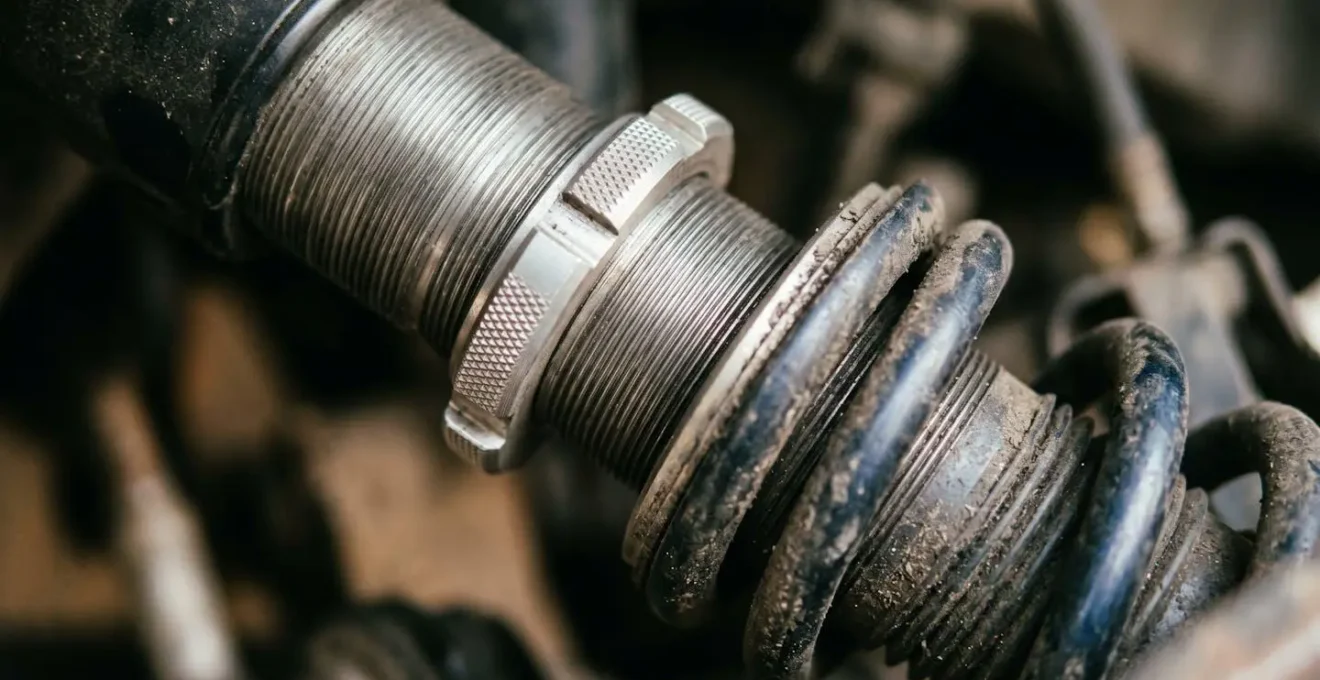
While it sounds technical, the process is straightforward and is the single most effective adjustment you can make to improve your ride. The aim is to have the suspension compress by about 20-30% of its total travel under your static weight. This sweet spot provides a balance between absorbing small bumps and resisting bottoming out on large ones.
Your Action Plan: Measuring and Setting Rider Sag
- Extend and Measure: Fully extend the suspension (e.g., by lifting the scooter deck) and measure from a fixed point on the frame to the axle (measurement A).
- Load and Measure: With you on the scooter in your normal riding gear, have a helper measure the same distance again (measurement B).
- Calculate and Aim: Subtract B from A to get your rider sag. Aim for this value to be 20-30% of the total suspension travel (check your scooter’s manual for this spec).
- Adjust Preload: If sag is too high (more than 30%), tighten the preload adjuster (usually clockwise) to increase spring tension. If sag is too low (less than 20%), loosen the adjuster.
- Test and Refine: Make small, incremental adjustments and test ride until the scooter feels compliant over small bumps without bottoming out on dropped kerbs.
How Suspension Protects Your Chassis When Mounting Dropped Kerbs?
A common misconception is that suspension exists solely for the rider’s comfort. From an engineering perspective, its primary role is to protect the vehicle itself. Every time a scooter wheel hits an obstacle—a pothole, a raised paving slab, or a UK-style dropped kerb—it experiences a sharp impact force. Without suspension, that force is transmitted almost instantaneously through the frame, stressing welds, rattling electronics, and potentially damaging the battery and its sensitive management system (BMS).
Suspension works on a principle known as impulse reduction. Impulse is the product of force and the time over which it is applied. By compressing, a spring and damper system extends the time of the impact event. This drastically reduces the peak force experienced by the chassis. Think of the difference between being punched quickly and being pushed slowly with the same amount of energy; the slow push is far less damaging. This is what suspension does for your scooter, hundreds of times on every ride.
Case Study: Scientific Analysis of E-Scooter Impact Forces
A peer-reviewed study in the Experimental Techniques journal provides concrete evidence. Researchers measured acceleration forces on e-scooters hitting obstacles. Their findings demonstrated that suspension systems significantly reduce peak impact forces by extending the time over which force is applied. Crucially, the study noted that without effective suspension, instantaneous peak forces exceeded safe thresholds, not just for rider comfort, but for the integrity of key components like battery management systems, folding mechanism latches, and critical stem welds. This highlights that suspension is a key element of the scooter’s structural design and longevity.
For a budget-conscious buyer, this is a critical point. The upfront cost of a model with a robust suspension system can be offset by the reduced likelihood of a catastrophic frame or component failure down the line. A cracked weld on the steering stem or a damaged battery connector caused by repeated impacts is a far more expensive fix than the initial premium for suspension. It is a classic case of investing in prevention to avoid the high cost of a cure.
Why Full Suspension Is Critical for Users with Back Pain on Uneven Pavements?
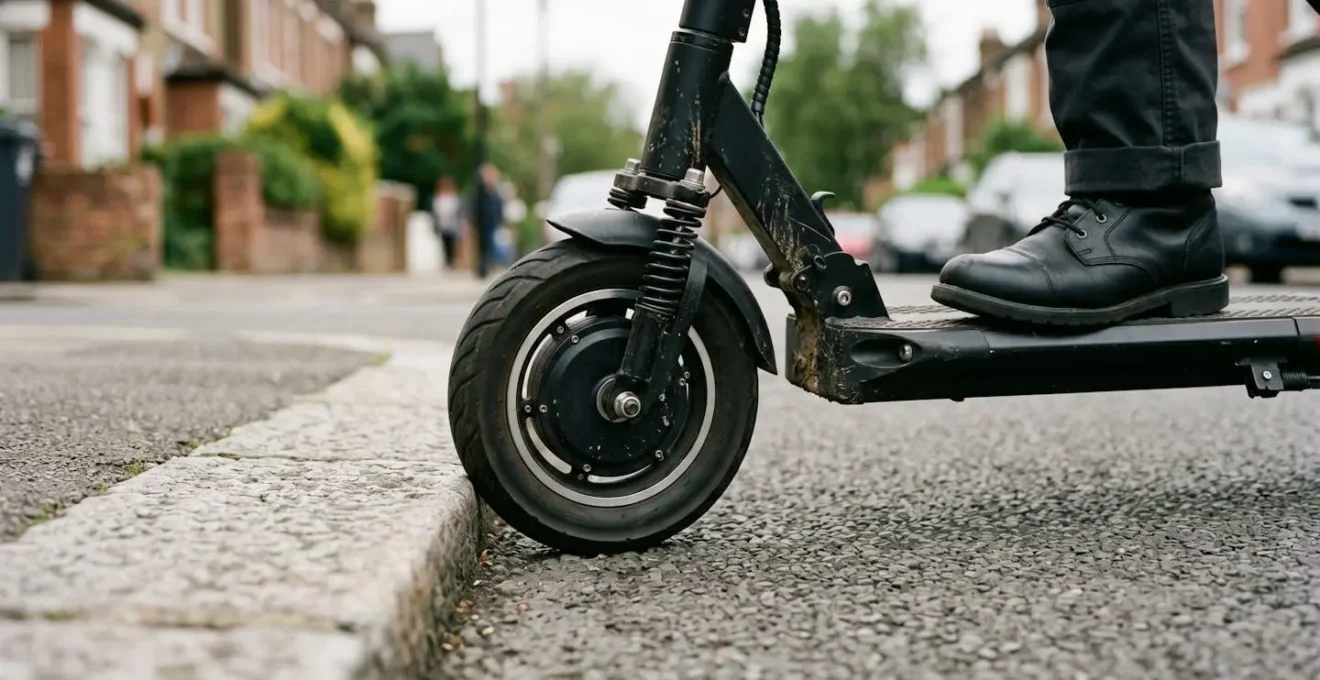
For many, the appeal of an e-scooter is its convenience. But for anyone with a sensitive back or joints, the choice of scooter can have significant long-term health implications. The vibrations transmitted from the pavement to the rider are not just a nuisance; they are a recognized occupational hazard known as Whole-Body Vibration (WBV). While a single ride might feel fine, the cumulative effect of these repetitive shocks can exacerbate existing conditions or even create new problems.
The spine is ill-equipped to handle the specific repetitive, high-frequency shocks from pavement that a scooter transmits. Without proper suspension, the cumulative effect is similar to being tapped lightly but repeatedly on the head for an hour—individually tolerable impacts that become damaging through repetition.
– Dr. Andrea Vella and Dr. Alessandro Vigliani, Research on Longitudinal Dynamics of Electric Scooters, SAE International Journal
This powerful analogy from researchers Dr. Andrea Vella and Dr. Alessandro Vigliani illustrates the danger perfectly. The human spine is a superb shock absorber for natural movements like walking, but it’s not designed to dampen the constant, high-frequency ‘buzz’ of an unsuspended scooter on broken tarmac. This is where full (dual) suspension becomes less of a feature and more of a piece of essential health equipment. It acts as a primary filter, absorbing the damaging vibrations before they can reach the rider’s body.
Scientific studies quantify this risk. For instance, a comprehensive health impact study found that over 61.85% of vibrations on pavers are classified as ‘non-healthy’ under established WBV guidelines. A scooter with well-tuned dual suspension can dramatically reduce this exposure, transforming a potentially harmful journey into a low-impact one. For a rider with back pain, the choice is stark: invest in a scooter with a capable full suspension system or risk turning a convenient mode of transport into a source of chronic pain.
Squeaking Springs: When to Lubricate and When to Replace?
Like any mechanical system, suspension requires maintenance. Over time, exposure to UK damp and road grime can cause pivot points to dry out or bearings to become contaminated. The first sign of trouble is often an unwanted noise—a high-pitched squeak, a metallic clunk, or a grinding sound. Ignoring these auditory warnings can lead to increased wear and eventual failure. For the practical owner, learning to diagnose these sounds is key to low-cost maintenance and preventing expensive repairs.
A high-pitched squeak is the most common issue and is usually the least serious. It’s typically caused by dry bushings or pivot points where metal or elastomer components rub against each other. This is a simple maintenance job: a thorough cleaning followed by an application of a suitable lubricant (like marine-grade grease or a wet-style bicycle chain lube that resists being washed away) will often solve the problem. It’s a sign that the system needs attention, not necessarily replacement.
More worrying sounds like a metallic ‘clunk’ or a grinding noise point to more advanced wear. A clunk can indicate a worn-out bushing that now has excessive play, or that the suspension is bottoming out too easily (a sign your preload needs adjusting). A grinding or scraping noise is a red alert, often signalling contamination or failure within a bearing. This requires immediate action—disassembly, cleaning, and likely replacement of the damaged parts—to prevent further damage to the suspension arms or frame mounts.
The following diagnostic chart provides a practical guide to interpreting these sounds and taking the appropriate action:
| Sound Type | Most Likely Cause | Recommended Action | Urgency Level |
|---|---|---|---|
| High-pitched squeak | Dry pivot points or bushings | Clean and apply marine-grade grease or wet bicycle chain lube | Low – Maintenance |
| Metallic clunk | Worn bushing or suspension bottoming out | Inspect bushings for wear; adjust preload to prevent bottoming | Medium – Inspect soon |
| Grinding or scraping | Contamination in bearings or bearing failure | Disassemble, clean thoroughly, and replace damaged bearings | High – Replace immediately |
| Rhythmic clicking | Loose mounting bolts or worn spring seats | Tighten all fasteners to manufacturer torque specs | Medium – Tighten promptly |
Key takeaways
- Suspension is an engineering necessity, not a luxury, for protecting a scooter’s frame and electronics from the impact forces of uneven UK pavements.
- The right suspension configuration (front, rear, or dual) depends on your specific use-case, with dual systems offering the best protection for both rider and machine in mixed urban terrain.
- Properly tuning your suspension’s preload for your weight is a critical, no-cost adjustment that prevents damage and dramatically improves performance and safety.
Hydraulic vs Coil: Which System Costs More to Fix When It Leaks?
The final piece of the puzzle for a budget-conscious buyer is the long-term cost of ownership. The two most common types of suspension are simple coil/spring systems (sometimes with an elastomer bumper) and more complex hydraulic systems. While they perform a similar function, their failure modes and repair costs are vastly different. A simple coil spring system is robust and cheap. Its most common failure is ‘soft’—the spring gradually loses its tension over years of use, causing the ride to become saggy and less effective. The fix is straightforward: replacing a spring is a low-cost, DIY-friendly job.
Hydraulic systems, which use oil to dampen the spring’s movement, offer a more controlled and sophisticated ride. However, they introduce a new point of failure: seals. A hydraulic shock can suffer a ‘hard failure’ when a seal gives way, causing a sudden oil leak and a complete loss of damping. While a seal kit itself might not be expensive, the labour to properly disassemble, clean, replace the seals, and refill with the correct weight of oil is complex and often requires a professional mechanic. A minor leak can quickly become a significant repair bill.
Even worse is damage to the hydraulic piston or cylinder, often from a catastrophic bottom-out or contamination. In this scenario, the entire unit usually needs to be replaced, leading to a very high repair cost. This breakdown highlights the financial trade-off: a simple coil spring is cheaper to own and fix, while a hydraulic system offers superior performance at the cost of higher potential repair bills and a need for more specialised maintenance.
This comparative table breaks down the typical costs associated with different failure modes, providing a clear financial overview for long-term planning.
| Suspension Type | Failure Mode | Parts Cost | Labour Complexity | Total Typical Repair Cost | Lifespan |
|---|---|---|---|---|---|
| Coil/Spring | Soft failure: Gradual sagging, reduced effectiveness | £15-£40 (spring replacement) | Low – DIY friendly | £15-£60 | 2-3 years under regular use |
| Elastomer | Soft failure: Hardening or degradation over time | £10-£30 (bushing set) | Low – Simple swap | £10-£45 | 1-2 years (weather dependent) |
| Hydraulic (seal failure) | Hard failure: Sudden oil leak, complete loss of damping | £20-£50 (seal kit) | High – Professional rebuild required | £80-£150 | 4-6 years with proper maintenance |
| Hydraulic (piston damage) | Hard failure: Scored cylinder, catastrophic leak | £120-£250 (full unit replacement) | Medium – Bolt-on replacement | £150-£300 | N/A – Requires new unit |
Ultimately, viewing suspension as a mere luxury is a false economy. For regular use on the varied and often challenging pavements of the UK, it is a fundamental engineering system. It protects your investment from premature failure, enhances your control and safety, and safeguards your long-term health from the cumulative damage of vibration. The decision is not whether you need suspension, but rather which system represents the best balance of performance, durability, and long-term cost for your specific needs.