
For high-frequency scooter users, convenience often masks a serious threat: a progressive structural collapse of the spine. Generic advice like « sit up straight » is dangerously inadequate. This guide, from a postural specialist’s perspective, reveals that avoiding long-term injury isn’t about single habits, but about understanding and correcting a chain reaction of biomechanical errors that begins at the seat and radiates through the entire body.
As a daily scooter user, you value the freedom and convenience it provides. But have you noticed a persistent ache in your lower back, a stiffness in your shoulders, or a tingling in your legs after a long day of riding? Many riders dismiss these as minor annoyances, the inevitable cost of spending hours seated. The common advice is often simplistic: « adjust your seat, » « take more breaks, » or « just sit up straight. »
From my perspective as a posture specialist, this advice is not just unhelpful—it’s dangerous. It fails to address the underlying reality of what’s happening to your body. The issue is not a single bad habit; it’s a silent, progressive structural collapse. Each hour spent in a poorly configured position inflicts micro-trauma on your joints, ligaments, and spinal discs. Your mobility tool is slowly, imperceptibly, becoming a source of chronic injury.
But what if the true key to long-term health on your scooter wasn’t about simply « trying » to sit better, but about understanding the biomechanical chain reaction that leads to pain? This article will dissect the eight most critical postural errors that scooter users make. We will move beyond platitudes and provide a clinical, corrective framework to transform your scooter from a potential health risk back into a tool of empowerment. We will examine how specific adjustments to your knees, arms, pelvis, and even your scooter’s hardware are not just for comfort, but for the fundamental protection of your spine.
Summary: The Clinical Guide to Scooter Posture and Spinal Health
- Knees at 90 Degrees: Why Footwell Space Matters for Hip Health
- The Shoulder Shrug: Signs Your Armrests Are Set Too High
- Sliding Forward: How to Stop the ‘Sacral Sit’ Slouch
- The 20-Minute Rule: Why You Must Shift Your Weight or Stand
- Cutting Circulation: Is Your Seat Edge Pressing Behind Your Knees?
- The Slouch Factor: How Tiller Position Affects Your Spine Alignment
- Hip Width + 2 Inches: The Formula for Comfort Without Sliding?
- How Proper Scooter Suspension and Seating Provide Spinal Protection?
Knees at 90 Degrees: Why Footwell Space Matters for Hip Health
The 90-degree angle at your knees and hips is the cornerstone of orthopedic posture. It’s not an arbitrary number; it’s the position that allows for a neutral pelvic tilt and a naturally curved lumbar spine. For scooter users, the most common disruptor of this foundation is inadequate footwell space. When you are forced to sit with your knees bent at an acute angle or your feet tucked too far back, a destructive postural cascade begins. Your hip flexor muscles, particularly the psoas and iliacus, are held in a shortened, contracted state.
This chronic shortening has severe consequences. As the Journal of Orthopaedic & Sports Physical Therapy notes, understanding the role of these muscles is critical for treatment. In their study on hip motion, they state:
Information regarding the specific contributions of hip flexor muscles to limitations in hip extension range of motion (ROM) is necessary for the prescription of appropriate treatment.
– Journal of Orthopaedic & Sports Physical Therapy Research Team, Effect of Knee and Hip Position on Hip Extension Range of Motion Study
Essentially, tight hip flexors pull the pelvis into an anterior tilt, exaggerating the curve in your lower back (lordosis) and compressing the spinal discs. This leads to lower back pain, reduced hip mobility, and can even contribute to knee pain as your body attempts to compensate. Ensuring your scooter allows for ideal 90-degree angles at both the hips and knees is the first and most crucial step in maintaining your biomechanical integrity.
The Shoulder Shrug: Signs Your Armrests Are Set Too High
Observe scooter riders and you will frequently see it: the subtle, unconscious « shoulder shrug. » The shoulders are elevated towards the ears, the neck appears shortened, and the upper back is tense. This is a classic sign that the armrests are set too high. While it may seem like a minor issue, this position forces the trapezius and levator scapulae muscles into a state of constant, low-grade contraction. This is a significant problem, as a Motorcycle Consumer News survey found that 60% of riders reported experiencing discomfort or pain, with the neck and shoulders being primary areas of complaint.
This sustained tension is a direct path to myofascial trigger points, chronic neck pain, and tension headaches. The visual below demonstrates the unhealthy internal rotation and muscular tension that results from improper arm positioning, leading to what I term a « structural collapse » of the shoulder girdle.

Conversely, armrests that are too low cause the user to slouch and round their shoulders forward to rest their arms, contributing to a kyphotic (hunched) upper back posture. The correct height is one where your arms can rest naturally with your shoulders completely relaxed and down, away from your ears. Your elbows should be bent at approximately 90 degrees, allowing your hands to rest on the controls without any strain. This neutral position is non-negotiable for preventing upper body pain.
Sliding Forward: How to Stop the ‘Sacral Sit’ Slouch
The « sacral sit » is one of the most destructive postural habits for any seated individual, and scooter users are particularly susceptible. It occurs when you slide forward on the seat, causing your pelvis to tilt backward (posterior pelvic tilt). Instead of sitting on your ischial tuberosities (the « sit bones »), your weight shifts onto your sacrum and tailbone. This immediately forces your lumbar spine to flex, flattening its natural supportive curve and transforming your entire spine into a rounded « C » shape. This posture puts immense pressure on the intervertebral discs of the lower back.
This isn’t just theory; it’s a clinically proven source of pain. Research on motorcycle riders found a significant link between this exact posture and back pain, noting that a significant association exists between sitting posture and lower back discomfort (p=0.000). The researchers were clear about the direct correlation between the severity of the slouch and the intensity of the pain.
Motorcyclists who had slumped postures had more severe pain than motorcyclists who had flat posture, long lordosis posture, or short lordosis posture.
– Motorcycle Riding Posture Research Team, Motorcycle Riding Posture: A Review
To combat this, you must consciously engage your core and ensure you are sitting all the way back in your seat, feeling your weight firmly on your sit bones. The use of a small lumbar roll or a properly contoured seat back can provide crucial tactile feedback to prevent this forward slide. A seat with a slightly textured, non-slip surface can also provide the friction needed to maintain a stable pelvic position.
The 20-Minute Rule: Why You Must Shift Your Weight or Stand
If there is one rule that every long-term scooter user must adopt, it is this: you cannot remain static. Your spinal discs—the cushions between your vertebrae—are avascular, meaning they have no direct blood supply. They rely on the pumping action of movement to absorb nutrients and expel waste products. When you sit in one position for an extended period, this process halts. You are, quite literally, starving your disc tissue. This is not hyperbole; it is a fundamental principle of spinal biomechanics.
As spinal biomechanics researchers explain, this lack of movement has dire consequences for disc health. It’s a process of accelerated degeneration that cannot be ignored.
Since discs are avascular, they get nutrients only through the pumping action of movement. Staying static literally starves the disc tissue, accelerating degeneration.
– Spinal biomechanics researchers, Journal of Transport & Health research on motorcycle riding effects
This is why the « 20-Minute Rule » is so critical. Every 20 minutes, you must introduce movement. This doesn’t necessarily mean stopping and getting off your scooter (though that is ideal). It can be as simple as performing a pelvic tilt, shifting your weight from one sit bone to the other, or arching and rounding your back a few times. These small movements are enough to create the « pumping action » needed to keep your discs healthy. Movement is not a suggestion; it is a physiological necessity for anyone spending hours in a seated position.
Your In-Ride Spinal Health Protocol
- Mandatory Postural Resets: Every hour, stop, get off the scooter, and walk for a minimum of two minutes.
- Active Stretching: During these breaks, perform gentle extension stretches (arching your back) to reverse the effects of seated flexion.
- Micro-Shifts: Every 20 minutes while riding, consciously shift your weight from side to side and perform pelvic tilts (rocking your pelvis forward and back).
- Hydration Check: Use break opportunities to hydrate. Well-hydrated discs are more resilient to compression and injury.
- Positional Awareness: After each break, take a moment to consciously reset your posture: sit back, align your knees and hips, and relax your shoulders.
Cutting Circulation: Is Your Seat Edge Pressing Behind Your Knees?
A properly fitted scooter seat should end 2-3 inches before the back of your knees. If the seat pan is too deep, its front edge will press directly into the popliteal fossa—the sensitive area behind your knee. This area is a major thoroughfare for critical neurovascular structures, including the popliteal artery, vein, and tibial nerve. Continuous pressure here is not just uncomfortable; it’s a direct impediment to your circulatory and nervous systems. This pressure can lead to numbness, tingling, and swelling in the lower legs and feet.
The physiological impact is dramatic and measurable. A duplex ultrasonography study on the effects of knee flexion on a scooter demonstrated a startling reduction in blood flow. The research revealed a statistically significant decrease in mean velocity (6.5 vs 3.2 cm/s) and volumetric flow rate (227.8 vs 106.2 mL/min) when the knee is flexed on a scooter. This is clinical proof that poor positioning can effectively halve the blood flow to your lower leg.

As the illustration above highlights, this anatomical region is particularly vulnerable. The solution is straightforward: ensure there is a gap of two to three finger-widths between the front edge of your seat and the back of your knees. This simple measurement prevents compression, ensures proper blood flow, and protects the nerves of your lower leg from damage. If your current scooter doesn’t allow for this, a seat depth adjustment or a different seat may be necessary for your long-term health.
The Slouch Factor: How Tiller Position Affects Your Spine Alignment
The scooter’s tiller—the column that holds the handlebars—is the primary interface between you and the vehicle. Its position dictates your entire upper body posture. A tiller that is too far away forces you to reach forward, a seemingly small action with devastating consequences for your spine. Reaching pulls your shoulders forward, rounding your upper back (thoracic kyphosis) and protracting your head. This « slouch factor » places an enormous strain on the muscles of your neck, shoulders, and back, which now have to work overtime to hold your head up against gravity.
This isn’t just about muscle fatigue; it compromises your control over the scooter. As ergonomics specialists from Harley-Davidson point out, this over-extension affects your ability to operate the vehicle safely and effectively. Their guidance is clear:
Reaching too far for the handlebar grips can affect your shoulders, neck, arms, and back. It can also make it tough to manipulate the throttle, braking, and steering controls to properly operate the motorcycle.
– Harley-Davidson Ergonomics Specialists, Motorcycle Ergonomics & Comfort Guidelines
The ideal tiller position allows you to hold the handlebars with a slight bend in your elbows while your back remains comfortably against the seatback and your shoulders are relaxed and down. You should not have to lean or stretch to reach the controls. If you find yourself slouching forward to steer, it’s a clear sign that the tiller needs to be adjusted closer to you. A neutral arm reach without spinal compensation is essential for both postural health and safe operation.
Hip Width + 2 Inches: The Formula for Comfort Without Sliding
While a seat must not be too deep, it also must not be too wide. A common misconception is that a wider seat is always more comfortable. For a scooter user, a seat that is too wide is a direct cause of postural instability. It encourages lateral sliding during turns and on uneven terrain, forcing your core and hip muscles to constantly work to stabilize your body. This leads to fatigue and can exacerbate the « sacral sit » as you slide around seeking a stable position. The ideal seat width provides support without restriction.
The general formula for a stable, comfortable fit is your hip width plus approximately one inch on each side (two inches total). This provides enough room to be comfortable and shift your weight slightly, but is snug enough to provide lateral support and prevent you from sliding. This concept of providing adequate room for movement without being excessive is backed by ergonomic research.
SAE International Ergonomic Study
A comprehensive investigation of scooter riding postures by SAE International identified that having the proper amount of room for leg and arm movements played a major role in both rider comfort and the ability to maintain proper postural alignment. The study, which evaluated multiple physical parameters, found a strong correlation between a well-fitted operator space and reduced postural strain. A seat that is too wide fails this test, as it does not provide the necessary containment to support the pelvis and trunk against lateral forces encountered during riding.
This principle of « supported movement » is key. A correctly sized seat acts as a gentle brace for your pelvis, giving your core muscles a stable base from which to work. It allows you to feel connected to the scooter, improving both your comfort and your control. Before choosing a scooter or seat, measure your hip width and apply this simple but effective formula.
Key takeaways
- Postural integrity is a system: An error in one area (e.g., knees) triggers a compensatory collapse in others (e.g., spine and shoulders).
- Static positioning is tissue damage: Lack of movement starves spinal discs of nutrients, accelerating degeneration. Frequent micro-movements are mandatory.
- Your scooter’s setup is a health device: Seat depth, width, armrest height, and suspension are not luxury features but critical components of spinal protection.
How Proper Scooter Suspension and Seating Provide Spinal Protection
Finally, we must address an invisible but relentless force acting upon your spine: whole-body vibration. Every bump, crack, and uneven surface on your path transmits vibratory forces up through the scooter frame and directly into your musculoskeletal system. As a recent study in Scientific Reports revealed a 37.7% cumulative prevalence of self-reported spinal pain among young motorcyclists, it’s clear these forces are not benign. These micro-traumas accumulate over time, aggravating disc issues, causing muscle fatigue, and accelerating spinal degeneration.
This is where your scooter’s hardware becomes an extension of your own postural health system. A robust suspension system is your first line of defense. Its job is to absorb and dampen these harmful vibrations before they reach your body. Furthermore, as researchers have noted, the smaller wheels on many scooters mean users experience more severe vibrations than cyclists, making quality suspension even more critical.
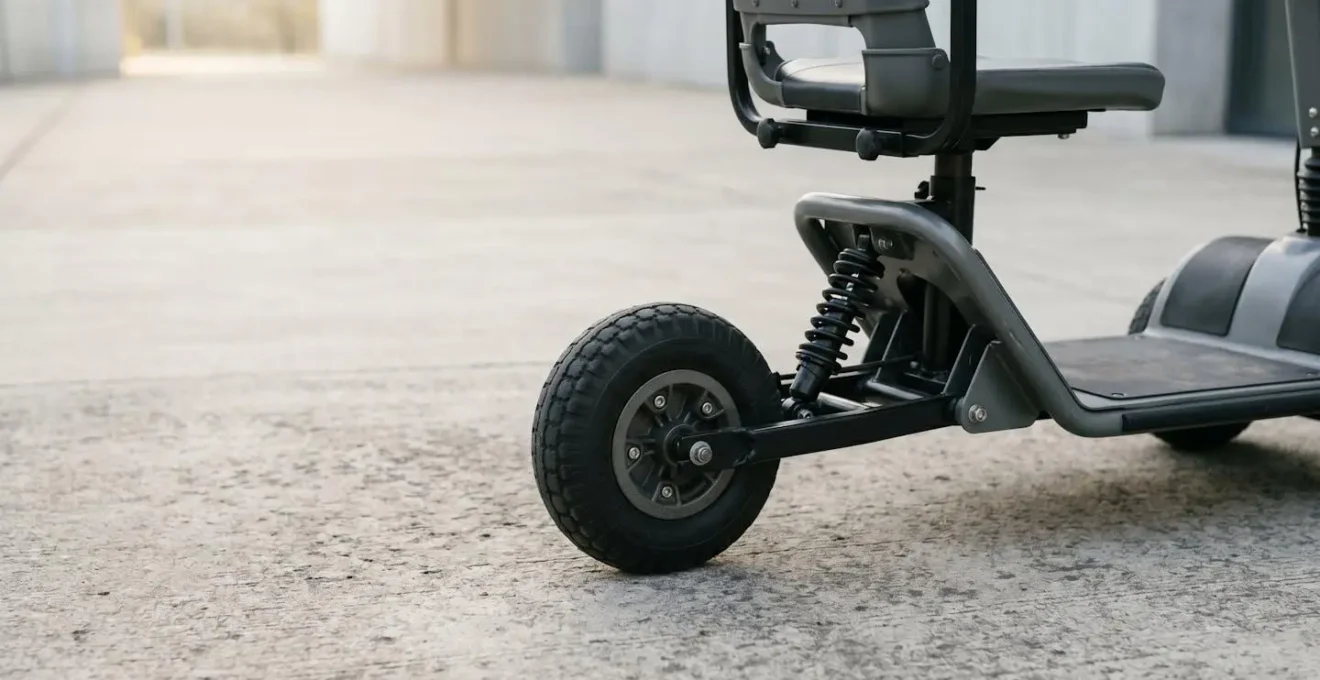
However, suspension is only half of the equation. The seat itself is the final interface. A well-designed seat with high-density foam or gel inserts provides a secondary layer of vibration damping. It works in concert with the suspension to provide comprehensive spinal protection. Thinking of your scooter’s seat and suspension as mere comfort features is a mistake. They are active, essential components of your long-term health strategy, working to shield your spine from the thousands of micro-shocks it endures on every ride.
Your mobility should never come at the expense of your long-term health. By viewing your scooter setup through this clinical lens—as a system that must be tuned to your unique biomechanics—you can mitigate these risks. Take a critical, informed look at your scooter and your posture today. The first step is a conscious assessment; begin now to protect your spine for the years to come.