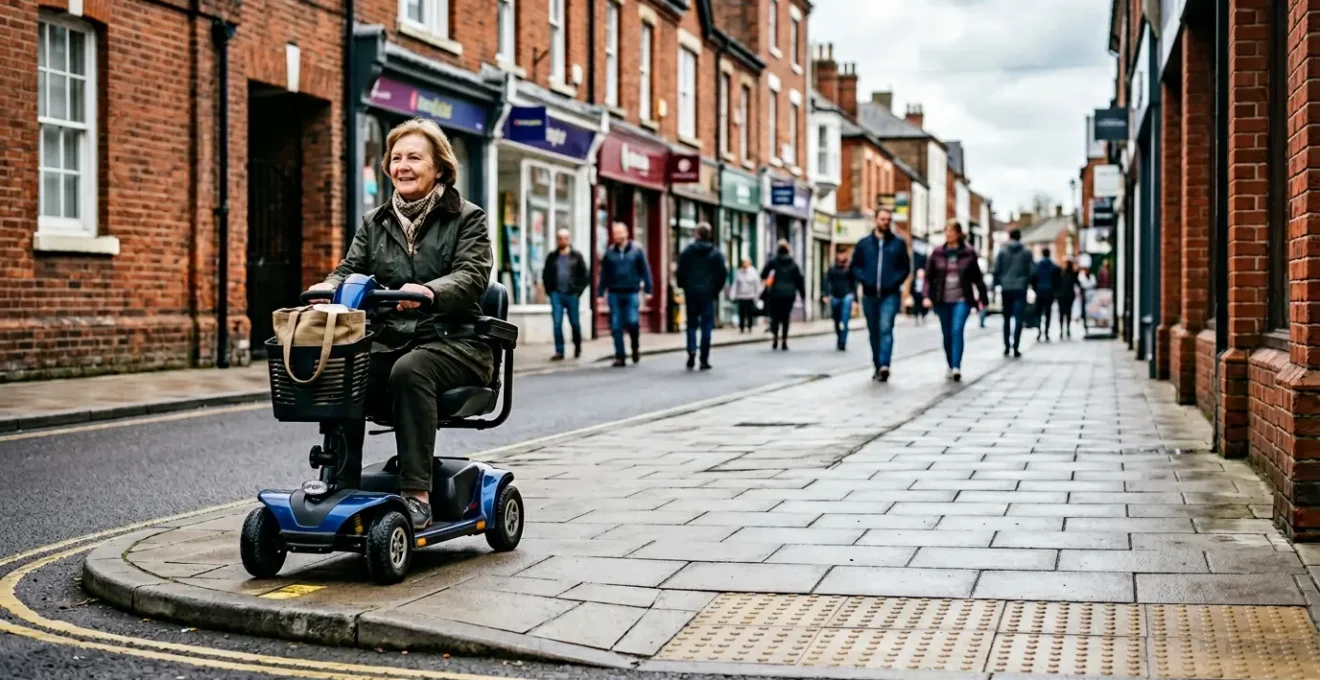
Maintaining independence with a mobility scooter isn’t just about having the right machine; it’s about mastering the logistics of daily life. This guide moves beyond basic advice to focus on the practical micro-decisions that make a real difference, from safely carrying your weekly shop to knowing your legal rights when entering a store. It provides the foresight and strategies needed to turn your scooter into a seamless tool for everyday freedom.
For the estimated 300,000–350,000 mobility scooter users in the UK, a scooter is more than a vehicle; it’s a lifeline to independence. It represents the ability to manage daily tasks like grocery shopping, attending GP appointments, and meeting friends without relying on others. However, true independence isn’t unlocked the moment you turn the key. It’s built through mastering a series of small, logistical challenges that are rarely discussed.
Many guides focus on choosing a scooter, but they often stop there. The real-world usability depends on navigating a world not always designed for accessibility. You might wonder about the practicalities: how do you manage a heavy shopping load without tipping? What protection actually works in a sudden downpour? Can you confidently take your scooter on a bus or train? These are not minor details; they are the very fabric of an active and self-reliant life.
This is where we shift the focus. Instead of general advice, we will concentrate on the practical, logistical ‘micro-decisions’. The secret to seamless daily routines lies not in grand plans, but in foresight and specific knowledge. It’s about understanding weight distribution, pre-emptively scouting routes with digital tools, and knowing precisely what to say if your access is questioned. This is the difference between simply owning a scooter and truly living with one.
This article is structured to walk you through these real-world scenarios. We’ll break down the common hurdles into manageable strategies, giving you the confidence to plan your day, your week, and your life with the freedom you deserve. From your local high street to public transport, we’ll equip you with the logistical toolkit for genuine independence.
Summary: Mastering Your Daily Routines with a Scooter
- Basket or Backpack: How to Carry a Weekly Shop Without Destabilizing the Scooter?
- Rain Capes vs Canopies: What Really Works in a British Downpour?
- Bus or Train: Which Public Transport Policy Is More Scooter-Friendly in the UK?
- The Error of Assuming All GP Surgeries Are Fully Accessible
- High Street Chains vs Independents: Where Can You Actually Park Inside?
- Hatchback or Saloon: Will It Fit Without Folding the Back Seats?
- Can a Shopkeeper Legally Refuse Entry to Your Scooter?
- How to Plan Accessible Routes That Avoid Steps and Steep Hills?
Basket or Backpack: How to Carry a Weekly Shop Without Destabilizing the Scooter?
One of the first tests of independence is the weekly shop. A front basket seems like the obvious solution, but loading it with heavy items like milk cartons or tinned goods can be a critical error. It raises the scooter’s centre of gravity and places excessive weight over the steering column, making the vehicle dangerously unstable, especially when turning or navigating uneven pavements. The key to safe carrying capacity is understanding dynamic stability.
The goal is to keep weight as low and as central as possible. Under-seat storage should always be your first choice for heavy items. For larger shops, a rear-mounted bag or panniers are far superior to a front basket or hanging bags from the handlebars. A backpack worn by the user is a viable option, but it must not be so heavy that it affects your posture or balance when leaning into a turn. Think like a logistics expert: the heaviest items go to the base, and the weight is distributed evenly from left to right.
Overloading the very back of the scooter, for instance by hanging multiple bags off the rear of the seat, also carries risks. This can make the front wheels light, increasing the chance of them lifting off the ground during acceleration or when going up an incline, which leads to a complete loss of steering. A balanced, stability-first loading strategy is a non-negotiable skill for safe and independent shopping trips.
Here is a simple strategy to follow:
- Step 1: Prioritize under-seat storage compartments or rear-mounted bags over front baskets to maintain a low center of gravity.
- Step 2: Distribute weight evenly between the left and right sides to prevent lateral tipping when turning.
- Step 3: Place heavier items (canned goods, liquids) closest to the scooter’s base and central point.
- Step 4: Avoid placing excessive weight at the back of the seat, as this increases the risk of the front wheels lifting during acceleration or on inclines.
- Step 5: Consider side-mounted panniers for perfect lateral balance on larger shopping trips.
Rain Capes vs Canopies: What Really Works in a British Downpour?
The unpredictable British weather is a significant hurdle for scooter users. Getting caught in a sudden downpour is not just uncomfortable; it can damage your scooter’s electronics and compromise your safety. The two main solutions, rain capes and rigid canopies, present a classic trade-off between total protection and practical usability. Choosing the right one depends on understanding their inherent strengths and weaknesses, especially concerning wind.
A rigid canopy offers the most comprehensive protection from rain, creating a dry cabin for the user. However, its major flaw is wind resistance. In anything more than a light breeze, a canopy acts like a sail, significantly impacting the scooter’s stability and making it difficult to control, particularly in crosswinds. They can also suffer from condensation on the inside, fogging up the screen and reducing forward visibility, which is a serious safety concern.
A scooter cape, a large waterproof garment that covers you and the scooter’s tiller, is a more flexible solution. It offers good protection from intermittent showers and is highly portable. Its main drawback is that it can flap in the wind, and poorly designed capes may obscure your lights and indicators. The most effective solution for all-weather UK conditions is often a layered and modular system: high-quality personal waterproofs, a well-designed scooter cape with clear panels for controls and lights, and waterproof covers for your basket or rear bag. This approach provides adaptable protection without compromising the scooter’s stability.
This table breaks down the key considerations:
| Protection Type | Water Resistance | Wind Resistance Issues | Visibility Concerns | Storage/Portability | Best Use Case |
|---|---|---|---|---|---|
| Rigid Canopy | Excellent (full overhead cover) | High wind resistance; acts as sail in crosswinds; affects stability | Condensation/fogging reduces forward vision | Permanent fixture; not portable | Predictable light rain; sheltered routes |
| Rain Cape | Good (covers user and controls) | Flapping in wind but less structural resistance | May obscure lights/indicators; requires transparent panels | Highly portable; folds for storage | Intermittent showers; variable weather |
| Layered System (cape + waterproofs + covers) | Superior (multi-layer protection) | Moderate; flexible materials adapt to wind | Optimized with high-vis strips and clear panels | Modular; components stored separately | All-weather UK conditions; long journeys |
Bus or Train: Which Public Transport Policy Is More Scooter-Friendly in the UK?
Integrating your scooter with public transport exponentially increases your range and freedom. However, the accessibility policies of bus and train operators in the UK are distinct and require different approaches. Success depends on knowing the rules of the specific service you intend to use before you travel.
For bus travel, the landscape is relatively standardized. Thanks to the Public Service Vehicle Accessibility Regulations 2000 (PSVAR), all single-decker buses have been required to be accessible since 2016, and all double-deckers since 2017. In practice, this means they must have a designated space for a wheelchair user, which a Class 2 mobility scooter can use if it fits and is not occupied. However, the final decision rests with the driver, who must consider the safety and space available. It’s a common policy for only one wheelchair or approved scooter to be allowed on board at a time.
Train travel presents a more complex picture. Accessibility varies significantly between different train operating companies, the age of the rolling stock, and the specific station. To address this, National Rail has introduced a mobility scooter permit scheme. This initiative, trialled and then expanded between 2020 and 2024, standardises access on many routes. Users apply for a permit for their specific scooter model. If approved, they receive a sticker for their scooter, which confirms to staff that the device has been assessed and is safe for travel on that network’s trains. The scheme typically accommodates scooters up to 1200mm in length and 700mm in width, but it’s not universal. Proactive research is essential: always check the specific policy of the train operating company you’ll be using.
The Error of Assuming All GP Surgeries Are Fully Accessible
Attending a GP appointment is a non-negotiable part of life, and it’s a journey where accessibility should be a given. However, it’s a critical error to assume that every surgery, especially those in older or converted buildings, is fully accessible for a mobility scooter. While they must make ‘reasonable adjustments’, the reality on the ground can involve narrow doorways, a single step at the entrance, or internal corridors too tight to navigate.
Arriving for an appointment only to find you cannot get inside is frustrating and disempowering. This is where the concept of ‘digital reconnaissance’ becomes an essential skill for independent living. Before you ever leave the house, you can use freely available online tools to scout your destination and identify potential barriers. This proactive check transforms an unknown journey into a predictable one.
Start with Google Maps Street View. Take a virtual trip to the surgery’s front door. Look for steps, narrow gates, or the presence of a dropped kerb. Switch to Satellite View to assess the surrounding area for potential parking and the quality of the pavement. This simple, two-minute check can save you from a wasted journey. If the digital scout reveals potential issues, the next step is a quick phone call. Don’t just ask « Are you accessible? »; ask specific, logistical questions: « What is the width of your main entrance door? » or « Is there a patient toilet on the ground floor that a scooter can access? »

This proactive approach puts you in control. It allows you to anticipate problems and find solutions, such as identifying an alternative accessible entrance or arranging for a staff member to meet you. It’s a powerful strategy for ensuring critical appointments are never missed due to unforeseen physical barriers.
Your Pre-Appointment Digital Reconnaissance Checklist
- Use Google Maps Street View to virtually scout the surgery entrance for visible steps, narrow gates, or a level threshold.
- Switch to Satellite View to identify the presence of dropped kerbs on approaches and potential parking spots near the entrance.
- Call the surgery reception to inquire about internal accessibility: corridor width, consultation room turning space, and accessible toilet location.
- Ask whether accessible facilities are on the ground floor or if a lift is required and functional.
- Document your findings and share them with local access forums or disability organisations to build community knowledge.
High Street Chains vs Independents: Where Can You Actually Park Inside?
When it comes to shopping, not all stores are created equal. The ability to enter and navigate a shop is a fundamental part of the daily routine. Generally, large high street chains and supermarkets offer a more reliable level of accessibility than smaller, independent shops, primarily due to the scale of their premises and standardized store-fitting policies.
Most large UK supermarkets accommodate mobility scooters thanks to spacious aisles designed for shopping trolleys, level entrances, and accessible checkouts. Chains like Sainsbury’s, Tesco, and Asda are typically easy to navigate with a Class 2 pavement scooter. Some even provide their own in-store mobility aids, though availability can be limited. In contrast, discount supermarkets such as Aldi and Lidl, while still allowing scooter entry, often have a more compact layout with narrower aisles, requiring greater caution and manoeuvring skill.
Independent shops, particularly those on traditional high streets or in older buildings, present the biggest challenge. They may have a stepped entrance, narrow doorways, or an internal layout packed with displays that make it impossible for a scooter to pass through. This is not necessarily a reflection of unwillingness, but often a result of architectural constraints. In these situations, the ‘park and walk’ approach might be necessary, where you leave your scooter securely outside. However, this is not always a safe or practical option. The key is to manage expectations and plan accordingly. If you need to visit a specific independent shop, a quick phone call ahead of time to ask about access can save a lot of time and frustration.
This table offers a general guide to what you can expect from major UK supermarkets:
| Supermarket Chain | Typical Aisle Width | Scooter Access Policy | In-Store Mobility Aid Provision | Accessibility Features |
|---|---|---|---|---|
| Sainsbury’s | Wide (suitable for browsing) | Scooters allowed; Class 2 recommended | Free wheelchairs and mobility scooters (first-come, first-served) | Spacious layout; accessible checkouts |
| Tesco | Wide (suitable for browsing) | Scooters allowed | Varies by location | Large stores typically accessible |
| Asda | Wide (suitable for browsing) | Scooters allowed | Varies by location | Wide aisles in larger format stores |
| Morrisons | Wide (suitable for browsing) | Scooters allowed | Varies by location | Generally accessible layouts |
| Aldi | Moderate (may require caution) | Scooters allowed but tighter navigation | Limited; scooter may need to stay at entrance | Compact store format; narrower aisles |
| Lidl | Moderate (may require caution) | Scooters allowed but tighter navigation | Limited; scooter may need to stay at entrance | Compact store format; narrower aisles |
Hatchback or Saloon: Will It Fit Without Folding the Back Seats?
For those wishing to transport their scooter by car, the question of « will it fit? » is paramount. This decision heavily influences both the type of car and the type of scooter you can use. The most common mistake is assuming that a car’s boot capacity, listed in litres, is the deciding factor. In reality, the boot aperture—the size and shape of the opening—is the true limiting factor.
This is where hatchbacks hold a significant advantage over saloons (sedans). A hatchback’s boot opening is typically much taller and wider, providing a squarer aperture that makes it far easier to load a bulky item like a folded or dismantled scooter. A saloon’s boot opening is often a narrow letterbox shape, which can make it impossible to get the scooter inside, even if the internal boot space is technically large enough.
Before purchasing a car or a scooter, taking critical measurements is non-negotiable. Measure the scooter’s dimensions when folded or broken down into its heaviest/largest part. Then, measure the car’s boot, paying close attention to three things: the height of the boot lip from the ground (a high lip makes lifting much harder), the width and height of the aperture at its narrowest point, and the internal depth. A practical loading technique is the ‘pivot and slide’: approach the boot at an angle, lift the front of the scooter onto the lip, and then pivot it around the boot corner as a fulcrum before sliding it in. For many, a scooter specifically designed for car boot transport, which disassembles into several lightweight pieces (each under 15kg), is the most practical solution.
- Measure the boot lip height from the ground; lower is better.
- Measure the boot aperture (opening) at its narrowest points.
- Compare the scooter’s folded/dismantled dimensions to the aperture, not just the internal volume.
- Practice the ‘pivot and slide’ loading technique to minimise strain.
- For heavier scooters, research vehicle-mounted hoists or portable ramps.
- Consider scooters designed for tool-free disassembly into manageable parts.
Key Takeaways
- Mastering scooter logistics, not just ownership, is the key to true independence.
- Proactive « digital reconnaissance » of routes and destinations prevents access issues before they happen.
- Understanding the legal framework of ‘reasonable adjustments’ empowers you to confidently assert your right to access.
Can a Shopkeeper Legally Refuse Entry to Your Scooter?
Few things are more disheartening than being denied entry to a shop because you are on your mobility scooter. It’s crucial to understand that in most cases, this is not legal. Your right to access is protected by law, and knowing this is the first step to confidently navigating these situations.
The relevant legislation is the Equality Act 2010. Under this Act, service providers—which includes shops, cafes, banks, and other businesses—have a legal duty to make ‘reasonable adjustments’ to ensure that disabled people are not at a disadvantage. For a user of a Class 2 pavement scooter, the scooter is considered a mobility aid, akin to a wheelchair. The most ‘reasonable’ adjustment is simply to allow you and your scooter entry, provided it is physically possible and does not pose a genuine, demonstrable health and safety risk.
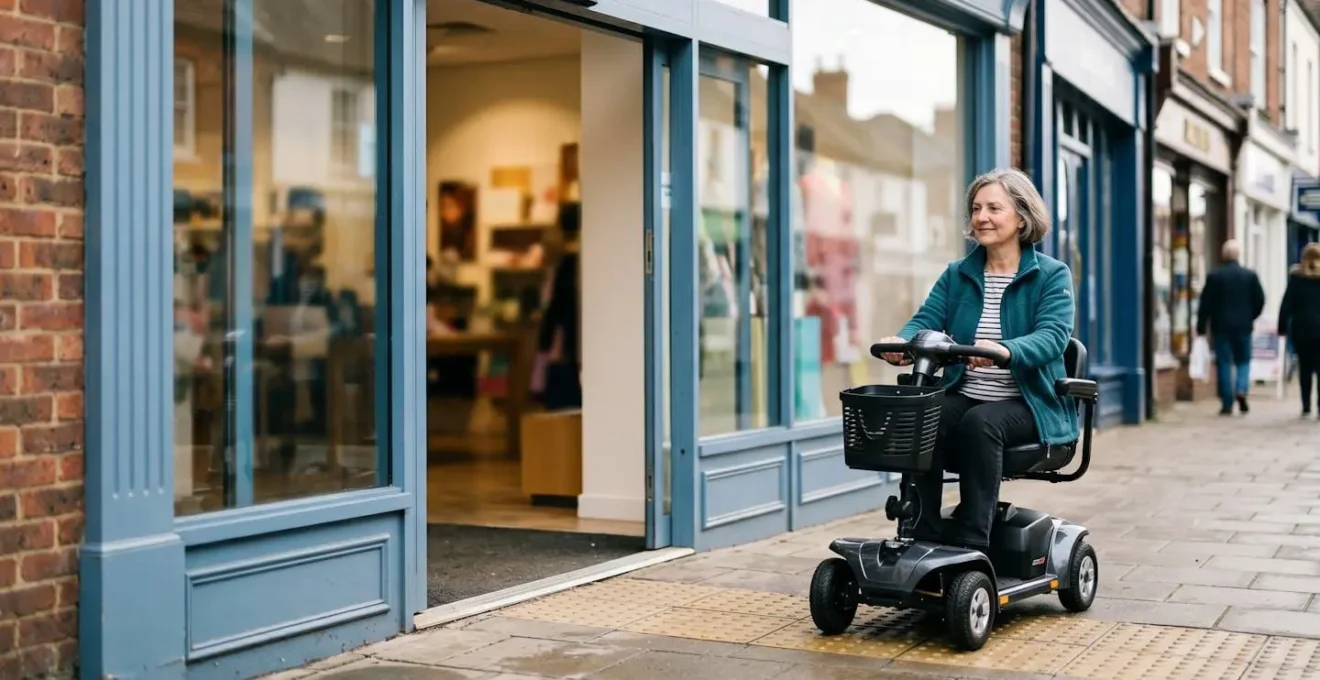
A shopkeeper cannot legally refuse entry based on convenience, aesthetic preference (« it doesn’t look good »), or vague, unfounded safety fears. Refusal is only justifiable if, for example, the aisles are so narrow that the scooter genuinely cannot pass without knocking over stock, or if it physically blocks a fire exit. It’s about physical impossibility, not inconvenience. If you are challenged, staying calm and informed is your greatest asset. A simple, polite de-escalation script can be incredibly effective:
- Acknowledge and Validate: Start by saying something like, « I understand you may have concerns about space, and I appreciate you want to keep the shop safe for everyone. »
- State Your Position: Calmly explain, « This is a Class 2 mobility scooter, which is legally considered a mobility aid, just like a wheelchair. It’s essential for my independence. »
- Gently Invoke the Law: Conclude with, « My understanding of the Equality Act 2010 is that shops are required to make reasonable adjustments to allow access. Could we see if there’s a safe way for me to come in? »
This three-step approach turns a potential confrontation into a collaborative conversation, often resolving the issue immediately.
How to Plan Accessible Routes That Avoid Steps and Steep Hills?
The ultimate skill in scooter-based independence is mastering route planning. A journey is only as good as its most inaccessible point. A single step, a steep hill that drains your battery, or a path blocked by bollards can stop a trip in its tracks. While standard mapping apps like Google Maps are useful, they are not designed with the specific needs of a mobility scooter user in mind. Therefore, you need to use them strategically and supplement them with specialist tools.
Advanced use of Google Maps can reveal a lot. The ‘Street View’ feature is your most powerful tool for digital reconnaissance, allowing you to virtually travel a route to spot dropped kerbs, pavement quality, and potential obstructions. Activating the ‘Terrain’ or ‘Cycling’ layer can help identify steep gradients that the standard map view hides—critical for battery management and safety. However, these tools are reactive. A more proactive approach involves using dedicated accessibility apps.
In the UK, an excellent example is Mobility Mapper. This free app is specifically designed for users of wheeled mobility devices. It generates routes that actively avoid barriers like steps, steep hills, high curbs, and narrow paths. Its power lies in its specificity and its community-driven data; users can report new barriers or accessible features, creating an ever-evolving map of real-world accessibility. By combining the broad overview of Google Maps with the specialised detail of an app like Mobility Mapper, you create a comprehensive and reliable route plan.
This two-tiered planning process is the pinnacle of logistical mastery. It involves:
- Using Google Maps Street View and Terrain layer for initial scouting.
- Cross-referencing with a dedicated accessibility app like Mobility Mapper or AccessAble for barrier-free routing and venue details.
- Calculating a ‘safe return radius’ based on your scooter’s battery, the terrain, and a safety margin.
By adopting this methodology, you move from simply hoping a route is accessible to knowing it is. You are no longer just a traveller; you are the architect of your own journey.
Now that you are equipped with the strategies to navigate the outside world, from shopping and appointments to public transport, you have built a foundation of logistical knowledge. This is the core of true independence: the ability to plan, anticipate, and solve challenges before they arise. By continuing to apply this access-first mindset, you transform your mobility scooter from a simple aid into a passport to a full and active life in your community.