In summary:
- High ground clearance alone is misleading; the ‘breakover angle’—determined by clearance and wheelbase—is the true measure of a scooter’s ability to clear obstacles.
- Bottoming out isn’t just an annoyance; it can lead to costly damage to the battery and motor, with repairs potentially exceeding $500.
- There’s a trade-off: higher clearance raises the center of gravity, increasing tipping risk on corners, which must be managed with proper riding technique.
- Proactive ‘virtual reconnaissance’ with tools like Street View and active ‘rider-as-suspension’ techniques are essential for safe navigation in complex environments.
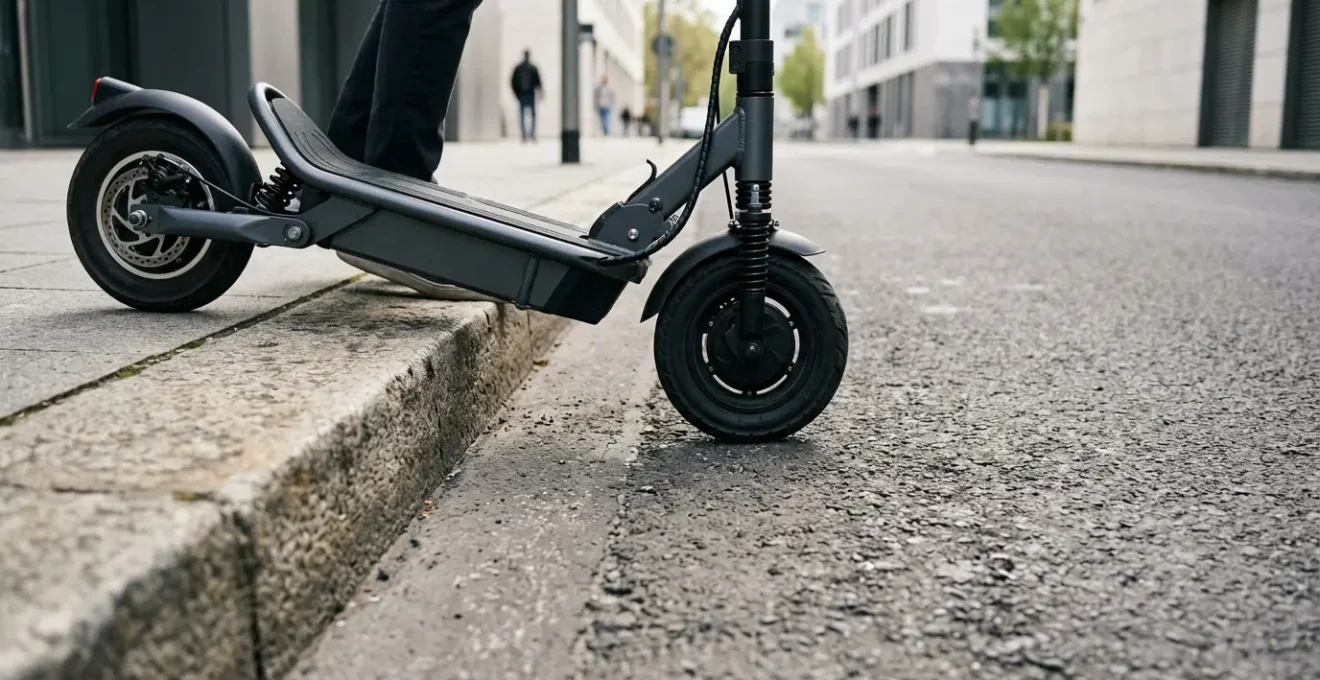
There’s a unique, gut-wrenching sound every scooter rider dreads: the harsh scrape of the undercarriage against unforgiving concrete. It’s the sound of being high-centered on a dropped kerb that wasn’t quite dropped enough, or a threshold that proved to be a bigger challenge than anticipated. For anyone navigating areas with aging infrastructure or venturing off perfectly paved paths, this isn’t a rare occurrence; it’s a constant, background anxiety. The common advice is simple and predictable: get a scooter with high ground clearance. People talk about bigger wheels or ‘all-terrain’ models as the only solution.
This advice, while not wrong, barely scratches the surface. It treats the scooter as a static object and the rider as a passive passenger. But what if the key wasn’t just in the machine’s specifications, but in the rider’s understanding of the hidden physics at play? What if mastering obstacle navigation was less about the number on a spec sheet and more about becoming a street-smart navigator who understands the delicate balance between clearance, stability, and technique? The real secret to gliding over urban imperfections lies in seeing the geometry of the challenge, anticipating the risks, and using your body as an active part of the solution.
This guide will deconstruct the dynamics of ground clearance. We will explore why deck height can be a deceptive metric, analyze the true costs of bottoming out, and dissect the trade-offs between clearance and stability. By the end, you’ll have a new framework for both choosing a vehicle and, more importantly, riding it with confidence over any terrain.
Summary: A Street-Smart Guide to Clearing Urban Obstacles
- Ground Clearance vs Deck Height: Don’t Be Fooled by the Specs
- The Cost of Bottoming Out: How to Protect Your Motor and Battery Case?
- The Tipping Risk: Does High Clearance Make You Less Stable on Corners?
- Why High Clearance Helps You Tackle Steeper Ramp Gradients?
- Grass and Tree Roots: When High Clearance Becomes Essential in the Park?
- Kerb Climbing: How Repeated Impacts Weaken the Front Fork?
- Virtual Walkthrough: Using Street View to Check Kerb Drops Before You Go
- How to Navigate Uneven Outdoor Terrain Safely Without Tipping Over?
Ground Clearance vs Deck Height: Don’t Be Fooled by the Specs
When you’re scanning a scooter’s spec sheet, « ground clearance » seems like a straightforward number. It’s the space between the lowest point of your scooter’s undercarriage and the ground. While typical mobility scooters offer a range of 2 to 5 inches (about 5 to 13 centimeters), this single figure can be dangerously deceptive. The critical mistake is confusing ground clearance with deck height. You might be standing on a deck that feels high, but the lowest point—often the motor housing or battery case—could be perilously close to the ground.
Manufacturers can add to the confusion. As Heavy Duty Mobility experts point out, some brands create ambiguity by listing multiple measurements. This highlights a crucial point for any street-smart navigator: you must know exactly what part of the scooter that clearance number refers to. Is it the chassis frame or a vulnerable component hanging below it?
Beware of misleading ground clearance measurements. Some brands like Pride Mobility can make things confusing by providing two measurements – one for just the motor and another for everything else beneath the scooter.
– Heavy Duty Mobility experts, Mobility Scooter High Ground Clearance Guide
The truly important metric is the breakover angle. This is the geometric relationship between your wheelbase (the distance between your front and rear wheels) and your ground clearance. A short wheelbase with high clearance creates a superior breakover angle, allowing you to clear sharp peaks like kerbs and steep ramps without getting stuck. A long wheelbase, even with decent clearance, is far more likely to get high-centered. This angle, not just the clearance height, is the true indicator of your scooter’s obstacle-clearing capability.

As the diagram shows, a scooter’s ability to pass over a peak is not just a vertical measurement. It is a function of geometry. Focusing only on the clearance figure on a spec sheet is like trying to understand a story by reading a single word. You miss the entire context of how the machine will perform in the real world of imperfect surfaces.
The Cost of Bottoming Out: How to Protect Your Motor and Battery Case?
That scraping sound is more than just an annoyance; it’s the sound of your wallet getting lighter. Bottoming out, or striking the undercarriage on an obstacle, can inflict serious and costly damage on the most critical components of your scooter: the motor and the battery. These parts are often the lowest-hanging fruit for a poorly designed kerb or an unseen pothole. The financial consequences can be significant, with minor repairs like tire patches costing around $15 while battery replacements can exceed $500. A single hard impact can crack a battery case, leading to internal damage or, in the worst-case scenario, complete failure.
Protecting these components starts with situational awareness, but it’s equally important to know what to do after an impact has occurred. A hard knock might not show immediate effects, but it can create stress fractures or dislodge connections that lead to failure down the road. Performing a post-impact inspection is not paranoia; it’s essential maintenance. You need to become a detective, looking for subtle clues that indicate a bigger problem is brewing under the deck.
Are there new rattles or grinding noises? Does the scooter pull to one side? Is the battery case showing any signs of bulging or leaking? These are not issues to ignore. An early inspection can be the difference between a minor adjustment and a catastrophic component failure. The battery is the heart of your scooter, and the motor is its muscle. Leaving their health to chance after a known impact is a risk no rider should take. Protection isn’t just about avoiding the hit; it’s about diligent follow-up when a hit is unavoidable.
The Tipping Risk: Does High Clearance Make You Less Stable on Corners?
In the quest for maximum ground clearance, it’s easy to overlook a fundamental law of physics: for every action, there is an equal and opposite reaction. Raising a scooter’s chassis to clear obstacles also raises its center of gravity (CoG). This single change has a profound impact on stability, particularly during cornering. A higher CoG means the scooter is inherently more susceptible to tipping over when subjected to lateral forces, like those experienced in a sharp turn.
This isn’t just theory; it’s a tangible risk. As vehicle dynamics experts confirm, a higher CoG directly increases the likelihood of a rollover. When you turn, centrifugal force pushes your scooter and your body outwards, away from the corner. A low CoG helps anchor the vehicle to the ground, resisting this force. A high CoG, however, gives that force more leverage, making it easier for the scooter to become unstable and tip.
A higher center of gravity increases the likelihood of rollover, especially during sharp turns or sudden maneuvers. When a vehicle corners, it experiences a centrifugal force that pushes it away from the turn’s center.
– Number Analytics research team, The Role of Center of Gravity in Vehicle Stability
So, are high-clearance scooters a dangerous trap? Not if you understand how to manage this risk. The solution lies in realizing that the scooter’s CoG is only half the equation. The rider’s body position creates a combined center of gravity. Research from motorcycle cornering provides a powerful lesson: by shifting your body weight, you can actively manage the system’s stability. Leaning your body into the turn lowers the combined CoG, counteracting the tipping force. This technique allows the scooter to remain more upright while still navigating the corner effectively. You transition from being a static passenger to an active participant in maintaining balance.
Why High Clearance Helps You Tackle Steeper Ramp Gradients?
Navigating a steep ramp, whether it’s a driveway, a loading ramp, or an accessibility ramp, presents a unique geometric challenge. It’s not about the approach or departure, but the transition at the very top. This is where a scooter is most vulnerable to getting high-centered, and it’s where the concept of the breakover angle becomes paramount. As we’ve established, this angle is the key to understanding obstacle clearance, and it’s directly tied to both ground clearance and wheelbase.
The relationship is elegantly described by a mathematical formula. The breakover angle is calculated using the mathematical formula 2 × arctan(2 × ground clearance / wheelbase). You don’t need to be a mathematician to grasp the core principle: to get a bigger, better angle, you need to either increase the ground clearance or decrease the wheelbase. A high breakover angle means you can conquer a sharper peak without the undercarriage making contact. This is precisely why off-road vehicles are designed with very short front and rear overhangs and maximum clearance.
This principle applies directly to scooters. As automotive experts at Cars.com note, the ideal setup for a sharp breakover angle is a short wheelbase combined with high center ground clearance. When the wheels are closer together, the scooter can pivot over a much sharper crest. This is what allows a high-clearance model to ascend a steep ramp, transition smoothly at the top, and descend without that dreaded scraping sound. It has less to do with engine power and everything to do with the fundamental geometry of the vehicle’s design. It’s the reason two scooters with the same advertised « ground clearance » can have wildly different abilities when faced with the exact same ramp.
Grass and Tree Roots: When High Clearance Becomes Essential in the Park?
The urban environment isn’t just concrete and asphalt. Parks, green spaces, and even poorly maintained verges introduce a different kind of obstacle: uneven, unpredictable terrain. While a dropped kerb is a singular challenge, a grassy field or a path riddled with tree roots is a continuous series of them. On these surfaces, high ground clearance transitions from a « nice-to-have » for specific obstacles to an absolute necessity for continuous travel.
On soft ground like grass or dirt, a scooter’s wheels can sink slightly, effectively reducing your functional ground clearance. A low-slung model that just barely clears a paved path can quickly find itself bogged down or snagged on a hidden root or rock. As the experts at Heavy Duty Mobility explain, « all sorts of obstacles like rocks, tree roots, and uneven terrain can stop the scooter in its tracks. » High clearance provides the buffer needed to glide over these minor imperfections without losing momentum or risking damage.
Case Study: Navigating Manchester’s Cobblestones
A real-world example from Manchester, UK, powerfully illustrates this principle. A mobility scooter user with a model featuring 3.5 inches (9cm) of clearance successfully navigates the city’s historic cobblestone streets for their daily errands. While not roots, the constantly uneven and jarring surface of the cobbles presents a similar challenge. The user’s initial concern was alleviated when they discovered that their scooter’s specific clearance was perfectly suited to the environment, allowing them to travel without difficulty or worry. This case highlights how matching your scooter’s clearance to the most common environmental challenge—not just the worst-case one—is key to enabling safe and reliable daily mobility.
Whether it’s the ancient cobblestones of a historic city or the sprawling root system of an old oak tree in a park, the principle remains the same. Sufficient ground clearance provides a crucial margin of error. It allows the suspension and wheels to do their job of absorbing bumps without the risk of a hard stop from the chassis hitting the ground. It’s what makes the difference between a pleasant trip through the park and a frustrating journey spent trying to un-stick your vehicle.
Kerb Climbing: How Repeated Impacts Weaken the Front Fork?
Sometimes, an obstacle is too high to roll over smoothly. Riders often resort to « bumping » up a kerb—a maneuver that sends a sharp, jarring impact directly through the front wheel and into the scooter’s frame. While a single, gentle bump might seem harmless, the cumulative effect of these repeated impacts can lead to a serious and often invisible problem: structural fatigue. The front fork and the headset (the bearings that allow the handlebars to turn) bear the brunt of this force.
Every impact, no matter how small, sends a shockwave through the metal. Over time, these repeated stresses can cause microscopic cracks to form, especially around welded joints. These tiny cracks can grow with each subsequent impact until they compromise the structural integrity of the fork. This isn’t a sudden failure but a slow, gradual weakening. The danger is that it often goes unnoticed until it’s too late. The first sign of a problem might be a strange creaking noise, a « notchy » feeling in the steering, or the scooter starting to pull to one side.
Ignoring these warning signs is a grave mistake. They are the scooter’s way of telling you that critical components are under stress. A fatigued fork or headset can lead to poor handling, unpredictable steering, and in the worst-case scenario, a complete structural failure while riding. Being a street-smart rider means listening to your machine. Regular checks for the warning signs of fatigue are just as important as checking your tire pressure.
Here are key warning signs to watch for:
- Notchy Steering: A feeling of resistance or catching when you turn the handlebars.
- Creaking Noises: Audible stress sounds, especially when turning or applying the brakes.
- Visible Stress Marks: Hairline cracks, discoloration, or paint flaking near the fork’s welds.
- Poor Handling: The scooter consistently pulling to one side or feeling unstable in a straight line.
Virtual Walkthrough: Using Street View to Check Kerb Drops Before You Go
The ultimate street-smart tactic is to win the battle before it even begins. Why rely on luck when you can use technology to perform virtual reconnaissance of your route? Tools like Google Street View are not just for sightseeing; they are powerful planning instruments for any scooter rider. Before you even leave the house, you can take a virtual trip down your intended path to identify potential hazards like high kerbs, broken pavement, or poorly designed ramps.
This proactive approach transforms you from a reactive rider into a strategic navigator. You can spot a problem intersection from the comfort of your chair and plan an alternate, smoother route. It allows you to assess the *type* of kerb drop you’ll encounter. Is it a gentle, ramped transition or a sharp, 90-degree edge that will require you to stop and lift the front wheel? You can also look for secondary obstacles, like a storm drain inconveniently placed right at the bottom of a ramp, which could catch a wheel and cause a sudden stop.
By using reference objects in the images—like the height of a car’s tire or the size of a standard brick—you can even get a rough estimate of a kerb’s height. This level of pre-planning can be the difference between a smooth, stress-free journey and one fraught with unexpected challenges and potential damage to your scooter. It’s about taking control and minimizing surprises.
Your Action Plan: Street View Obstacle Pre-Assessment
- Identify Kerb Drop Type: Examine if the transition is a smooth ramp or a sharp right-angle edge, as each requires a different approach.
- Check for Drainage Obstacles: Look for storm drains, manholes, or grates positioned at the kerb drop that could catch a wheel.
- Assess Pavement Condition: Identify potholes, cracks, or degraded surfaces near the drop that could complicate your maneuver.
- Use Historical Imagery: Toggle between different date captures in Street View to see if a problem area is a recent issue or a chronic piece of neglected infrastructure.
- Estimate Dimensions: Use reference objects like parked cars (a standard wheel is about 16 inches) or bricks to roughly gauge the height of kerbs.
Key takeaways
- True obstacle clearance is defined by the ‘breakover angle’ (clearance + wheelbase), not just the ground clearance number on a spec sheet.
- High clearance introduces a stability trade-off by raising the center of gravity, which must be managed by the rider through active body positioning.
- The best strategy is a combination of proactive planning (using tools like Street View for ‘virtual reconnaissance’) and reactive skill (using your body as active suspension).
How to Navigate Uneven Outdoor Terrain Safely Without Tipping Over?
You’ve chosen the right scooter, planned your route, and understand the physics. But when you’re actually riding over that bumpy path or uneven lawn, the final piece of the puzzle is you. The most sophisticated scooter is still a rigid machine; the rider is the adaptive component. To navigate challenging terrain safely, you must adopt an active riding style and think of yourself as part of the scooter’s suspension system. As the experts at GYROOR note, « When you stand on a scooter, your body and the scooter form a system that must stay aligned over the wheels. »
This « Rider-as-Suspension » stance is key. Instead of standing stiffly, keep your knees and elbows slightly bent. This allows your body to absorb the shocks from bumps and dips, insulating the scooter’s main frame from the full force of the impact. Your legs become the primary shock absorbers, keeping the combined center of gravity stable and the wheels in contact with the ground. It’s the difference between being a sack of potatoes jostled around on top of the machine and being a skilled pilot in full control.
This active approach also involves strategic thinking borrowed from motorsports. Practice ‘Line Choice’ by looking 10-15 meters ahead, constantly reading the terrain to identify the smoothest path. Master ‘Momentum Management’ by maintaining a steady, controlled speed—fast enough to glide over small imperfections but slow enough to react to sudden changes. By engaging your core for stability and actively shifting your weight in turns, you are no longer at the mercy of the terrain. You are dynamically interacting with it, making constant, small adjustments to maintain balance and control. This is the pinnacle of street-smart riding: a partnership between rider and machine, working together to conquer any obstacle.
To truly own the urban landscape, start by combining pre-ride virtual reconnaissance with these active, on-the-go riding skills. This dual approach will transform your ability to handle any obstacle with confidence and control.