The persistent ache in your arms and shoulders after a scooter ride is not a sign of weakness, but a signal of poor biomechanics that can be corrected with simple ergonomic adjustments.
- Minor changes, like mirror positioning and lever choice, significantly reduce the static load on muscles and nerves.
- Understanding your scooter’s controls as an interface with your body allows you to optimize for energy conservation, not just comfort.
Recommendation: Instead of enduring the pain, perform a 5-point ergonomic self-audit of your scooter setup to identify and eliminate the root causes of your fatigue.
That familiar, nagging ache that settles into your shoulders, the tingling that starts in your fingers after just 30 minutes of riding—these are signals from your body. For many scooter users, this upper limb fatigue is accepted as an unavoidable part of the journey. As a sports physiotherapist specializing in endurance, I see it differently. This discomfort is not a price you have to pay for mobility; it’s a solvable biomechanical problem. The common advice to « just take more breaks » or « stretch a bit » only treats the symptoms, not the cause.
The real issue lies in a misunderstanding of the relationship between you and your machine. Many of us unknowingly hold positions that create a constant, low-level strain—a « static load »—on our muscles and nerves. This sustained tension is incredibly draining and is the true source of premature fatigue. We often focus on the big parts, like seat height, but neglect the crucial micro-interactions at our fingertips, wrists, and shoulders that accumulate into significant energy debt over a ride.
But what if the key wasn’t to build more endurance to tolerate the pain, but to eliminate the pain by creating a more efficient system? This is the core of ergonomic optimization. It’s about understanding the « why » behind the ache. Why does turning your head cause shoulder strain? Why do your hands go numb? The answers lie in the anatomy of movement and the principles of energy conservation.
This guide will walk you through a series of targeted adjustments and techniques, moving from your fingertips to your core. We will explore how specific equipment choices and small changes in posture can decompress nerve pathways, reduce muscular strain, and transform your ride. You will learn to view your scooter not as something to be endured, but as an extension of your own body, optimized for pain-free endurance.
To help you navigate these crucial ergonomic optimizations, this article is structured to address each key area of upper body support and control. The following summary outlines the path we will take to achieve a more comfortable and sustainable ride.
Summary: A Physiotherapist’s Roadmap to Eliminating Scooter-Related Arm Fatigue
- Thumb vs Finger Levers: Which Causes Less Cramp?
- Turning Heads: How Mirrors Save Your Neck Muscles?
- Cycling Gloves: Can Gel Padding Stop the Tingle in Your Hands?
- Resting While Driving: The Importance of Armrest Width
- 3 Simple Arm Stretches to Do at Traffic Lights
- Why Easy-Reach Charging Ports Matter for Chronic Fatigue Syndrome Users?
- How Delta Tillers Allow You to Drive with Just Your Thumbs?
- Delta Tiller vs Standard Handlebars: Which Ergonomic Steering Suits You?
Thumb vs Finger Levers: Which Causes Less Cramp?
The very first point of interaction with your scooter’s controls—the levers—is often the first point of failure for long-term comfort. The choice between thumb-actuated and finger-actuated levers isn’t merely a preference; it’s a critical ergonomic decision. Finger levers require a sustained gripping motion, engaging the flexor tendons that run through the carpal tunnel in your wrist. For short trips, this is trivial. But over time, this sustained contraction and pressure can contribute to the compression of the median nerve, the hallmark of carpal tunnel syndrome.
This condition is more common than many realize; research indicates that carpal tunnel syndrome affects approximately 3.8% of the general population, and activities involving repetitive wrist and finger flexion can be a significant aggravating factor. Thumb levers, conversely, utilize the powerful and more isolated thumb muscles (thenar eminence group). This action typically requires less sustained force and keeps the wrist in a more neutral position, reducing the strain on the delicate structures within the carpal tunnel.
From a biomechanical standpoint, the goal is to minimize static load. A finger lever often requires the rest of your hand to maintain a tight grip on the handlebar, creating a constant state of tension. A thumb lever allows the other four fingers to rest more passively, acting as guides rather than primary force applicators. If you experience cramping or a « pins and needles » sensation in your first three fingers, it could be a sign that your lever system is forcing your hand and wrist into a compromising position. Choosing a system that favors thumb control can be a powerful first step in nerve pathway decompression.
Turning Heads: How Mirrors Save Your Neck Muscles?
One of the most underestimated sources of shoulder and neck fatigue is not from holding the handlebars, but from the simple act of looking behind you. Every time you twist your torso and crane your neck to check for traffic, you engage a complex chain of muscles, including the trapezius, levator scapulae, and the cervical erectors. While a single movement is harmless, the repetition over a 30-minute ride creates significant cumulative strain. This repetitive twisting is a major contributor to the « knots » you feel in your upper back and the radiating ache in your shoulders.
This is where well-positioned mirrors become more than a safety feature—they become a primary ergonomic tool. By allowing you to check your surroundings with a simple flick of the eyes instead of a full-body rotation, mirrors effectively eliminate a massive source of muscular effort. The energy savings are not trivial. In ergonomic studies related to assembly line work, proper tool placement to reduce head and neck movement has a profound impact. For instance, a study on mirror use during assembly tasks demonstrated a 45% reduction in cervical erector spinae activity and a 90% reduction in the average neck flexion angle. While driving a scooter is different, the principle of minimizing head movement to reduce muscle load is directly transferable.
The key is optimal positioning. Your mirrors should be adjusted so that the very edge of your shoulder is visible in the inner corner, providing a reference point, while the rest of the mirror gives a clear, wide view of the lane behind you. This setup should enable you to gain all the necessary information with your peripheral vision and a tiny eye movement, keeping your head facing forward and your neck and shoulder muscles in a relaxed, neutral state.

As you can see, the goal is to achieve a state where your body remains static and relaxed while your eyes do the work. This simple « micro-intervention » of using mirrors effectively offloads a tremendous amount of static and dynamic load from your neck and upper back, preserving your energy for controlling the scooter and enjoying the ride.
Cycling Gloves: Can Gel Padding Stop the Tingle in Your Hands?
The tingling or numbness in your hands, medically known as paresthesia, is a common complaint among scooter riders. It’s often caused by two main factors: sustained pressure on the nerves in your palm and high-frequency vibrations transmitted from the road through the handlebars. This is where a good pair of padded cycling gloves can be a game-changer. The « tingle » is frequently a sign of compression of the ulnar nerve, which runs through the palm of your hand and is responsible for sensation in your little and ring fingers. This is so common in cyclists it’s often called « handlebar palsy. »
The solution lies in pressure redistribution. Gel-padded gloves are specifically designed to address this. The gel inserts are strategically placed over the hypothenar region of the palm (the fleshy area below the little finger) to cushion the ulnar nerve. This padding works by increasing the contact surface area of your hand on the grip, which distributes the pressure more evenly and away from the sensitive nerve pathway. The effectiveness is measurable; clinical studies demonstrate that quality padded gloves reduce peak pressure over this region by 10-29%. This reduction can be the difference between a comfortable ride and one that ends with numb, tingling hands.
However, it’s important to have realistic expectations, as noted by one medical research team. In their study on the effects of gloves on median nerve compression (related to carpal tunnel syndrome), they found that a:
Gel padded glove does not seem to have a protective effect on the carpal tunnel syndrome induced by compression but provides significant comfort.
– Medical research team, PubMed – Protective effect of glove on median nerve compression in the carpal tunnel
This is a crucial distinction. Gloves are a powerful tool for managing comfort and preventing nerve irritation from pressure and vibration. They are a frontline defense against « handlebar palsy. » But if you have pre-existing, significant carpal tunnel syndrome, they are a comfort aid, not a cure. For scooter riders, they are an essential piece of ergonomic equipment to manage the energy cost of road vibration and sustained grip pressure.
Resting While Driving: The Importance of Armrest Width
Armrests on a mobility scooter are one of the most critical, yet frequently overlooked, ergonomic components. They are not merely a place to casually rest your elbows; they are the foundation for your entire upper body posture. The width of these armrests dictates your shoulder position, which in turn affects your neck, upper back, and even your ability to breathe efficiently. When armrests are too narrow, they force your shoulders to round forward and inward. If they are too wide, you may be encouraged to slouch or lean to one side to find support, creating muscular imbalances.
The ideal armrest width allows your shoulders to remain relaxed and in a neutral position, directly underneath your ears. Your forearms should be able to rest comfortably on the pads with your elbows bent at approximately 90-100 degrees, without you having to hunch or « wing out » your arms. This posture minimizes the static load on your trapezius and deltoid muscles, the very muscles that scream in protest after a long ride. As experts from RestoreMobility note, this adjustability is key: « Users can customize their seating by adjusting the width of the armrests, benefiting people with different shoulder widths and preferences. » This customization is the core of personalized ergonomics.
Furthermore, poor upper body posture has cascading effects. When your shoulders slump forward, your head juts forward to compensate, placing immense strain on your cervical spine. This « forward head posture » can have surprising consequences. In fact, studies on spinal alignment demonstrate that poor head and neck positioning can reduce respiratory efficiency. By properly setting your armrest width, you aren’t just making your arms more comfortable; you are creating a chain reaction of good posture that supports your spine and improves your physiological function. It’s a prime example of using biomechanical leverage to your advantage.
Your 5-Point Ergonomic Self-Audit
- Points of contact: List all your scooter’s control inputs (levers, tiller grips) and primary support points (seat, backrest, armrests, footplate). Are you actively using all of them for support?
- Collect existing settings: Take note of your current setup. Are the armrests at the factory-default width? Is the tiller angled for your reach or is it set as it came?
- Check for coherence: Sit on your scooter in your natural driving position. Do your settings force your wrists to bend, your shoulders to hunch, or your back to slump? Compare this posture to the ideal neutral positions discussed.
- Assess sensation hotspots: During or after a ride, map out your discomfort. Is it a general ache (fatigue) or a sharp, localized pain or tingle (a specific nerve or muscle « hotspot »)? This helps distinguish between general strain and a specific ergonomic issue.
- Plan for integration: Based on this audit, choose just one micro-adjustment to make. For example, widen your armrests by half an inch. Use this new setting for a week and objectively assess if it improves or changes your « hotspots. »
3 Simple Arm Stretches to Do at Traffic Lights
While optimizing your scooter’s ergonomics is the best long-term solution for preventing fatigue, active intervention during your ride is also a powerful tool. Long periods of holding a static position, even a good one, can lead to muscle stiffness and reduced blood flow. Using brief stops, like at a traffic light or while waiting for a pedestrian to cross, to perform quick « micro-stretches » can make a world of difference. These movements help to decompress nerves, restore circulation, and release accumulated tension before it becomes painful.
The goal is not a full workout, but targeted, gentle movements that counteract the sustained positions of driving. Focus on movements that extend your wrists and fingers, open your chest, and reset your shoulder posture. These three simple exercises are designed to be done safely while seated on your scooter in just a few seconds.

Here are three effective stretches you can incorporate into your ride:
- Wrist Extension and Flexion: While keeping one hand on the handlebars for stability, extend your other arm straight out in front of you, palm facing up. Gently use your free hand to bend the outstretched wrist downwards, holding for 5 seconds to stretch the extensors. Then, flip your palm to face down and gently bend the wrist upwards, stretching the flexors. This helps with nerve gliding for both the median and ulnar nerves.
- Finger Fan and Bend: Open your hand and spread your fingers as wide as you can, like a fan. Hold for 5 seconds to combat finger cramping. Then, make a gentle fist, and one by one, gently bend your middle finger joints toward your upper palm, as if you’re gripping an imaginary roll of coins. This helps relieve stiffness from constantly gripping the controls.
- Shoulder Blade Squeeze: This is the perfect antidote to handlebar hunch. While sitting upright, simply squeeze your shoulder blades together as if you’re trying to hold a pencil between them. Hold for 5 seconds and release. This simple motion activates the rhomboid muscles, counteracts shoulder rounding, and opens up the chest, instantly relieving tension in the upper back.
Performing these small movements regularly prevents the build-up of static load and improves your overall endurance. Think of it as hitting the reset button for your muscles and nerves throughout your journey.
Why Easy-Reach Charging Ports Matter for Chronic Fatigue Syndrome Users?
For most users, the location of a scooter’s charging port is a minor convenience issue. But for individuals living with conditions like Chronic Fatigue Syndrome (CFS), Myalgic Encephalomyelitis (ME), or Fibromyalgia, it’s a critical aspect of ergonomic design. To understand why, one must first grasp the concept of « Spoon Theory. »
Spoon Theory explains the concept of ‘spoons’ as a metaphor for the limited energy units a person with chronic fatigue has each day.
– Christine Miserandino, Chronic Fatigue Syndrome and Spoon Theory Context
In this metaphor, each physical or mental action costs a « spoon. » A healthy person starts the day with a seemingly unlimited supply. A person with CFS starts with a finite number, perhaps just 12 spoons. Showering might cost one spoon, making breakfast another. An action that is trivial for most, like bending down low or reaching awkwardly to plug in a heavy charging cable, might cost an entire spoon. Expending a spoon on a poorly designed charging port is a spoon that cannot be used for an essential life activity. This is the essence of energy economy from a clinical perspective.
Mobility scooter manufacturers are increasingly recognizing this. The best ergonomic designs for low-energy users minimize these « spoon expenditures » at every turn. An easy-reach charging port, perhaps located high on the tiller or on the side of the seat base, eliminates the need to bend, crouch, or contort. It turns a one-spoon activity into a fraction-of-a-spoon activity.
Case Study: The Cumulative Cost of Micro-Exertions
Mobility scooter manufacturers are focusing more on accessibility for users with chronic conditions. Features like adjustable tiller angles, seat heights, and armrest widths allow users to tailor the device to their physical needs, reducing the cumulative energy cost of daily micro-exertions. These designs acknowledge that for someone with chronic fatigue, small inconveniences like bending or reaching are significant energy expenditures that add up. An accessible charging port is part of this larger philosophy: every micro-exertion saved contributes directly to the user’s quality of life and ability to perform other tasks.
Therefore, when considering a scooter, a user with CFS must evaluate every feature through the lens of energy economy. A feature that saves you from bending, twisting, or straining isn’t a luxury; it’s a fundamental tool for managing a finite energy budget and preserving independence.
How Delta Tillers Allow You to Drive with Just Your Thumbs?
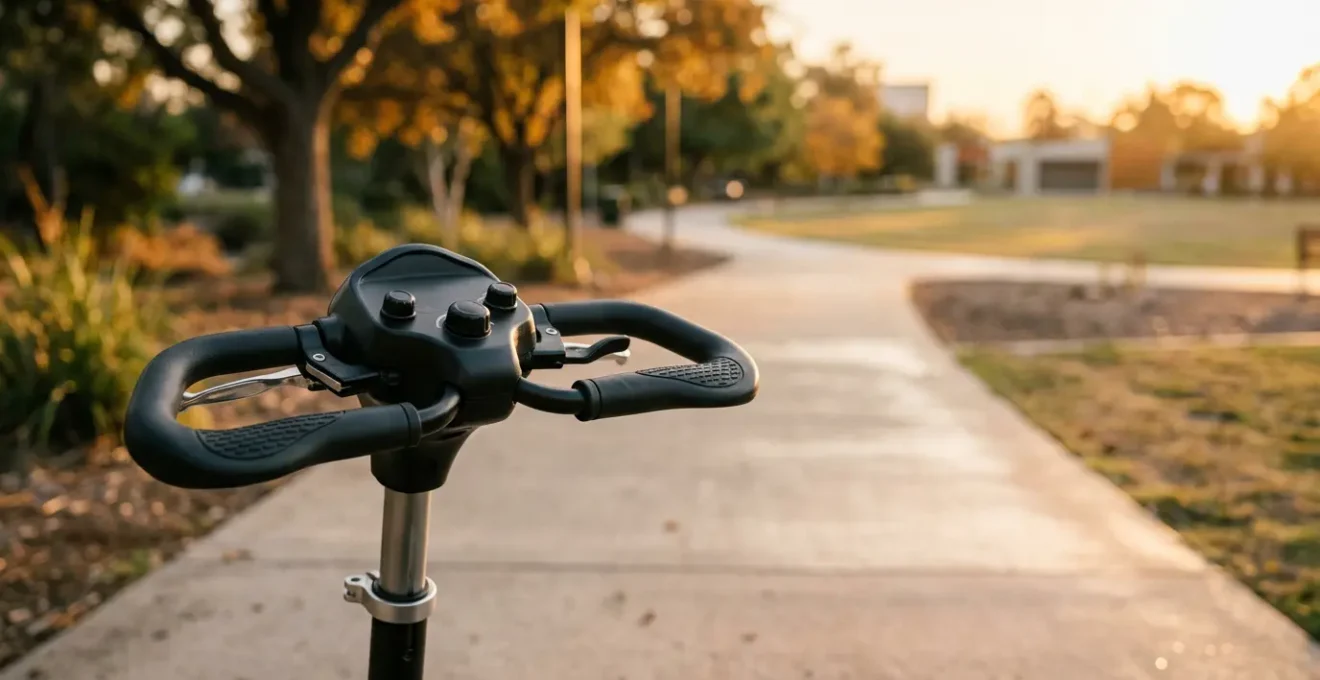
The delta tiller, a common feature on many mobility scooters, represents a significant leap in ergonomic design, particularly for users with limited hand strength, arthritis, or upper limb fatigue. Its wraparound, D-shaped design fundamentally changes the biomechanics of steering. Unlike standard handlebars that require a full-hand, power-grip posture, the delta tiller is designed to be operated with minimal force, often using just the thumbs or the palms of the hands.
This design allows the rider to rest their wrists on the tiller, keeping them in a neutral, « handshake » position. This posture is crucial for nerve pathway decompression, as it minimizes pressure on the median nerve within the carpal tunnel. The primary control is managed by pushing or pulling on one side of the « D » with the thumbs. From an anatomical perspective, this is a highly efficient movement. As described in Stanford Medicine’s guide to the carpal tunnel exam:
The median nerve supplies motor innervation to the abductor pollicis brevis, flexor pollicis brevis, and opponens pollicis, with the abductor pollicis brevis being the best measure of median nerve motor dysfunction.
– Stanford Medicine, Carpal Tunnel Exam – Stanford Medicine 25
The key takeaway is that the thumb has a robust, dedicated muscle group innervated by the median nerve. A delta tiller leverages this powerful and precise muscle group for control, while allowing the other finger flexors—the ones that cause fatigue and cramping from sustained gripping—to completely relax. You are no longer « holding on » to the handlebars; you are simply guiding the tiller. This shifts the control from a fatiguing fine-motor grip to an efficient gross-motor push-pull action, dramatically reducing the static load on the hands, wrists, and forearms.
This makes the delta tiller an ideal solution not only for those with existing conditions but for anyone looking to maximize their endurance on longer rides. It allows for multiple hand positions and even one-handed operation, giving you the ability to rest one arm completely while maintaining safe control of the scooter.
Key Takeaways
- Upper limb fatigue is a biomechanical issue, not an endurance failure, and can be solved with ergonomic adjustments.
- Small « micro-interventions » like mirror adjustments, glove choice, and targeted stretches have a large, cumulative impact on reducing static muscle load.
- Choosing the right control interface, such as a delta tiller, can fundamentally change the energy cost of driving by shifting from a fatiguing grip to an efficient push-pull motion.
Delta Tiller vs Standard Handlebars: Which Ergonomic Steering Suits You?
Choosing between a delta tiller and standard handlebars is the final, and perhaps most impactful, ergonomic decision a scooter user will make. This choice dictates wrist posture, grip requirements, and overall upper body engagement during a ride. There is no single « best » option; the right choice depends entirely on your specific physical needs, the type of riding you do, and the sources of your fatigue. Understanding the distinct biomechanical advantages and disadvantages of each system is key to making an informed decision that will support, rather than strain, your body.
Standard handlebars, common on motor scooters and some mobility devices, offer excellent leverage and allow for a more « active » riding style, where leaning into turns is part of the control. However, they typically demand a sustained grip and can force the wrists into positions of ulnar or radial deviation (bending side-to-side), which can strain tendons and nerves over time. A delta tiller, by contrast, prioritizes a neutral wrist posture and minimizes grip force, making it a superior choice for users with arthritis, carpal tunnel syndrome, or low hand strength.
The following table breaks down the core ergonomic differences to help you assess which system aligns better with your personal requirements for comfort and endurance. Consider your primary pain points and riding goals as you review the comparison.
| Feature | Delta Tiller (Mobility Scooters) | Standard Handlebars (Motor Scooters) |
|---|---|---|
| Wrist Position | Neutral ‘handshake’ position, minimizes carpal tunnel stress | Prone to ulnar/radial deviation, requires sustained grip |
| Grip Force Required | Minimal – uses push-pull palm steering dynamic | Constant gripping force needed for control |
| Best Suited For | Arthritis, limited hand strength, carpal tunnel, single-hand operation | Users needing leverage, active riding, leaning into turns |
| Posture Impact | Encourages relaxed, upright position with shoulders back | Can allow active riding but may encourage slouching if poorly adjusted |
| Control Type | Gross motor movements – less fatiguing for long journeys | Fine motor control – nuanced, more nimble in tight spaces |
| Ideal User Conditions | Chronic fatigue, low grip strength, postural support needs | Shoulder pain from ‘elbows-in’ posture, need for dynamic control |
Ultimately, the choice is about matching the tool to the user’s unique physiology. If your primary issue is hand and wrist pain from gripping, the delta tiller offers a clear advantage in energy economy. If you require nimble, fine-motor control and have no pre-existing hand issues, standard handlebars may be perfectly suitable, provided they are adjusted for proper shoulder and elbow posture.
Now that you are equipped with a physiotherapist’s understanding of biomechanics, the next step is to apply this knowledge. Begin by performing the 5-point ergonomic self-audit on your current scooter to create a personalized action plan for a more comfortable and enduring ride.