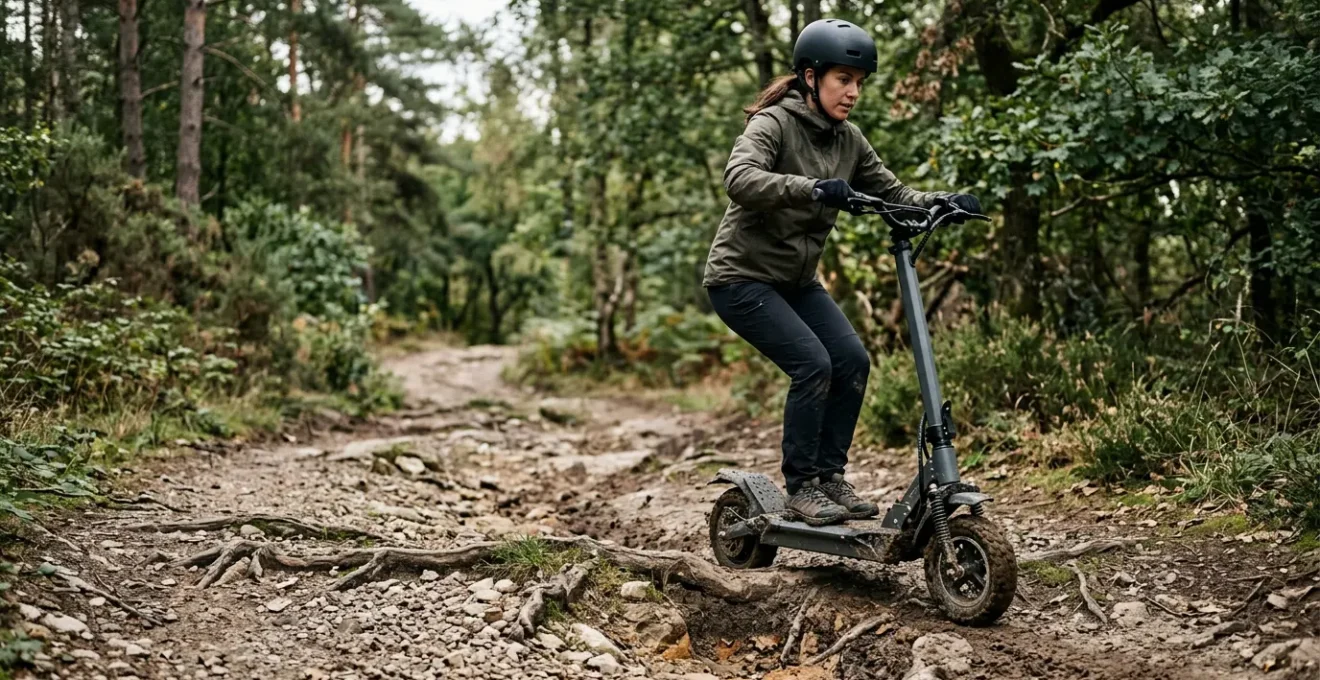
The anxiety of leaving smooth pavement for unpredictable terrain is a common fear for new scooter riders. The solution isn’t just to « slow down, » but to become an intelligent rider who understands the physics of control. This guide moves beyond generic advice, teaching you to proactively read surfaces, manage your scooter’s traction, and use specific techniques to conquer gravel, hills, and obstacles with confidence and safety.
The moment smooth asphalt gives way to a gravel path or a grassy shortcut can be a source of major anxiety for any electric scooter rider. Your hands tighten, your speed drops, and a dozen worst-case scenarios flash through your mind. That feeling of instability, the fear of a sudden tip-over, is a universal experience for those new to navigating the varied landscapes of the real world.
Common wisdom tells you to simply « slow down » or « bend your knees. » While not incorrect, this advice is dangerously incomplete. It treats the rider as a passive passenger, reacting to events as they happen. True mastery and safety on uneven ground don’t come from a few simple rules, but from a fundamental shift in mindset: from simply riding to actively reading the road ahead.
But what if the key wasn’t about avoiding every bump, but understanding how to handle them? The secret to confident off-pavement riding lies in understanding the core principles of traction, weight distribution, and control. It’s about learning to manage your traction budget—a finite resource that you spend on accelerating, braking, and turning—and knowing how different surfaces dramatically affect that budget. This is the difference between reacting with fear and responding with skill.
This guide will equip you with that skill. We will deconstruct the most common challenges—from crossing ruts and kerbs to managing steep, slippery hills—and provide the physical principles and practical techniques to transform your anxiety into an active, intelligent riding strategy. You will learn not just what to do, but precisely why you’re doing it.
To help you master these skills, we’ve broken down the core challenges of uneven terrain into a clear, step-by-step guide. Here’s what we’ll cover to build your confidence and control.
Contents: How to Become an Intelligent Rider on Any Surface
- Straight On or Diagonal? The Golden Rule for Crossing Ruts and Kerbs
- Why Slowing Down Is Vital for Traction on Loose Gravel?
- Wet Leaves and Mud: Identifying Surfaces That Will Trap Your Scooter
- Thread Depth: How to Know When Your Tires Are Too Bald for Off-Roading?
- What to Do If You Start Sliding Backwards on a Hilly Path?
- Hills and Grass: How Much Do They Really Slash Your Mileage?
- Why Motor Torque Matters More Than Speed on Steep Country Lanes?
- How High Clearance Prevents Getting Stuck on Dropped Kerbs and Thresholds?
Straight On or Diagonal? The Golden Rule for Crossing Ruts and Kerbs
One of the most intimidating obstacles for a new rider is a sharp, vertical edge like a kerb, a pothole lip, or a deep rut in a trail. The instinct is often to turn and cross it at a shallow, diagonal angle, hoping to ease over it. This is a critical mistake. A diagonal approach presents a longer, less stable edge to the tire, encouraging it to slide along the obstacle rather than climb over it, which is a primary cause of front-wheel washouts and falls.
The golden rule is to approach any sharp-edged obstacle as close to a 90-degree angle as possible. This allows the tire to hit the obstacle squarely, using the scooter’s momentum to lift up and over in one clean motion. This minimizes the time the tire spends in an unstable state and directs the force vertically, where your scooter’s suspension (and your bent knees) can absorb it most effectively. Remember, not all obstacles are created equal; research on kerb accessibility shows that 100mm kerb upstands are significantly more difficult to cross, highlighting a physical limit that even perfect technique can’t always overcome. Knowing when to cross and when to find another route is the first step of intelligent riding.
Before committing to an obstacle, you must perform a split-second risk assessment. It’s not about blind courage; it’s about a calculated decision. This involves judging the obstacle’s height against your scooter’s ground clearance, ensuring your angle is correct, and confirming the landing zone is safe. Making this assessment a habit is key to preventing over-commitment and potential accidents.
Your Go/No-Go Obstacle Assessment Plan
- Assess the obstacle squareness: Ensure the edge is perpendicular to your approach path for a 90-degree crossing angle.
- Evaluate obstacle height: Check if the obstacle height is within your scooter’s ground clearance specifications.
- Inspect the landing surface: Verify that the surface on the other side is stable and free from loose debris or additional hazards.
- Adjust body weight: Shift your weight backward just before impact to unweight the front wheel slightly, helping it lift.
- Commit to the approach: Apply steady, progressive throttle. Avoid hesitation or jerky inputs once the decision to cross is made.
Why Slowing Down Is Vital for Traction on Loose Gravel?
Telling a rider to « slow down » on gravel feels obvious, but it misses the crucial point. It’s not just about reducing speed for safety; it’s about managing a severely depleted traction budget. Think of traction as a finite resource. On clean asphalt, you have a full budget to spend on accelerating, braking, and turning. On loose gravel, that budget is slashed. The small, shifting stones act like microscopic ball bearings under your tires, drastically reducing the grip available.
This is where understanding the physics becomes paramount. Your tires need to press down on a stable surface to generate grip. On gravel, there is no stable surface. Each piece of stone can roll or slide, meaning your tire is constantly fighting to find purchase. By slowing down dramatically before you hit the gravel, you reduce the demands on your traction budget. You are asking less of your tires, leaving more of that limited grip available for the essential micro-adjustments needed for steering and balance. Speeding up or braking hard on gravel « spends » your traction budget instantly, leading to a loss of control.
The key is smooth, controlled input. Every movement—steering, leaning, throttle—must be deliberate and gentle. Jerky movements are the enemy, as they can easily overwhelm the minimal grip your tires have, causing either the front wheel to wash out or the rear to slide.

As the image above illustrates, the surface is a chaotic collection of individual points, not a solid plane. Maintaining control requires you to float over this instability with minimal force. The goal is to glide, not to plow. This is why a calm, slow approach is not a sign of timidness, but of an intelligent rider who understands and respects the surface they are on.
Wet Leaves and Mud: Identifying Surfaces That Will Trap Your Scooter
Some of the most dangerous surfaces are the ones that look the most benign. A colorful carpet of autumn leaves or a shallow patch of mud can be far more treacherous than jagged rocks. These surfaces are deceptive because they create a near-zero friction layer between your tire and the solid ground beneath. While often overlooked, electric scooter injury data shows that wet leaves and debris represent 5% of environmental crash factors, a significant number for such a specific hazard.
The danger of wet leaves lies in hydroplaning, but with organic matter. The leaves form a slick, pulpy layer that holds water. Your tire tread, designed to channel away water, is ineffective against this semi-solid layer. The result is a total loss of grip, often with no warning. Mud presents a similar challenge: it can either be slick on the surface or thick and heavy, physically grabbing your wheel and stopping your momentum, which can easily cause a tip-over at low speed. The key skill is proactive scanning—learning to identify these deceptive surfaces from a distance and choosing a safer path.
Becoming a terrain detective involves looking for subtle clues that reveal the true nature of the path ahead. Don’t just look at the ground in front of your wheel; scan 20-30 feet ahead, and look for patterns, colors, and textures that signal a change in surface. Here are some techniques to recognize surface deception:
- Look for the path crown: Identify the highest point of the trail where water naturally drains away, which often indicates firmer ground.
- Observe water flow patterns: Shiny surfaces, dark patches, and small drainage channels reveal where water collects and surfaces may be softest or most unstable.
- Check for existing tracks: Tire marks from cars or bikes can reveal the firmest line to take and expose what lies beneath the top layer of leaves or mud.
- Understand leaf hydroplaning: Recognize that a patch of wet leaves is not « damp ground. » Treat it like a patch of ice, with near-zero friction.
Thread Depth: How to Know When Your Tires Are Too Bald for Off-Roading?
Your tires are the single most important piece of safety equipment on your scooter, and the only part that touches the road. On uneven terrain, their role is magnified. While any tire can handle smooth, dry asphalt, it’s the tread—the pattern of grooves and blocks on the tire’s surface—that determines your ability to control the scooter on grass, mud, or wet trails. A « bald » tire, one where the tread has worn away, is effectively a racing slick, offering zero ability to manage loose or wet surfaces.
The tread on your tire performs two critical functions for off-road riding. First, the deep channels are designed to evacuate water and mud from the contact patch—the small area of the tire touching the ground. Without these channels, your tire will hydroplane on water or become a slick, mud-caked wheel with no grip. Second, the sharp edges of the tread blocks, especially on knobby off-road tires, are designed to bite into soft ground like dirt or grass to provide mechanical grip. When these blocks wear down and their edges become rounded, they lose their ability to dig in, and your scooter will feel like it’s spinning its wheels without going anywhere.
Judging tire condition is more than a casual glance. It requires a systematic check to ensure you have the grip you need for the terrain you plan to tackle. A brand new road tire may be less safe in mud than a worn knobby tire, so understanding the difference is key. Before any ride that involves leaving the pavement, a thorough inspection is not optional; it’s a vital safety procedure.
- Tread Depth: Verify that deep channels remain for evacuating material and that tread block edges are still sharp for biting into soft ground.
- Tire Pressure: Ensure pressure is within the manufacturer’s recommended range. Slightly lower pressure can increase the contact patch on soft ground, but too low risks pinch flats.
- Sidewall Inspection: Look for signs of dry rot, cracking, or damage. A tire can have deep tread but be structurally compromised from age or sun exposure.
- Embedded Objects: Check for and remove any stones, glass, or thorns lodged in the tread that could cause a slow leak or a sudden puncture.
What to Do If You Start Sliding Backwards on a Hilly Path?
Losing momentum on a steep, slippery incline is one of the most frightening situations a rider can face. The scooter grinds to a halt, and you feel that sickening lurch as it begins to slide backward. Panic is the natural reaction, but it’s also the most dangerous one. Grabbing the brakes suddenly or making sharp movements will almost certainly lead to a fall. The key is a calm, pre-planned emergency procedure rooted in the physics of weight transfer and brake control.
When your scooter is on a hill, gravity is constantly trying to pull it down. When you start sliding backward, your immediate goal is to regain control of this gravitational force. The most critical action is to shift your body weight forward and downhill. This may feel counterintuitive—your instinct is to lean back, away from the direction of the fall—but it’s essential. Shifting weight forward keeps the front wheel pressed firmly to the ground, which is vital for maintaining steering control. A light front wheel will lift or skid, leaving you with no way to guide the scooter.
Simultaneously, you must apply both brakes smoothly and progressively. Never grab a fistful of brake. A locked wheel is a sliding wheel, and a sliding wheel has no steering or stopping power. By gradually increasing pressure on both levers, you can bring the scooter to a controlled stop without locking either wheel. This is the moment where practice and muscle memory pay off.
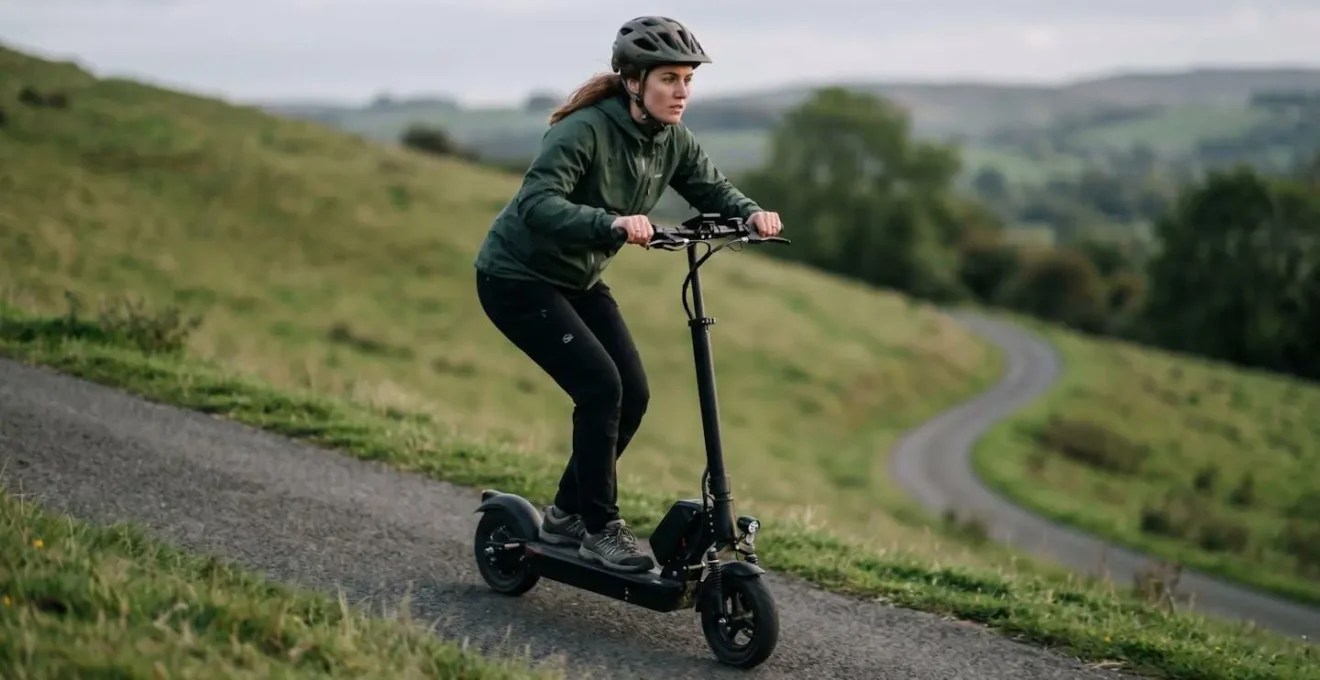
If you find yourself in this situation, execute the following steps calmly and deliberately:
- Apply Both Brakes Smoothly: Use gradual, controlled pressure on both front and rear brakes simultaneously. Do not grab or jerk them.
- Shift Weight Forward/Downhill: Move your body weight toward the handlebars to keep the front wheel planted and maintain steering control.
- Look Where You Want to Go: Direct your vision to a safe spot on the side of the path, not at the obstacle or down the hill. Your scooter will tend to go where you look.
- Prepare for a Controlled Dismount: If the slide is unrecoverable, prepare to step off to one side. Try to maintain hold of the handlebars to prevent the scooter from rolling away.
Hills and Grass: How Much Do They Really Slash Your Mileage?
Every scooter rider is familiar with the « estimated range » provided by the manufacturer. What many new riders fail to appreciate is how quickly that number becomes meaningless once you leave the ideal conditions of a flat, smooth, paved surface. Riding on hills and grass is one of the quickest ways to drain your battery, and understanding the scale of this impact is crucial for planning your rides and avoiding a long walk home.
The impact is not minor. Based on real-world use, performance testing on off-road surfaces demonstrates a 20-30% reduced range on gravel, dirt, or uneven terrain compared to pavement. This is a significant reduction. A scooter that promises 40 miles on a flat road might realistically only deliver 28-32 miles on a route with rolling hills and grassy paths. This reduction is caused by two main factors: gravity and rolling resistance.
Climbing a hill requires your scooter’s motor to fight directly against the force of gravity, demanding a massive increase in power output. Similarly, riding on soft surfaces like grass or dirt creates much higher rolling resistance than asphalt. Your tires sink into the surface, and the motor has to work constantly harder just to keep you moving forward. This combination of forces puts an enormous strain on the battery, draining it at an accelerated rate.
Energy Consumption Analysis: Flat vs. Hill Climbing
Off-road riding on hills is significantly more demanding on battery performance compared to flat surfaces. Analysis of all-terrain electric scooters shows that battery life can vary dramatically depending on terrain and speed, with steep inclines requiring substantially more power draw. High-capacity lithium-ion batteries delivering ranges of 30-50 miles on flat surfaces experience notably shorter distances when tackling elevation changes and loose surfaces, as motors work harder against gravity and rolling resistance.
Why Motor Torque Matters More Than Speed on Steep Country Lanes?
When riders look at scooter specifications, they are often drawn to the top speed. It’s an exciting, easily comparable number. However, when it comes to navigating the real world of steep country lanes, bumpy trails, and challenging inclines, top speed is almost irrelevant. The single most important motor specification for this kind of riding is torque.
Torque is the rotational force that your scooter’s motor can produce. Think of it as the « twisting power » that gets your wheel turning from a standstill or pushes you up a steep hill. Speed, on the other hand, is how fast that wheel can ultimately spin. On a steep, uneven lane, you don’t need to go fast. You need the raw power to overcome gravity and obstacles at a slow, controlled pace. A high-torque motor can deliver immense power even at very low speeds, allowing you to carefully navigate a rocky path or power up a grassy slope without needing a « running start. » A motor built for speed but lacking torque will bog down and fail in these situations.
This is the critical difference between a commuter scooter designed for flat city streets and a true all-terrain machine. The commuter prioritizes efficient high-speed cruising, while the all-terrain scooter prioritizes low-speed pulling power. The ability to apply precise amounts of power at a near-crawl is what gives a rider control in technically challenging situations.
Torque Control on Steep Hills: NAVEE ST3 Pro Performance
The NAVEE ST3 Pro demonstrates the critical importance of high-torque motors for challenging terrain. With its 1,350W peak power motor, the scooter delivers precise torque control on rocky and uneven mountain trails. The high torque at low speeds allows riders to navigate obstacles on hills without requiring momentum, enabling careful maneuvering where speed-focused motors would fail. This showcases how motor specifications directly translate to real-world hill-climbing capability and rider control.
Key takeaways
- Mastering obstacles like kerbs requires a direct, 90-degree approach to prevent your front wheel from sliding.
- Treat your traction as a finite « budget » that is severely reduced on loose surfaces like gravel, requiring slow and smooth inputs.
- Effective off-road riding depends on a combination of rider skill and machine capability, where tire tread, torque, and ground clearance are critical.
How High Clearance Prevents Getting Stuck on Dropped Kerbs and Thresholds?
We’ve covered rider skill, traction physics, and motor power, but there’s one final, physical limitation that no amount of technique can overcome: ground clearance. Ground clearance is the distance between the lowest point of your scooter’s deck or undercarriage and the ground. This single measurement dictates the maximum size of an obstacle you can physically pass over without getting beached, a frustrating and potentially damaging event known as « high-centering. »
Imagine riding over a dropped kerb or the threshold of a doorway. If the obstacle is taller than your scooter’s ground clearance, the deck will hit the peak of the obstacle, lifting your wheels off the ground and leaving you stuck. Your motor can have all the torque in the world, but if your wheels aren’t touching the ground, you’re not going anywhere. This is why scooters designed for urban commuting often have very low ground clearance—it provides a stable, low center of gravity for smooth roads, but makes them highly susceptible to getting stuck on even minor real-world imperfections.
For riders who want to confidently tackle varied terrain, a higher ground clearance is essential. While there’s no single magic number, off-road electric scooter design specifications indicate that 6 inches or more clearance is needed for reliably navigating rocks, roots, and uneven trails. This extra space provides the crucial buffer needed to clear common obstacles without scraping the undercarriage or getting high-centered. It’s the final piece of the puzzle that, combined with good tires, a high-torque motor, and skilled rider input, creates a truly capable all-terrain system.
Ultimately, a successful ride over uneven terrain is a partnership between an intelligent rider and a capable machine. Understanding your scooter’s physical limitations, like ground clearance, is just as important as mastering the techniques of weight transfer and traction management. It allows you to make informed decisions about which paths to take and which obstacles to avoid, ensuring every ride is both exciting and safe.
Now that you are armed with this knowledge, the next step is to apply it. Start small, on a familiar patch of grass or a short gravel driveway, and begin to feel how your scooter responds. Confidence isn’t built by reading, but by doing. Begin your journey to becoming an intelligent, all-terrain rider today.