
The belief that steel is simply ‘strong but heavy’ and aluminium ‘light but weak’ is a dangerous oversimplification for UK scooter buyers.
- True durability is a balance of a material’s resistance to impact (flex), its fatigue life under constant vibration, and its vulnerability to environmental factors like road salt.
- Modern aluminium alloys can be incredibly strong, but their rigidity can transfer more stress to welds, while steel’s natural flex can absorb impacts more effectively, prolonging frame life.
Recommendation: Instead of choosing a material, choose a chassis engineered for its intended use. For heavy-duty daily use on varied UK pavements, a well-protected steel frame often offers superior long-term resilience and repairability.
When considering the longevity of a mobility scooter, the debate often boils down to a simple choice: steel or aluminum? Buyers are told steel is the durable, heavy-duty option, while aluminum offers a lightweight, corrosion-resistant alternative perfect for travel. This binary choice, however, fails to capture the complex reality of material science and the unique challenges posed by UK pavements. The constant vibration from uneven surfaces, the shock from climbing kerbs, and the aggressive corrosion from winter road salt create a hostile environment for any chassis.
From a materials engineering perspective, the question is not merely about a material’s ultimate strength. It’s about its fatigue life—how many cycles of stress and impact it can endure before microscopic cracks begin to form. It’s about its ductility—does it bend and give a warning before failure, or does it crack suddenly? And critically, it’s about how it degrades when exposed to the damp, salt-laden British climate. A lightweight frame isn’t an advantage if it develops a critical failure at a weld joint after two years of daily use, and a « strong » steel frame is useless if it’s silently being eaten away by rust from the inside out.
This article moves beyond the simplistic sales pitch. We will analyse the distinct ways steel and aluminum frames respond to real-world stresses on UK roads. We’ll explore the critical failure points, the truth behind modern alloys, and what a « lifetime warranty » actually means when your chassis is on the line. The goal is to equip you with the knowledge to assess a scooter’s structural integrity not just by its material label, but by its engineering and suitability for your specific needs.
This guide breaks down the critical factors influencing chassis longevity, from environmental protection to user maintenance, providing a complete framework for making an informed decision.
Summary: A Mechanic’s Guide to Scooter Chassis Longevity in the UK
- How to Protect a Steel Chassis from Road Salt and Rain?
- The Welds Check: Where to Look for Cracks on a Used Scooter?
- Kerb Climbing: How Repeated Impacts Weaken the Front Fork?
- Is a Lightweight Frame Always Flimsy? The Truth About Modern Alloys
- What Does a ‘Lifetime Chassis Warranty’ Actually Cover?
- Cracked Chassis: The Invisible Danger of Overloading a Class 2 Scooter
- WD-40 vs Silicone Spray: What to Use on Axles and Tillers?
- What Technical Maintenance Can You Legally Do Yourself on a Mobility Scooter?
How to Protect a Steel Chassis from Road Salt and Rain?
The primary vulnerability of a steel chassis, particularly in the UK, is environmental degradation. Winter road salting creates an electrolyte solution that dramatically accelerates the process of corrosion (rust). This isn’t just a cosmetic issue; rust can compromise the structural integrity of welds and thin-walled tubing over time. In fact, MOT data suggests that across all vehicles, 18% of failures involve corrosion-related issues, highlighting the severity of the UK climate on metal structures. Protecting your investment requires a proactive, consistent maintenance routine, especially during the winter months.
The key is to create a barrier between the steel and the corrosive elements. A simple post-ride wipe-down is the most effective first line of defence. This removes the salt and grime before they can absorb atmospheric moisture and begin the chemical reaction that leads to rust. Think of it as washing your hands after handling something dirty; it’s a simple preventative measure with a significant impact.
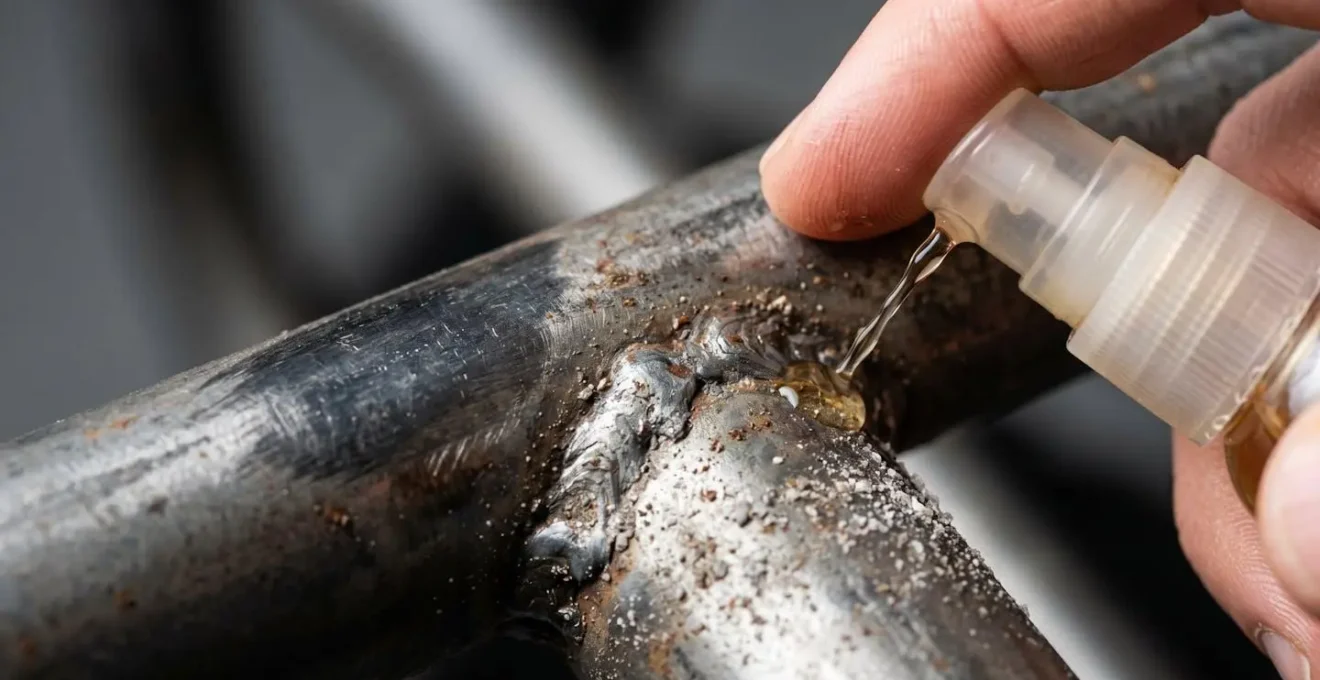
Beyond cleaning, applying a dedicated protective coating adds a crucial layer of security. Automotive wax on painted surfaces behaves like a raincoat for your scooter’s frame, causing water to bead up and run off instead of sitting on the surface. For exposed metal parts and hard-to-reach joints, a specialist anti-corrosion spray provides a more robust, moisture-displacing film. This small-time investment is a non-negotiable part of owning a steel-framed scooter in Britain.
UK Winter Post-Ride Chassis Protection Routine
- Step 1: Wipe-down with a damp cloth after each ride to remove road salt, mud, and grime that cause corrosion, using warm water and mild detergent.
- Step 2: Dry thoroughly, especially around joints and metal components, to prevent moisture from combining with salt residue.
- Step 3: Apply protective coating – a thin layer of automotive wax on painted surfaces or specialist anti-corrosion spray to create a barrier against moisture and road salt.
The Welds Check: Where to Look for Cracks on a Used Scooter?
Regardless of material, a scooter’s chassis is only as strong as its weakest point, which is almost always a weld. Welds are points of stress concentration, where the forces from bumps, turns, and rider weight are focused. A poorly executed weld or one subjected to repeated overloading can develop microscopic fatigue cracks that grow over time, leading to sudden and catastrophic failure. When inspecting a used scooter, knowing exactly where to look is more important than a general visual scan. The highest-stress areas are predictable and must be checked meticulously.
The three most critical zones are the headstock (where the steering column joins the frame), the seat post mount, and any suspension mounting points. These areas bear the brunt of dynamic loads. A simple but effective test is to run a fingernail across the edge of the weld (the « weld toe »). If your nail catches in a groove, it could indicate an « undercut, » a manufacturing defect that acts as a powerful stress riser where a crack is likely to initiate. Look for more than just visible cracks; fine lines of rust « bleeding » from a weld seam are a tell-tale sign that moisture is getting into a hidden fissure.
Case Study: The £100 Steel Weld vs. the Un-weldable Aluminium Frame
A real-world case highlighted the stark difference in repairability. A UK user experienced a seat post weld failure on a steel-framed scooter. A local mobile welder was able to perform a structural repair for a cost between £75 and £150. Had the frame been aluminium, the repair would have required specialist TIG welding, a service that is far more expensive and difficult to source. The case, detailed in a query on a UK-based expert advice forum, shows that steel’s « weldability » is a major factor in its long-term cost of ownership, as the initial failure occurred after only 8 months.
Your Pre-Purchase Weld Inspection Checklist
- Headstock/Tiller Joint: Run a fingernail across the junction where the steering column meets the frame. If it catches, you’ve found a potential geometry defect (undercut). Note any discolouration.
- Seat Post Mount: Check for visible lines, fissures, or preliminary rust ‘bleeding’ around the seat attachment welds. These bear continuous weight stress from the rider and any cargo.
- Suspension Mounting Points: Examine welds at shock absorber and front fork attachment points for hairline cracks or porosity (small surface holes), which indicate weakness.
- Visual Consistency: Are all welds uniform in appearance? Look for any that appear sloppy, uneven, or significantly different from the others, as this may indicate a previous, poor-quality repair.
- Listen for Creaks: While applying weight and rocking the scooter, listen for any creaking or groaning sounds originating from weld joints. This can indicate an internal crack under stress.
Kerb Climbing: How Repeated Impacts Weaken the Front Fork?
One of the most damaging events a scooter chassis can experience is mounting a kerb, especially incorrectly. Each impact sends a shockwave through the frame, with the highest forces concentrated at the front fork and the headstock welds. While a single, gentle ascent is unlikely to cause damage, repeated impacts contribute to metal fatigue. Think of it like bending a paperclip back and forth; it doesn’t break on the first bend, but repeated stress cycles eventually cause it to snap. The same principle applies to your scooter’s frame material, whether it’s steel or aluminum.
The angle of approach is the most critical factor. Approaching a kerb at an angle puts a torsional (twisting) load on the steering column and its welds, a type of force they are not designed to handle. This twisting action can weaken the heat-affected zone around the weld, making it more susceptible to cracking. A perpendicular, 90-degree approach ensures the impact force is distributed symmetrically through the front wheel and suspension, as the engineers intended. This minimizes the peak stress on any single point of the frame.
Equally important is managing the impact’s intensity through speed and weight distribution. Hitting a kerb at speed is like hitting the frame with a hammer. By slowing to a near stop, you allow the scooter to roll up the obstacle rather than smash into it. Shifting your weight slightly to the rear as the front wheel makes contact further unloads the front fork, letting the more robust rear of the chassis and your own body absorb a portion of the force. This technique transforms a high-impact event into a low-stress manoeuvre.
Safe UK Kerb Ascent Technique to Minimise Chassis Stress
- Approach at a 90-degree angle: Position the scooter perpendicular to the kerb edge to prevent lateral stress on the steering column and fork welds.
- Reduce speed and brake gradually: Slow to a minimum safe speed before the kerb. Avoid sharp braking during the ascent.
- Distribute weight slightly back: Shift your body weight toward the rear as the front wheel climbs to prevent the front fork from taking the full impact force.
Is a Lightweight Frame Always Flimsy? The Truth About Modern Alloys
The notion that all lightweight frames are inherently flimsy is outdated. While basic, cheap aluminum frames can be prone to failure, the material itself is not the issue; the specific alloy and engineering are. High-performance mobility scooters, much like modern aircraft and racing bicycles, use sophisticated aluminum alloys like 6061-T6 or even higher-strength 7075 series aluminum. These materials offer an exceptional strength-to-weight ratio, far exceeding that of standard mild steel.
However, strength is not the only factor. A key difference between steel and aluminum is elasticity. Steel, particularly alloys like Chromoly, has a natural flex. It can bend slightly under impact to absorb energy and then return to its original shape. This « compliance » contributes to a smoother ride and can help dissipate stress that would otherwise fatigue a weld. Most aluminum alloys are much more rigid. This rigidity provides a very responsive feel, but it also means that impact forces are transmitted more directly to the frame’s joints and to the rider. A rigid frame requires more robust engineering, particularly at the welds, to prevent stress concentration and eventual failure.
This is the central trade-off: the forgiving, shock-absorbing nature of steel versus the lightweight rigidity of aluminum. For a UK buyer, this has practical implications. A steel frame may better withstand the cumulative impacts of poorly maintained pavements, while an aluminum frame offers portability but demands a more careful riding style to avoid repeated, sharp shocks. The choice depends entirely on your priorities and typical usage.
This comparative table breaks down the key properties of common chassis materials used in mobility scooters available in the UK, helping to illustrate the trade-offs beyond simple weight.
| Property | 6061-T6 Aluminum | 7075 Aluminum | Chromoly Steel |
|---|---|---|---|
| Typical Use | Most store-bought scooters | High-performance/off-road | Quality bicycle frames |
| Strength-to-Weight | Good (30-40% lighter than steel) | Excellent (highest strength) | Very Good (lighter than mild steel) |
| Weldability | Excellent (easy to weld) | Difficult (specialist required) | Good (standard equipment) |
| Corrosion Resistance (UK climate) | Very Good (natural oxide layer) | Good (requires coating) | Poor (requires protection) |
| Cost | Moderate | High | Low to Moderate |
| Shock Absorption | Lower (rigid frame) | Lower (very rigid) | Better (flexes to absorb impact) |
What Does a ‘Lifetime Chassis Warranty’ Actually Cover?
A « lifetime chassis warranty » sounds like the ultimate guarantee of durability, but its real-world value depends entirely on the fine print. These warranties are marketing tools designed to inspire confidence, but they are often filled with exclusions that can render them useless, especially given the harsh conditions of UK use. The first critical question is: whose lifetime? The manufacturer may define « lifetime » as the expected service life of the scooter model (e.g., 5-7 years), not your own.
Furthermore, these warranties almost always cover only « manufacturing defects » in the frame. This means if a weld fails due to a flaw in its initial construction, it should be covered. However, if the frame cracks due to fatigue from years of riding on bumpy pavements, or if it rusts through because of exposure to road salt, the manufacturer will likely classify this as « wear and tear » or « environmental damage » and reject the claim. Given that these are the most common causes of frame failure in the UK, the warranty may offer little practical protection. Other common exclusions include exceeding the weight limit (even with shopping) or damage from accidents and improper use (like aggressive kerb climbing).
Ultimately, your primary protection as a consumer comes not from the manufacturer’s warranty, but from UK law. As the consumer rights group Which? clarifies:
The Consumer Rights Act 2015 requires that any products you buy must be of satisfactory quality, fit for purpose and as described.
– Which? Consumer Rights Authority, Faulty product guidance under UK Consumer Rights Act 2015
This statutory right means if a chassis fails prematurely under normal use, you may have a claim against the retailer, regardless of warranty terms. Before you buy, arm yourself with specific questions for the dealer to expose the true limits of their « lifetime » promise.
Questions to Ask Your UK Mobility Dealer Before Purchase
- Is the ‘lifetime’ warranty transferable if I sell the scooter, or does it apply only to the original purchaser?
- Who pays for transport and collection costs if I need to make a warranty claim for chassis repair?
- Does using the scooter in wet weather or on salted UK roads void the chassis warranty, or are environmental corrosion damages covered?
- What is the exact definition of ‘lifetime’ – does it mean my lifetime, the scooter’s expected service life, or a fixed period?
- Are there weight limit exclusions that could void the warranty if I carry heavy weekly shopping on a Class 2 scooter?
Cracked Chassis: The Invisible Danger of Overloading a Class 2 Scooter
Mobility scooters in the UK are categorised into classes with specific engineering and legal limits. A Class 2 scooter is designed and legally restricted to pavement use at a maximum of 4mph. In contrast, a Class 3 scooter can reach up to 8mph on roads. This distinction is not arbitrary; it dictates the entire engineering philosophy of the chassis. A Class 2 frame is optimised for low weight and low-speed travel on relatively smooth surfaces. It is simply not built to handle the combined stresses of higher speeds, road imperfections, and significant extra weight.
The « invisible danger » comes from regularly exceeding the scooter’s maximum weight capacity, a limit that includes the rider plus any shopping, bags, or accessories. While the scooter may seem to handle the extra load in the short term, every bump and pothole creates peak stress levels in the frame that are far higher than its design parameters. This is where material fatigue becomes a serious risk. An engineering analysis of scooter frames confirmed a critical point: while normal loads keep stress below the material’s yield point, overloading combined with repeated impacts can initiate and propagate fatigue cracks, especially at weld joints.
Engineering Analysis: How Overloading Leads to Failure
A Computer-Aided Engineering (CAE) study on scooter frame fatigue demonstrated that chassis are designed with a specific safety margin for a single rider’s weight. When a heavy load (like a week’s worth of groceries) is added to a Class 2 scooter, and it’s then driven over uneven surfaces or dropped off kerbs, the stress cycles can quickly exceed this safety margin. The study showed that these conditions are the primary driver for fatigue cracks initiating at welded connections, leading to a progressive and often invisible structural failure until it’s too late.
Treating a lightweight Class 2 scooter like a heavy-duty Class 3 vehicle by loading it with heavy shopping and using it on rough terrain is a recipe for chassis failure. The cracks may start small and hidden under paint, but they will grow with every trip until the frame’s integrity is critically compromised.
WD-40 vs Silicone Spray: What to Use on Axles and Tillers?
Proper lubrication is a cornerstone of mechanical maintenance, but using the wrong product can cause more harm than good. A common and critical mistake is using WD-40 as a lubricant. WD-40 is a water displacer and solvent, not a true lubricant. When sprayed on axles or pivot points, it will clean the area and initially seem to solve a squeak, but it also strips away any existing grease. It then evaporates quickly, leaving the metal parts completely unprotected and more vulnerable to wear and corrosion than before.
For the high-load, high-exposure environment of a mobility scooter in the UK, different parts require different types of lubrication. For moving metal-on-metal joints like wheel axles and suspension pivots, a thick, water-resistant grease is essential. White lithium grease, especially in a marine-grade formulation, is an excellent choice. It adheres strongly to surfaces, provides long-lasting lubrication, and offers excellent resistance to being washed away by rain and puddles. It creates a durable barrier against both friction and moisture.
For lighter-duty applications, like the sliding mechanism of a tiller height adjustment lever or plastic-on-metal contacts, a silicone spray is more appropriate. It provides a clean, dry lubricating film that doesn’t attract dirt and grime the way sticky grease can. It’s also excellent for rejuvenating and protecting plastic components from UV fading. Finally, for pure corrosion protection on the frame itself (not for moving parts), a dedicated anti-corrosion film like ACF-50 is the professional’s choice, providing a season-long barrier against the elements.
This table provides a clear guide on what product to use where, specifically tailored for the demands of the UK climate.
| Product Type | Best Use Case (UK Climate) | Water Resistance | Longevity | Application |
|---|---|---|---|---|
| WD-40 | Short-term water displacement only | Low (evaporates quickly) | Days | NOT recommended for UK scooters – strips existing grease and leaves parts vulnerable after evaporation |
| White Lithium Grease | Wheel axles, suspension pivots | Excellent (rain/puddle resistant) | Months | Marine-grade formulation ideal for UK wet conditions; apply to high-load rotating joints |
| Silicone Spray | Tiller height lever, plastic components | Good (protective layer) | Weeks to months | Light-duty lubrication; prevents plastic fading; doesn’t attract dirt like sticky grease |
| ACF-50 / XCP Clear | Frame corrosion protection (not lubrication) | Excellent (barrier coating) | Season-long | Anti-corrosion barrier for chassis; not a lubricant for moving parts |
Key Takeaways
- Chassis durability is not just about material (steel vs. aluminum) but about engineering for specific stresses like impacts (fatigue life) and UK weather (corrosion).
- Regular inspection of high-stress weld points (headstock, seat post, suspension mounts) is the most critical preventative maintenance you can perform.
- A « lifetime warranty » is a marketing term; your real protection comes from understanding its exclusions and your rights under the UK Consumer Rights Act 2015.
What Technical Maintenance Can You Legally Do Yourself on a Mobility Scooter?
While performing your own maintenance can be empowering and cost-effective, it’s crucial to understand the line between safe DIY tasks and jobs that must be left to a professional. In the UK, this isn’t just a matter of skill, but also of safety, legality, and insurance validity. Performing unauthorised repairs on safety-critical systems like brakes or the scooter’s frame can not only lead to an accident but could also void your insurance policy, leaving you personally liable for any damages or injuries.
Generally, user-serviceable tasks fall under the category of « visual checks and basic upkeep. » This includes routines like charging the batteries, cleaning the terminals, checking tyre pressures, and the weekly cleaning and drying of the chassis we’ve discussed. You are the first line of defence in spotting a problem, and a visual inspection for loose fasteners, developing cracks, or unusual wear should be a regular habit. These tasks require no specialist tools and pose minimal risk.
However, any work involving safety-critical systems is firmly in the professional-only domain. This includes brake adjustments, electrical diagnostics, motor work, and crucially, any structural frame repairs or welding. These tasks require specialist knowledge, calibrated tools, and an understanding of the potential consequences of failure. As experts at Eden Mobility UK point out, there’s a legal expectation of diligence from the user:
While no mandatory MOT exists for mobility scooters, the user has a duty of care to ensure their scooter is safe, especially if it’s a Class 3 model used on public roads.
– Eden Mobility UK, Road-Legal Mobility Scooter Guide 2026
This « duty of care » implies that knowingly using an unsafely maintained scooter could have legal ramifications. The best approach is to follow a clear checklist dividing DIY tasks from professional jobs and always consult your insurance policy regarding annual servicing requirements.
DIY vs. Professional Maintenance Checklist for UK Scooters
- DIY Safe Tasks: Tyre pressure checks and inflation to recommended PSI; battery charging routine and terminal cleaning; weekly cleaning and drying of chassis; visual inspection for cracks or loose fasteners.
- Professional-Only Tasks: Brake adjustment and pad replacement (safety-critical); electrical diagnostics and wiring repairs; motor replacement or complex mechanical work; any chassis weld inspection or structural frame repairs.
- Insurance Consideration: Many UK mobility scooter insurance policies require annual professional servicing and will be voided if unauthorised repairs (especially to frame, brakes, or electrical systems) are performed – verify your policy terms before attempting repairs.
By shifting your focus from a simple material choice to a holistic understanding of engineering, environmental factors, and maintenance, you can select a mobility scooter with a chassis truly built to last on UK pavements. The next logical step is to book a professional annual service to establish a baseline of your scooter’s health.