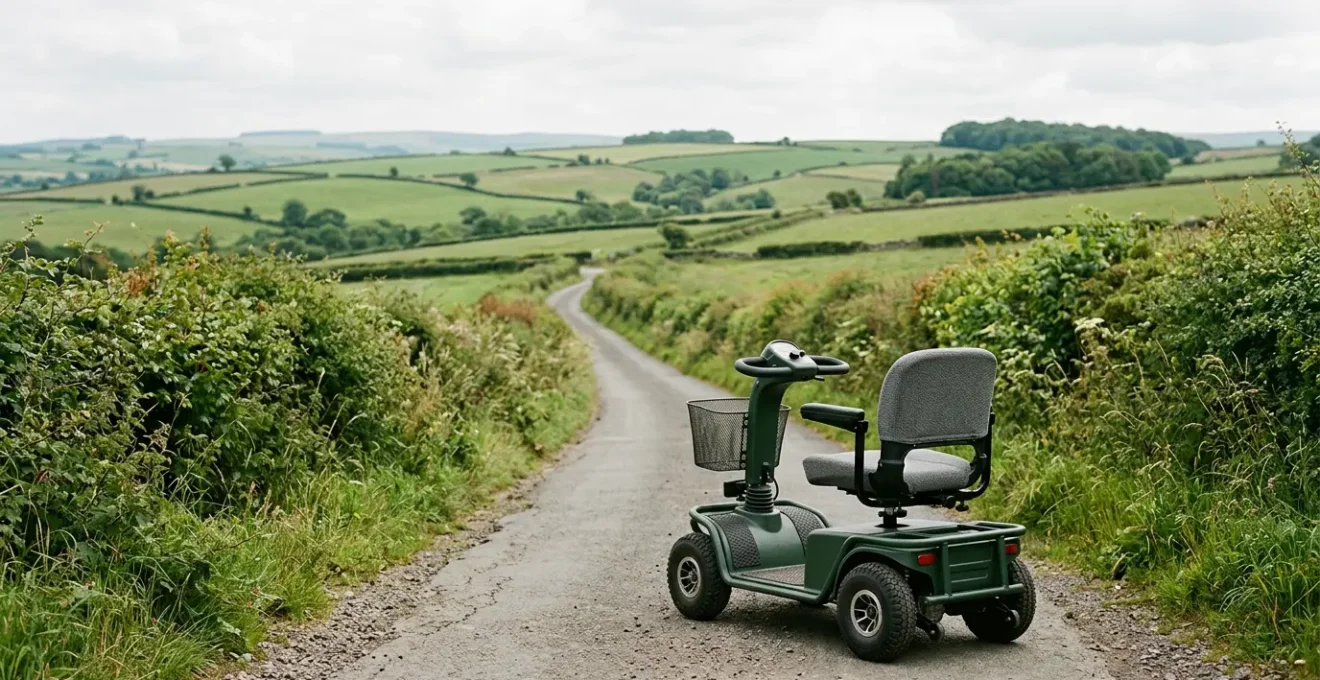
A heavy-duty Class 3 scooter is more than a vehicle; it’s a practical engineering solution to the unique mobility challenges of a rural lifestyle.
- Their true value lies in high-torque motors for steep inclines and advanced suspension for unpaved tracks, not just top speed.
- Operating on public roads comes with legal responsibilities, including registration and speed limits, that are non-negotiable.
- The extra cost is justified when it solves daily ‘friction points’ like navigating rough terrain and provides a genuine car alternative for local journeys.
Recommendation: Evaluate a model based on its ability to handle your specific terrain and storage realities, prioritising robust engineering over bells and whistles.
The promise of rural living often involves visions of tranquil country lanes, sprawling fields, and a quieter pace of life. But for those with mobility challenges, this idyll comes with practical frictions: cracked tarmac, steep, muddy tracks, and distances too far to walk but too short to justify using the car. Standard mobility scooters, designed for smooth pavements and shopping centres, often fall short when faced with the rugged reality of the countryside. They lack the power for inclines, the resilience for potholes, and the range for meaningful journeys.
This is where heavy-duty, Class 3 mobility scooters enter the picture. On paper, their specifications—larger batteries, powerful motors, and robust suspension—seem like the perfect answer. However, they also come with a significantly higher price tag and a larger physical footprint. The crucial question for anyone living outside the city limits isn’t just « can it handle the terrain? » but « is it a worthwhile and practical integration into my daily life? » The answer isn’t found in a brochure, but in a no-nonsense assessment of its real-world capabilities against the unique demands of a rural environment.
This guide moves beyond the spec sheets to tackle the practical questions. We will explore the rules you must follow to legally drive on country roads, why motor torque is more important than top speed on a steep hill, which suspension system truly tames gravel paths, and the often-overlooked realities of storing and manoeuvring a larger machine. By understanding these core aspects, you can make an informed decision on whether a heavy-duty model is a sound investment for reclaiming your independence in the countryside.
Summary: A Practical Guide to Heavy-Duty Scooters for Country Living
- The Rules of the Road: Where Can You Legally Drive a Heavy-Duty Beast?
- Why Motor Torque Matters More Than Speed on Steep Country Lanes?
- Coil vs Hydraulic: Which Suspension Handles Cobblestones and Gravel?
- Do You Have a Garage? The Reality of Parking a Class 3 Scooter
- The Supermarket Test: Can a Heavy-Duty Scooter Navigate Aisle 4?
- Why Slowing Down Is Vital for Traction on Loose Gravel?
- The Tortoise Switch: Why You Must Limit Speed on Pavements Legally?
- How to Navigate Uneven Outdoor Terrain Safely Without Tipping Over?
The Rules of the Road: Where Can You Legally Drive a Heavy-Duty Beast?
One of the biggest draws of a Class 3 scooter is its ability to be driven on the road, effectively turning it into a micro-vehicle for local trips. This freedom, however, comes with responsibilities. In the UK, you don’t need a driving licence, but you do become a road user subject to specific rules. The most fundamental step is registering your Class 3 scooter with the DVLA, a process that is free and does not require you to pay road tax. This legally classifies your scooter as a ‘powered vehicle’ and is non-negotiable for road use.
Your scooter must be equipped for the road like any other vehicle. This means having a full, functioning lighting system—including front and rear lights, indicators, and reflectors—plus a horn and rear-view mirrors. These aren’t optional extras; they are legal requirements for your safety and the safety of others. While you can use most roads, you are legally barred from motorways and dual carriageways with a speed limit over 50 mph. If you must use a dual carriageway where the limit is 50 mph, a flashing amber beacon is mandatory.
Finally, while insurance is not legally required, it is strongly recommended by government guidance and mobility experts. It provides financial protection against accidents or theft, offering peace of mind that is well worth the modest cost. To legally operate a Class 3 scooter on the road, you must also be at least 14 years old. Mastering these rules is the first step in your lifestyle integration of a heavy-duty machine.
Why Motor Torque Matters More Than Speed on Steep Country Lanes?
When looking at scooter specifications, it’s easy to get focused on the 8 mph top speed. But in a rural setting, top speed is a vanity metric. The real hero is motor torque. Torque is the rotational force the motor produces, and it’s what gets you up a steep, muddy farm track without grinding to a halt. A high top speed is useless if the scooter lacks the grunt to maintain momentum on an incline. For country lanes, think of torque as your engine’s pulling power.
This is where heavy-duty models justify their cost. They are equipped with powerful motors designed specifically for high-torque output. For example, some heavy-duty mobility scooter motors demonstrate that 1400-watt units can comfortably handle inclines between 11° and 18°. This is the kind of power needed to conquer the sharp hills and uneven access roads common in the countryside, where a standard scooter’s motor would quickly overheat or fail. High torque ensures a smooth, controlled ascent without straining the battery or leaving you stranded.
Case Study: Afikim Afiscooter S Performance
The Afikim Afiscooter S provides a perfect real-world example. It features a powerful 1400-watt motor that delivers exceptionally smooth and strong performance on steep slopes. Depending on the specific configuration, it can climb angles of 11° to 18°, making it an ideal choice for rural environments with challenging terrain. The high torque helps the scooter maintain consistent speed and stability on hills, preventing the motor and battery from being over-strained during demanding climbs.
Prioritising torque over top speed is a fundamental shift in mindset. It’s about choosing a machine built for real-world power and endurance, not just for cruising on a flat, smooth pavement. It’s the difference between a tool that works and a tool that excels at its job.
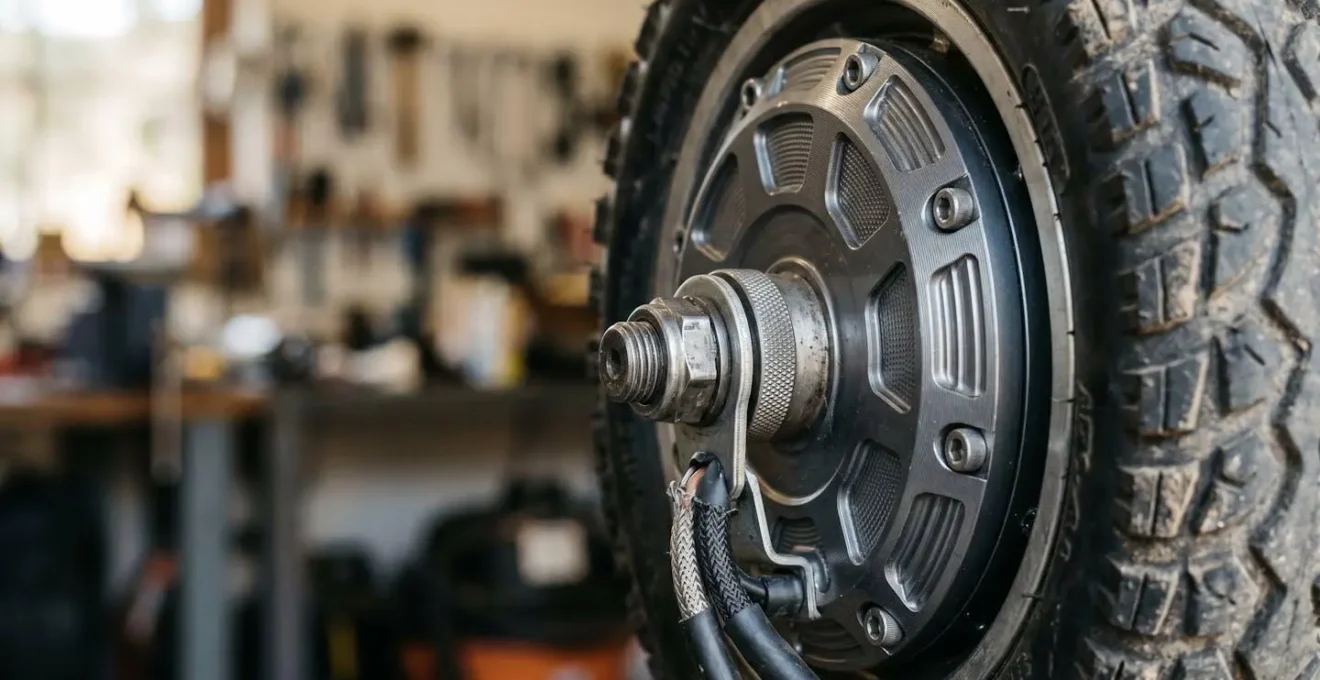
The engineering behind these motors, often brushless for efficiency and longevity, is what provides the reliable performance needed day in and day out on challenging rural routes. This focus on robust, powerful components is a hallmark of a true heavy-duty scooter.
Coil vs Hydraulic: Which Suspension Handles Cobblestones and Gravel?
A powerful motor is only half the battle on rural terrain. Without a capable suspension system, all that power is useless on a bumpy track. The ride would be unbearably jarring, and control would be compromised. Heavy-duty scooters typically feature one of two main types of suspension: traditional coil springs or more advanced hydraulic systems. The choice between them is a critical factor in both comfort and capability.
Coil spring suspension is the simpler, more traditional option. It excels at absorbing large, single impacts—think dropping off a kerb or hitting a deep pothole. It’s generally more affordable and easier for a local mechanic to service. However, on continuously rough surfaces like a long gravel driveway or a cobbled village street, it can feel ‘bouncy’ and transmit a lot of high-frequency vibrations to the rider, leading to fatigue. In contrast, hydraulic suspension is engineered to dampen these very vibrations. As a recent comparative analysis shows, these systems provide a much smoother ride over rough ground, significantly reducing body stress and improving control. Some premium systems even offer over 15 levels of damping adjustment to fine-tune the ride to your preference.
| Feature | Coil Spring Suspension | Hydraulic Suspension |
|---|---|---|
| Shock Absorption Type | Large single bumps (potholes) | High-frequency vibrations (gravel, rough surfaces) |
| Maintenance | Simple, field-reparable by local mechanics | Complex, requires specialized servicing |
| Adjustability | Basic preload adjustment on quality models | 15+ levels of damping adjustment on premium systems |
| Comfort on Long Rides | Can feel bouncy on continuous bumps | Significantly reduces rider fatigue |
| Cost | Lower manufacturing and installation cost | Higher cost, typically on premium scooters |
| Durability | Long lifespan, lower replacement costs | 2x longer life with quality systems |
| Best For | Budget-conscious users, simple terrain | Demanding off-road use, daily heavy use |
For true rural living, where unpaved tracks, cattle grids, and poorly maintained lanes are daily occurrences, a hydraulic suspension system is a significant upgrade that directly translates to a more comfortable and less fatiguing ride. While it comes at a higher initial cost and requires more specialised maintenance, the superior damping and control it offers make it a worthwhile investment for anyone serious about using their scooter as a primary mode of local transport.
Do You Have a Garage? The Reality of Parking a Class 3 Scooter
A heavy-duty scooter conquers the great outdoors, but its size and value present a new challenge: where do you store it? The ideal scenario is a dry, secure, and climate-controlled garage. However, the reality of rural properties often involves damp outbuildings, unheated barns, or simply a lack of dedicated indoor space. This is a critical ‘lifestyle integration’ point that must be considered before purchase.
Temperature and humidity are the enemies of your scooter’s electronics and, most importantly, its batteries. Storing a scooter in a location with wild temperature swings or high moisture can lead to corrosion and significantly shorten battery life. The best practice is to store it in an area where the temperature remains steady, ideally between 0°C and 30°C. If the scooter must be kept in a colder outbuilding, consider removing the batteries and storing them separately indoors. For sealed lead-acid (SLA) batteries, it’s vital to recharge them at least every two weeks during storage to prevent permanent damage.
Theft is another real-world concern, especially in more isolated locations. A heavy-duty scooter is a valuable asset. If storing it in a barn or shed, consider installing ground anchors to secure it. The risk of battery fires, although rare, is also a serious consideration. As fire safety research indicates that even modest 1kWh lithium-ion batteries can release vast quantities of toxic gas during thermal runaway. This underscores the importance of proper charging practices and storing the scooter away from flammable materials.
Your 5-Point Rural Storage Audit
- Assess your space: Identify all potential storage locations (garage, shed, utility room) and measure their entryways and floor space.
- Check the climate: Use a simple thermometer/hygrometer for 24 hours in your chosen spot. Are there extreme temperature swings or high humidity?
- Evaluate power access: Is there a safe, dry, and accessible power socket for charging, away from damp floors and flammable materials?
- Analyse security: How secure is the location? Assess the quality of locks, doors, and windows. Is it visible from the road?
- Plan for the worst: Consider the proximity to living quarters in case of fire and ensure you have a clear, accessible fire extinguisher nearby.
Thinking through the logistics of storage isn’t just a minor detail; it’s as important as checking the motor’s torque. A scooter you can’t store safely and conveniently will quickly become a burden rather than a source of freedom.
The Supermarket Test: Can a Heavy-Duty Scooter Navigate Aisle 4?
A scooter that can climb a steep hill is fantastic, but its utility plummets if it can’t get you through the village shop doorway or down the tinned goods aisle. This is the « Supermarket Test »—a real-world measure of a heavy-duty scooter’s indoor manoeuvrability. Their larger size, wider wheelbase, and bigger turning circle can make navigating tight indoor spaces a significant challenge. This is a crucial friction point where off-road capability can clash with daily practicality.
When assessing a model, the turning radius is the key specification to look for. As a rule of thumb, mobility scooter specifications typically recommend a turning radius under 150cm for effective indoor navigation. Anything larger will likely require complex, multi-point turns to get around sharp corners, which can be stressful and impractical in a busy environment. Before buying, measure the doorways and tightest corners in the local shops, post office, or doctor’s surgery you frequent.
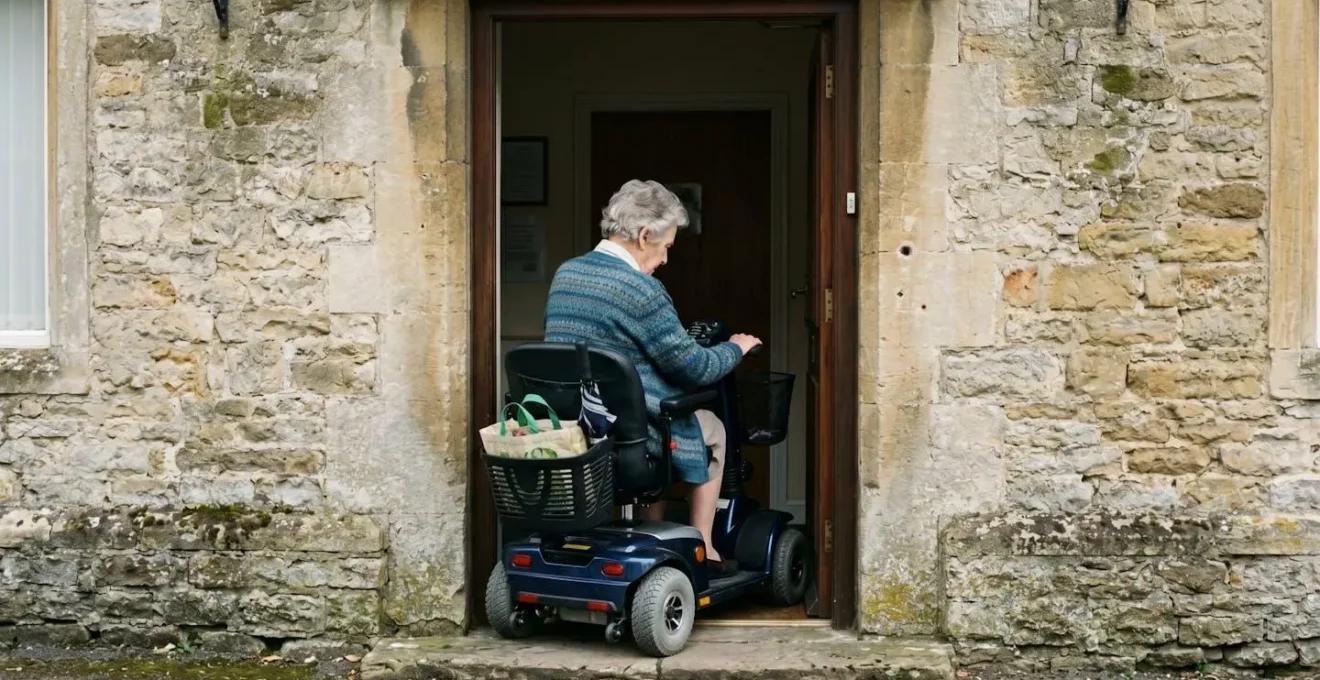
Even with a tight turning radius, you’ll need to master the art of the three-point turn for very confined spaces. This technique involves a slow, deliberate sequence of forward and reverse movements with the handlebars turned fully. Here’s how to do it:
- Approach the turn at the slowest possible speed; engage the ‘tortoise’ mode if available.
- Turn the handlebars fully in your desired direction and move forward as far as you can.
- Stop, then turn the handlebars fully in the opposite direction and reverse slowly.
- Repeat this forward-reverse sequence, adjusting your angle with each small movement.
- Complete the manoeuvre once you are aligned with your new path.
The ability to blend off-road prowess with indoor agility is the hallmark of a well-designed heavy-duty scooter. It’s a balance that separates the truly practical models from those that are merely powerful. Passing the supermarket test is a non-negotiable part of making a scooter a successful integration into your rural life.
Why Slowing Down Is Vital for Traction on Loose Gravel?
You’ve chosen a scooter with a powerful motor and great suspension. You’re cruising down a country lane, and ahead lies a patch of loose gravel left by a tractor. The instinct might be to power through it, but that’s the fastest way to lose control. On loose surfaces, speed is the enemy of traction. The physics are simple: slowing down allows the tyre more time to press into the loose material, compacting it and creating a more solid base for grip.
Sudden movements are the primary cause of skids. Abrupt braking or sharp turns on gravel will almost certainly cause the wheels to lose their footing. The key is smoothness and anticipation. Look well ahead—at least 50 meters—to spot changes in the road surface. This gives you ample time to decelerate gently and prepare for the transition. Once you’re on the gravel, maintain a steady, even speed. Use smooth, gentle applications of the throttle to ‘pull’ the scooter forward, rather than coasting or making sudden bursts of acceleration.
Pneumatic (air-filled) tires provide better traction and shock absorption on uneven terrain, while solid tires are puncture-proof but offer less grip.
– Gyroor Technical Guide, Electric Scooter Hill Climb Specs
Your choice of tyre is also critical. Knobbly, all-terrain tyres have a significant advantage on loose surfaces compared to the smooth tyres found on standard scooters. Their deeper treads are designed to bite into materials like gravel and mud, providing far superior grip. Even with the best tyres, however, the fundamental principle remains: approach loose surfaces slowly, operate smoothly, and let the machine’s weight work with you, not against you.
The Tortoise Switch: Why You Must Limit Speed on Pavements Legally?
Heavy-duty scooters are built for the road, but many journeys will involve stretches on pavements—navigating through a village centre or getting from your driveway to the road. This is where the ‘tortoise switch’, or speed limiter, becomes one of the most important features on your machine. It’s not just a handy option; it’s a legal necessity. In the UK, Highway Code regulations specify that Class 3 scooters must be limited to 4 mph on pavements, footpaths, and any pedestrian areas.
This 4 mph limit is a sensible rule designed to ensure the safety of pedestrians. A heavy-duty scooter can weigh over 150kg, and at its 8 mph top speed, it carries significant momentum. Reducing the speed to a fast walking pace makes the scooter far less intimidating to others and gives you more reaction time to avoid obstacles or people. Engaging the tortoise switch is a sign of a responsible and considerate operator; it’s an act of community-mindedness that is essential for maintaining public goodwill towards mobility scooter users.
Beyond the legal and social imperatives, there is a major practical benefit to using the speed limiter: battery conservation. Constantly running at 8 mph, especially in stop-start environments like a village high street, drains the battery rapidly. Operating in the 4 mph mode can dramatically extend your battery’s life for the day, reducing energy consumption by up to 40% in some urban-style settings. This means you’ll have more power in reserve for the longer, more demanding road journey home. The tortoise switch is therefore a dual-purpose tool: it ensures legal compliance and safety while also acting as a smart energy-saving strategy.
Key Takeaways
- Legal compliance is the foundation: Registering with the DVLA and adhering to road/pavement speed limits is non-negotiable.
- True rural performance is defined by torque and suspension, which provide control on hills and comfort on rough tracks, not by top speed.
- Practicality is paramount: The best scooter is one that can be safely stored, charged, and manoeuvred in the real-world indoor spaces you use daily.
How to Navigate Uneven Outdoor Terrain Safely Without Tipping Over?
Successfully navigating the lumps and bumps of the countryside is the ultimate test of both rider skill and machine capability. A heavy-duty scooter’s wider wheelbase and advanced suspension provide a stable platform, but safe operation on uneven ground relies on understanding and respecting the physics of balance. Tipping over is a real risk, but it can be almost entirely mitigated by adopting a few key techniques.
The single most important principle to master is the 90-Degree Rule. Always, without exception, approach obstacles like kerbs, exposed roots, or the threshold of a doorway at a perpendicular (90-degree) angle. Hitting an obstacle from the side (an oblique angle) is the number one cause of side-tipping, as it allows one wheel to climb while the other remains low, dangerously shifting the centre of gravity. By hitting it head-on, both front wheels make contact simultaneously, keeping the scooter level and stable.
Your body weight is a powerful tool for maintaining stability. When traversing across a cambered (sloped) path, consciously lean your body ‘into the slope’. This action helps to counteract the scooter’s natural tendency to lean downhill, keeping the combined centre of gravity safely over the wheelbase. Similarly, how you load your scooter matters. Always place heavy items like shopping in low-slung panniers or under-seat storage. Never use a high-mounted rear basket for heavy goods, as this raises the centre of gravity and dramatically increases the risk of a tip-over, especially on uneven terrain.
Finally, as with riding on gravel, slow and steady wins the race. Reduce your speed *before* you encounter the uneven patch. Momentum magnifies instability and reduces your time to react. If you ever feel the scooter becoming unstable, prioritise your own safety. A quick and safe dismount is always better than trying to save the machine. A scooter can be righted, but an injury is a far greater setback.
To determine if a heavy-duty model is the right investment for you, begin by auditing your own environment. Map your most frequent routes, assess the gradients, analyse your storage options, and measure the doorways of your essential local stops. By comparing the realities of your lifestyle against the practical capabilities we’ve covered, you can move beyond the price tag and make a sensible, informed choice for your rural independence.