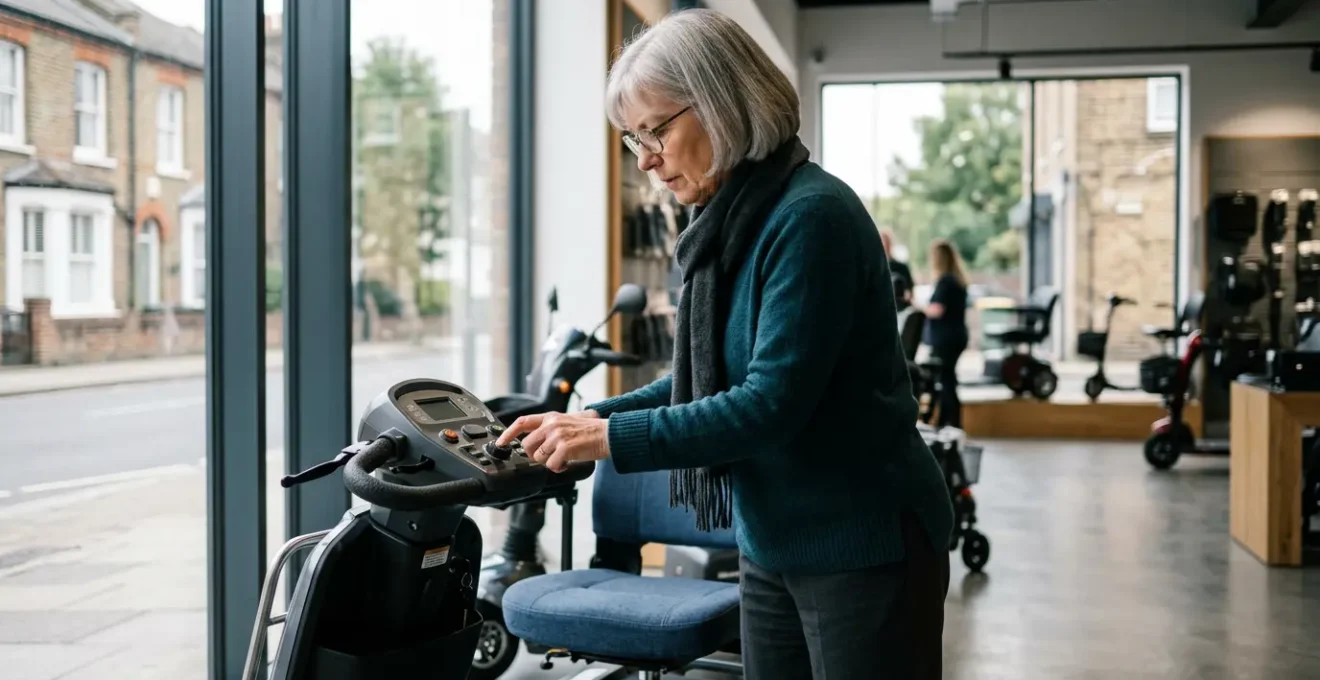
Choosing your first mobility scooter is a major financial and logistical decision, where the biggest risks—DVLA fines, un-claimable VAT, and a scooter that won’t fit your home—are rarely discussed by retailers.
- The legal difference between a Class 2 (pavement) and Class 3 (road) scooter dictates registration, insurance needs, and potential penalties.
- Hidden running costs for insurance and servicing can add over £300 per year to your expenses, a crucial factor beyond the initial purchase price.
Recommendation: Before visiting a showroom, measure your home’s narrowest points and doorways, verify your eligibility for 20% VAT relief, and understand the real-world running costs to create a realistic budget.
Embarking on the journey to purchase your first mobility scooter is an empowering step towards renewed independence. For many, it’s a passport to rediscovering local shops, parks, and the simple freedom of movement. However, the path is often clouded with confusing jargon, from « Class 2 vs. Class 3 » to the intricacies of NHS funding and VAT relief. Most guides will tell you to « think about where you’ll use it » or « check the battery range, » but this advice barely scratches the surface of the UK’s specific regulatory and practical landscape. As a veteran mobility specialist, I’ve seen too many well-intentioned buyers make costly errors that a simple brochure will never warn you about.
The reality is that the wrong choice can lead not just to frustration but to unexpected DVLA fines, hundreds of pounds in unforeseen annual costs, or owning a machine that can’t even get through your own front door. The key to a successful purchase isn’t found in a glossy features list, but in a strategic understanding of the hidden logistics and financial obligations. This guide is designed to move beyond the sales pitch. We will demystify the critical, UK-specific questions you need to answer before you spend a single penny. We’ll explore the legal minefields, the real-world measurement tests for your home, the true cost of ownership, and the correct way to navigate funding and tax relief to ensure your investment truly serves your independence for years to come.
This article provides a comprehensive roadmap for first-time buyers in the UK. By following the structured advice within, you will be equipped to make a confident, informed, and financially savvy decision. The following sections break down each critical consideration step-by-step.
Summary: A BHTA Expert’s Guide: Choosing Your First UK Mobility Scooter Without Costly Mistakes
- Why Choosing the Wrong Class Could Lead to DVLA Fines?
- How to Measure Your Hallway or Shed Before Buying a Scooter?
- NHS Wheelchair Services or Motability: Which Route Get You Funded Faster?
- The Mistake of Ignoring Insurance and Service Costs That Adds £300/Year
- Why a 10-Minute Car Park Test Drive Is Not Enough for UK Pavements?
- Chronically Sick vs Temporarily Injured: Do You Qualify for VAT Relief?
- Hatchback or Saloon: Will It Fit Without Folding the Back Seats?
- How to Claim VAT Relief on a Medical Scooter in the UK Correctly?
Why Choosing the Wrong Class Could Lead to DVLA Fines?
The single most important decision you’ll make is choosing between a Class 2 and a Class 3 mobility scooter. This isn’t just about speed; it’s a legal distinction with significant consequences. Class 2 scooters are designed for pavement use only, with a maximum speed of 4 mph. Class 3 scooters are road-legal, capable of 8 mph on the road (but must be limited to 4 mph on pavements), and come with a host of mandatory requirements similar to a car, including lights, indicators, a horn, and rear-view mirrors. Critically, a Class 3 scooter must be registered with the DVLA. While there is no road tax to pay, failure to register can lead to penalties.
The risks of non-compliance are severe and often underestimated by first-time buyers. Driving a Class 3 scooter on the road without the required features or registration is illegal. As the DVLA makes clear, the consequences can be life-altering. In an official statement on the matter, the DVLA warns about the potential penalties:
If you cause an accident while driving a mobility scooter or powered wheelchair that’s not in a class, you can be given the same penalty as if you were driving a car. You can go to prison, get a driving ban or get an unlimited fine.
– DVLA, GOV.UK Mobility Scooters and Powered Wheelchairs Rules
This underscores the importance of understanding the rules before you buy. Choosing a Class 3 scooter for its higher speed without being prepared for the legal responsibilities is a serious financial and personal risk. The following table from the official GOV.UK guidance breaks down the key differences you must be aware of.
| Requirement | Class 2 (Pavement) | Class 3 (Road Legal) |
|---|---|---|
| Maximum Speed | 4 mph | 8 mph on road, 4 mph on pavement |
| DVLA Registration | Not required | Required |
| Road Tax | Not required | Exempt but must be registered |
| Lights and Reflectors | Not required | Required (front and rear) |
| Indicators | Not required | Required |
| Horn | Not required | Required |
| Rear-view Mirror | Not required | Required |
| Minimum Age | No minimum | 14 years |
| Maximum Weight | 113.4 kg unladen | 150 kg unladen |
| Road Use | No (except where no pavement) | Yes (not motorways or bus lanes) |
How to Measure Your Hallway or Shed Before Buying a Scooter?
One of the most common and costly mistakes is buying a scooter that doesn’t fit your living environment. A sleek model that performs beautifully in a spacious showroom can become a cumbersome obstacle in the confines of a typical UK home, especially in older properties like Victorian terraces with their characteristically narrow hallways. Before you even think about battery life or colour, you must conduct a thorough ‘Hallway Test’. This means taking a tape measure to every critical access point in your home. The scooter’s width and turning circle are the two most important specifications to check against your measurements.
Start with your front door, measuring its width at the narrowest point. A standard UK front door is around 762mm to 838mm, but older doors can be smaller. Next, measure your hallway’s width, paying close attention to any pinch points like radiators or furniture. To assess the turning circle, measure diagonally from corner to corner in the tightest part of your hall; this will give you an idea of the space available for a three-point turn. Don’t forget about storage. Whether it’s a shed, garage, or a space under the stairs, measure the depth, width, and height to ensure the scooter will fit comfortably, with enough room left over for you to access it and for a charging point.
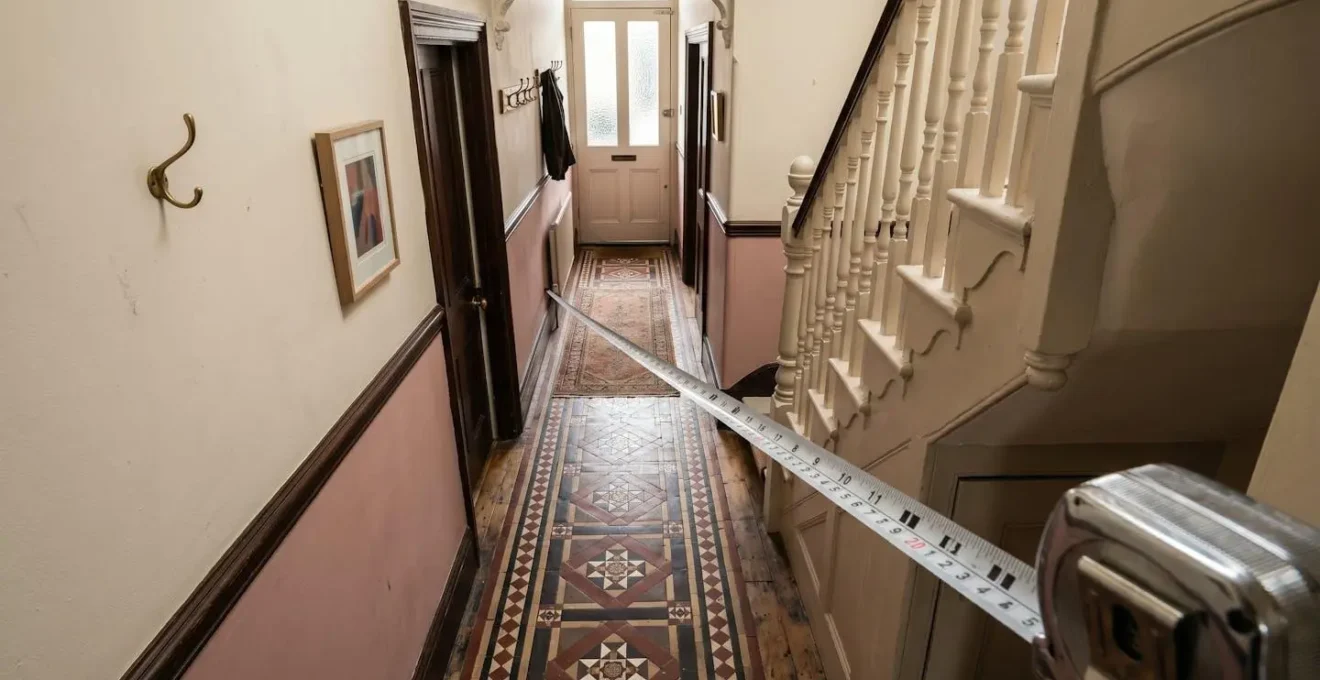
This measurement process is your first and most important piece of due diligence. Remember to also account for threshold heights between rooms, steps at the entrance, and the dimensions of any lifts if you live in a flat. A scooter is only a tool for independence if it can be easily stored, charged, and moved in and out of your home. A model that is too large becomes a barrier, not a facilitator.
NHS Wheelchair Services or Motability: Which Route Get You Funded Faster?
For many, the cost of a mobility scooter is a significant barrier. Fortunately, there are two primary funding routes in the UK: NHS Wheelchair Services and the Motability Scheme. However, they operate very differently in terms of eligibility, speed, and choice. Understanding which path is right for you can save you months of waiting and frustration. NHS Wheelchair Services are accessible via a GP referral and are based on clinical need. The key criteria is a long-term medical condition (over 6 months) that impairs your mobility. While the equipment and repairs are provided free of charge, the process can be notoriously slow. In fact, 70% of wheelchair users wait more than three months for their assessment and equipment delivery through the NHS.
In contrast, the Motability Scheme offers a much faster route for those who qualify. Eligibility is not based on a GP referral but on receiving a qualifying mobility allowance, such as the Enhanced Rate of the Mobility Component of Personal Independence Payment (PIP) or the Higher Rate Mobility Component of Disability Living Allowance (DLA). Once your eligibility is confirmed, you can lease a new scooter or powered wheelchair, with the payments taken directly from your allowance. The package typically includes insurance, breakdown assistance, and all servicing and repairs. While you may need to contribute towards a more expensive model, the process is generally measured in weeks, not months. The table below provides a clear comparison to help you decide which route aligns best with your circumstances.
| Route | Eligibility Requirement | Typical Timeline | Insurance Included | Repairs Covered | Choice Range |
|---|---|---|---|---|---|
| NHS Wheelchair Services | GP referral + long-term need (6+ months) | 3+ months average waiting time | No | Yes (free via approved repairer) | Limited to standard NHS models |
| Motability Scheme | Enhanced rate mobility component (PIP/DLA) | Faster (weeks once eligibility confirmed) | Yes (included) | Yes (included in package) | Wider range with potential contribution |
| Private Purchase | None | Immediate | No (purchased separately) | No (user responsibility) | Full market choice |
The choice between NHS and Motability often comes down to a trade-off: the potentially no-cost but slow and limited NHS route versus the faster, more comprehensive, but allowance-dependent Motability scheme. If you are not eligible for either, a private purchase remains the third option, offering immediate access and full market choice but with all costs falling to you.
The Mistake of Ignoring Insurance and Service Costs That Adds £300/Year
A common oversight for first-time buyers is focusing solely on the sticker price of the scooter. This can be a significant financial mistake, as the total cost of ownership includes several recurring annual expenses that can easily add hundreds of pounds to your budget. While mobility scooter insurance is not legally mandatory for Class 2 scooters, it is strongly recommended by every reputable body, including the BHTA. For Class 3 scooters used on the road, it is a practical necessity.
Public liability insurance is the most crucial cover. This protects you financially if you cause an accident resulting in injury to someone else or damage to their property. Considering the potential for unlimited fines mentioned by the DVLA, this is not an area to cut corners. Policies for basic public liability can start from as little as £38-£45 per year. Comprehensive insurance, which also covers theft, vandalism, and accidental damage to your own scooter, will cost more but provides complete peace of mind. Beyond insurance, you must budget for an annual service. Just like a car, a scooter needs a regular safety check by a qualified engineer to inspect brakes, batteries, tyres, and mechanical parts. This is essential for safe operation and typically costs between £80 and £120.
Finally, batteries are a consumable item. Depending on usage, a set of scooter batteries will need replacing every one to two years, representing another significant recurring cost. When you add these expenses together, the real running cost of a scooter becomes clear.
The following breakdown, based on industry data from providers like TGA Mobility, shows how these hidden costs can accumulate, reaching over £300 annually.
| Cost Category | Estimated Annual Cost | What It Covers | Is It Mandatory? |
|---|---|---|---|
| Public Liability Insurance | £40-£65 | Injury to others, damage to property | No, but strongly advised |
| Comprehensive Insurance | £100-£150 | Theft, vandalism, accidental damage, breakdown | No, but recommended |
| Annual Service | £80-£120 | Safety check, mechanical inspection, parts adjustment | No, but essential for safety |
| Battery Replacement (every 1-2 years) | £50-£150 (prorated) | Replacement batteries | Yes (consumable item) |
| Total Annual Running Cost | £220-£335 | Full protection and maintenance | – |
Why a 10-Minute Car Park Test Drive Is Not Enough for UK Pavements?
Every retailer will offer you a test drive, but a quick spin on a smooth, flat showroom floor or car park is woefully inadequate for assessing how a scooter will perform in the real world. The reality of British pavements is a gauntlet of challenges: dropped kerbs, cracked paving slabs, adverse cambers (slopes), and narrow passages. A scooter that feels stable and powerful in ideal conditions may feel dangerously unsteady or underpowered when faced with these everyday obstacles. To make a confident choice, you must conduct what I call the ‘Pavement Gauntlet’ Test Drive, simulating the actual conditions you will encounter daily.
The most important test is mounting a dropped kerb. You must approach it head-on (at a right angle) to avoid tipping and assess whether the scooter has enough power and ground clearance to climb the incline without getting stuck. Another crucial test is navigating a sloped pavement, which is common on many UK streets. Check how the scooter handles both uphill and downhill; do the brakes feel responsive and can you maintain control easily? You should also practice reversing into a tight space, like a doorway, to test its manoeuvrability. The suspension is another key factor. Driving over deliberately uneven surfaces will quickly reveal how much comfort the scooter provides—a stiff ride can be jarring and painful over longer distances.

A reputable supplier should be happy to let you test the scooter in a more realistic environment. Ask to try it on the pavement outside the shop. Take it into a local café or post office to see if it can navigate doorways and tight aisles. Your comfort is paramount, so ensure you can reach all the controls without straining and that the seat provides adequate support for the duration of your typical journey. This real-world testing is the only way to be certain that the scooter you choose is a true partner for your independence.
Chronically Sick vs Temporarily Injured: Do You Qualify for VAT Relief?
One of the most significant ways to reduce the cost of your mobility scooter is by qualifying for VAT relief, which effectively provides a 20% discount on the purchase price. However, there is widespread confusion about who is eligible. It is a common myth that you need to be registered disabled or be receiving disability benefits to qualify. This is not true. The eligibility criteria are defined by HMRC and are based on a simple ‘litmus test’: are you « chronically sick or disabled »?
To provide clarity, HMRC has issued specific guidance. As an official expert on the topic, HMRC states:
For VAT purposes, you’re chronically sick or disabled if you have a physical or mental impairment which has a long term and substantial adverse effect on your ability to carry out everyday activities or a condition that the medical profession treats as a chronic sickness.
The key phrase here is « long term. » This is the dividing line. If you have a temporary injury, such as a broken leg, from which you are expected to make a full recovery, you do not qualify. The relief is intended for individuals with ongoing conditions. This includes not only physical impairments but also conditions the medical profession treats as chronic, such as arthritis, multiple sclerosis (MS), diabetes, or heart disease. It’s also important to note that you do not need a doctor’s note; eligibility is based on self-declaration.
To make it simpler, here is a breakdown of the criteria based on HMRC’s Notice 701/7:
- QUALIFYING: You have a physical or mental impairment with a long-term (lasting or expected to last for at least 12 months) and substantial adverse effect on your ability to carry out everyday activities.
- QUALIFYING: You have a condition treated as a chronic sickness by the medical profession, such as arthritis, MS, or severe heart conditions.
- QUALIFYING: You have a terminal illness.
- NOT QUALIFYING: You are an elderly person who is able-bodied. Age alone does not qualify you.
- NOT QUALIFYING: You have a temporary disability, such as a broken limb or are recovering from an operation, and are expected to fully heal.
Hatchback or Saloon: Will It Fit Without Folding the Back Seats?
For many users, the ability to transport their scooter by car is non-negotiable. This brings another logistical challenge: will it actually fit in your boot? This is a question where precise measurements are everything. You need to know both the dimensions of your car’s boot and the dimensions of the scooter, particularly a ‘car boot’ or ‘folding’ model when it is disassembled or folded. The heaviest part of a disassembled boot scooter typically weighs between 10-15kg, a crucial factor for anyone who will be lifting it. Before you buy, measure your boot’s depth, width at the narrowest point, and the height from the floor to the parcel shelf or boot lip.
To assist with this, the table below provides an approximate compatibility guide for some of the UK’s most popular car models. This should be used as a starting point, but always double-check with the specific dimensions of the scooter you are considering. A « tight fit » may mean the scooter only just fits, while « may require seats down » indicates it will likely not fit without folding down your rear seats, reducing passenger space. A smaller supermini like a Toyota Yaris may struggle to accommodate anything other than a micro or lightweight folding scooter.
| UK Car Model | Boot Depth (mm) | Boot Width (mm) | Boot Height (mm) | Micro Scooter | Folding Scooter | Car Boot Scooter |
|---|---|---|---|---|---|---|
| Ford Fiesta | 980 | 1060 | 750 | ✓ Yes | ✓ Yes | Tight fit |
| Vauxhall Corsa | 950 | 1030 | 720 | ✓ Yes | ✓ Yes | May require seats down |
| Volkswagen Golf | 1070 | 1120 | 830 | ✓ Yes | ✓ Yes | ✓ Yes |
| Nissan Qashqai | 1200 | 1350 | 900 | ✓ Yes | ✓ Yes | ✓ Yes |
| Ford Focus | 1050 | 1100 | 800 | ✓ Yes | ✓ Yes | ✓ Yes |
| Honda Civic | 1000 | 1070 | 760 | ✓ Yes | ✓ Yes | Check dimensions |
| Toyota Yaris | 890 | 1000 | 700 | ✓ Yes | Tight fit | No |
| Skoda Octavia | 1150 | 1200 | 850 | ✓ Yes | ✓ Yes | ✓ Yes |
| Peugeot 208 | 960 | 1040 | 730 | ✓ Yes | ✓ Yes | May require seats down |
| Hyundai Tucson | 1250 | 1400 | 920 | ✓ Yes | ✓ Yes | ✓ Yes |
| Note: Measurements are approximate. Always verify with specific scooter dimensions before purchase. Typical car boot scooters when disassembled: heaviest part 10-15kg, dimensions approximately 650mm x 400mm x 350mm. | ||||||
If lifting is a concern or if your chosen scooter is too heavy, there are two main solutions: ramps and hoists. Portable aluminium ramps, costing around £80-£200, allow you to wheel the scooter into the boot but require physical effort. A professionally installed car boot hoist, costing £400-£800, can lift scooters up to 40kg automatically but requires a permanent vehicle installation. This is an essential consideration for users with limited strength or for heavier scooter models.
Key Takeaways
- Distinguish between Class 2 (pavement) and Class 3 (road-legal) scooters to avoid DVLA fines and ensure legal compliance.
- Measure your home’s doorways, hallways, and storage spaces meticulously before buying to ensure the scooter will fit your environment.
- Understand the full ‘Total Cost of Ownership’, including annual insurance (£40-£150) and servicing (£80-£120), not just the initial price tag.
How to Claim VAT Relief on a Medical Scooter in the UK Correctly?
Once you’ve confirmed your eligibility for VAT relief, the process of claiming it is straightforward, but it must be done correctly and at the right time. The most important rule is that VAT relief must be applied at the point of sale; it cannot be claimed back from HMRC later. This means you must inform the supplier that you qualify *before* you pay. This simple action can result in an immediate 20% savings on qualifying items, which is a substantial discount on a major purchase. This relief doesn’t just apply to new scooters; a crucial point often missed is that it covers more.
As the official guidance confirms, the scope is broader than many realise. A key clarification from HMRC states:
VAT relief also applies to second-hand scooters sold by a dealer, as well as essential spares and repair services, as long as the user qualifies.
– HMRC, VAT Notice 701/7 – Reliefs from VAT for disabled and older people
This means that ongoing costs for maintaining your independence can also be reduced. When you inform the supplier, they will provide you with a simple eligibility declaration form to complete. This is a self-declaration and does not require a doctor’s signature or any medical proof. You simply need to provide your name, address, and state the nature of your chronic sickness or disability. The retailer is responsible for keeping this form for their records. To ensure you follow the process correctly and secure your discount, follow the simple action plan below.
Action Plan: Your 4-Step VAT Relief Process
- Confirm Eligibility: First, verify that you are chronically sick or disabled (as defined by HMRC) and are purchasing the scooter for your own personal or domestic use.
- Inform Supplier Before Payment: This is the critical step. You must tell the retailer that you qualify for VAT relief before you finalise the transaction. The discount is applied at the source, not refunded later.
- Complete the Declaration Form: The supplier will ask you to fill in and sign a simple VAT exemption declaration form. This will state your name, address, and the nature of your disability.
- Verify the Final Invoice: After paying, check your invoice to ensure it clearly shows 0% VAT on the eligible items. The final price should be the VAT-exclusive price. Keep a copy for your records.
By following these four steps, you can confidently and correctly claim the significant savings to which you are entitled, making your journey to renewed mobility more affordable.