For riders with sensitive joints, the best tire isn’t a single product, but a component within a complete comfort system.
- Pneumatic (air-filled) tires are unmatched in absorbing the high-frequency vibrations that aggravate joint pain.
- Solid tires trade this micro-compliance for puncture immunity, making a robust suspension system non-negotiable.
Recommendation: Prioritize a scooter with full suspension and pair it with pneumatic tires for the ultimate pain-free ride. Use tire sealant as a low-cost insurance policy against flats.
The debate between pneumatic and solid scooter tires often boils down to a simple trade-off: comfort versus convenience. For the average rider, a puncture-proof solid tire might seem like a straightforward, hassle-free upgrade. But for individuals managing arthritis, back pain, or other joint sensitivities, this choice is not about convenience—it’s a critical decision that directly impacts their daily comfort, mobility, and well-being. The constant, high-frequency vibrations transmitted from hard tires through the scooter frame can turn a pleasant ride into a painful ordeal.
Many discussions stop at this surface-level comparison, suggesting that if you want comfort, you must accept the risk of flats. This perspective is incomplete. True ride comfort isn’t born from a single component, but from a holistic system where the tires, suspension, and even the rider’s posture work in harmony to dissipate road energy before it reaches the body. The search for a smooth ride is not a luxury; for those with joint pain, it’s a necessity for maintaining an active and independent lifestyle.
But what if the solution wasn’t just choosing « air » over « solid, » but understanding how to master the properties of your chosen system? The key lies in moving beyond the binary choice and embracing a new framework: the « Comfort Trinity. » This approach involves managing the entire energy absorption chain, from the rubber that meets the road to the final damping elements that protect your spine.
This guide will deconstruct the physics of ride comfort, moving past the generic pros and cons. We will explore how to mitigate the primary drawback of air-filled tires, quantify the real-world impact of tire pressure, and examine the science of vibration on joint pain. By the end, you’ll be equipped not just to choose a tire, but to engineer a complete mobility solution tailored to your body’s specific needs.
This article provides a detailed breakdown of every factor to consider when choosing between pneumatic and solid tires, especially for users with joint sensitivity. The following sections will guide you through the intricacies of tire maintenance, performance, and its interaction with scooter suspension to help you build the most comfortable ride possible.
Summary: Pneumatic vs. Solid Tires: Which Option Offers the Smoothest Ride for Arthritic Joints?
- Sealant Slime: Can You Prevent Flats Without Changing the Tube?
- PSI Impact: Why Under-Inflated Tires Drain Your Battery Faster?
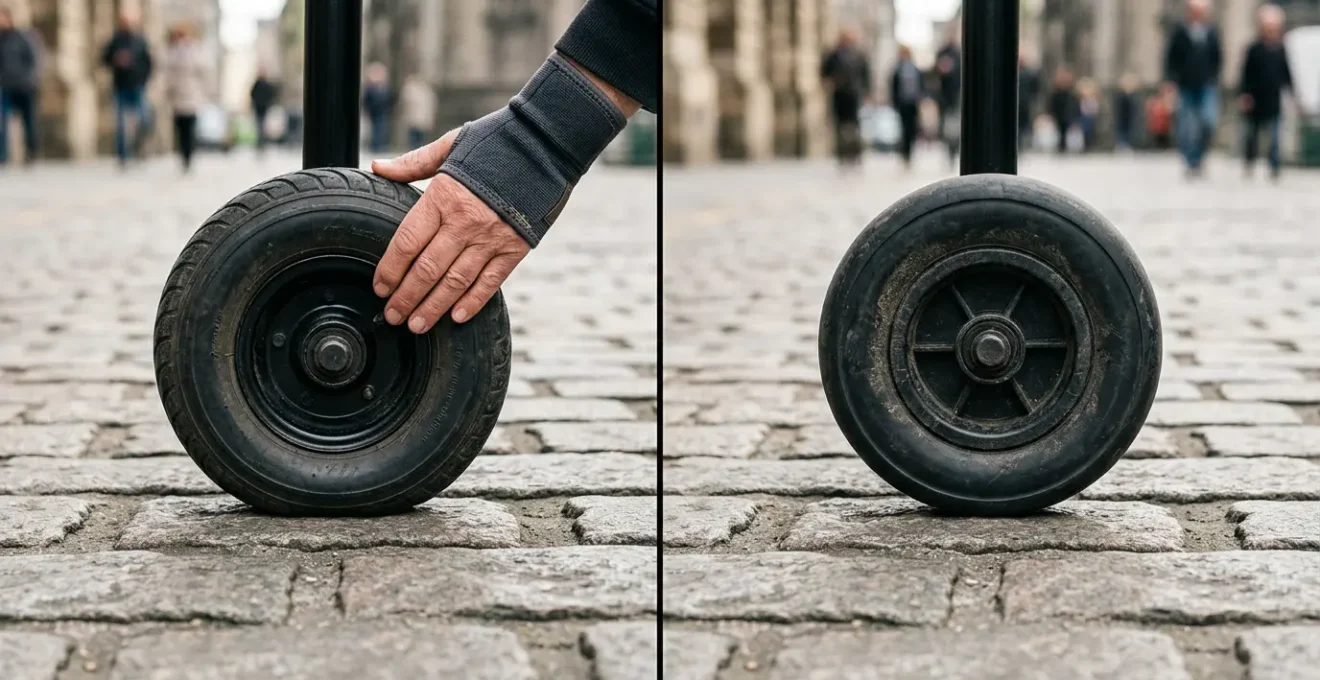
- The Vibration Test: Comparing Solid vs Air on Cobblestones
- Why Pneumatic Tires Offer Better Traction on Wet UK Pavements?
- The Best of Both Worlds? Pros and Cons of Infill Tires
- Thread Depth: How to Know When Your Tires Are Too Bald for Off-Roading?
- Why Solid Tires Need Suspension to Avoid Rattling Your Teeth?
- Why Full Suspension Is Critical for Users with Back Pain on Uneven Pavements?
Sealant Slime: Can You Prevent Flats Without Changing the Tube?
The primary deterrent for many prospective pneumatic tire users, especially those with limited hand strength or mobility due to arthritis, is the fear of getting a flat. The prospect of being stranded or facing a difficult roadside repair is a significant concern. However, modern technology offers a remarkably effective and low-cost solution: tire sealant, often known by the popular brand name « Slime. » This viscous, fibrous liquid is injected into the inner tube and remains dormant until a puncture occurs.
When a sharp object penetrates the tire, the escaping air forces the sealant into the hole. The fibers and polymers in the liquid clog the opening, and the sealant quickly coagulates to form a permanent, flexible plug. This process is automatic and often happens so quickly the rider may not even notice a puncture has occurred. For a small initial effort, you gain significant peace of mind, effectively giving your comfortable air-filled tires the reliability of a solid tire for most common road hazards.
While it’s not a magical cure for all types of tire damage—it won’t fix large gashes or sidewall damage—it’s incredibly effective against the most frequent culprits like thorns, glass shards, and nails. Crucially, research shows that tire sealant effectively seals punctures up to 1/4 inch (or about 6mm) in diameter. This covers the vast majority of threats you’ll encounter on paved surfaces, transforming the flat tire from a probable nuisance into a remote possibility.
Action Plan: 5-Step Tire Sealant Installation
- Remove the Valve Core: Use the small tool often included with the sealant cap to unscrew and remove the inner pin from your tire’s valve stem.
- Inject the Sealant: Connect the hose from the sealant bottle to the valve stem and gently squeeze in the manufacturer-recommended amount, typically around 4 oz (118 mL) per scooter tire.
- Reinstall the Valve Core: Securely screw the valve core back into the valve stem until it is snug. Do not overtighten.
- Re-inflate the Tire: Inflate the tire to your scooter’s recommended PSI. Be sure to wipe any sealant residue from the valve tip.
- Distribute the Sealant: Immediately after inflating, spin the wheel for a minute or two to ensure the sealant coats the entire inner surface of the tire, ready to plug any future leaks.
PSI Impact: Why Under-Inflated Tires Drain Your Battery Faster?
Maintaining the correct tire pressure, or PSI (Pounds per Square Inch), is the single most important maintenance task for any pneumatic tire user. For riders with joint pain, it’s a dual-purpose adjustment: it fine-tunes ride comfort and directly impacts the scooter’s efficiency. An under-inflated tire has a larger, « mushier » contact patch with the road. This increased surface area creates significantly more rolling resistance, a force that the scooter’s motor must constantly work to overcome. Essentially, you’re forcing the motor to fight against your own tires.
This extra workload translates directly into increased battery consumption. The motor draws more power to maintain the same speed, draining your battery faster and reducing your overall range. The effect is not trivial; controlled tests demonstrate that a 3% range reduction can occur for every 1 PSI drop below the recommended pressure. For a scooter with a 20-mile range, being just 5 PSI low could steal over 3 miles from your journey. For riders who rely on their scooter for essential travel, this loss of range can be a major issue.
This is why a reliable, easy-to-use tire pressure gauge is a critical tool. For users with arthritis or limited hand strength, traditional gauges can be difficult to handle. Modern digital gauges with ergonomic designs are a game-changer.
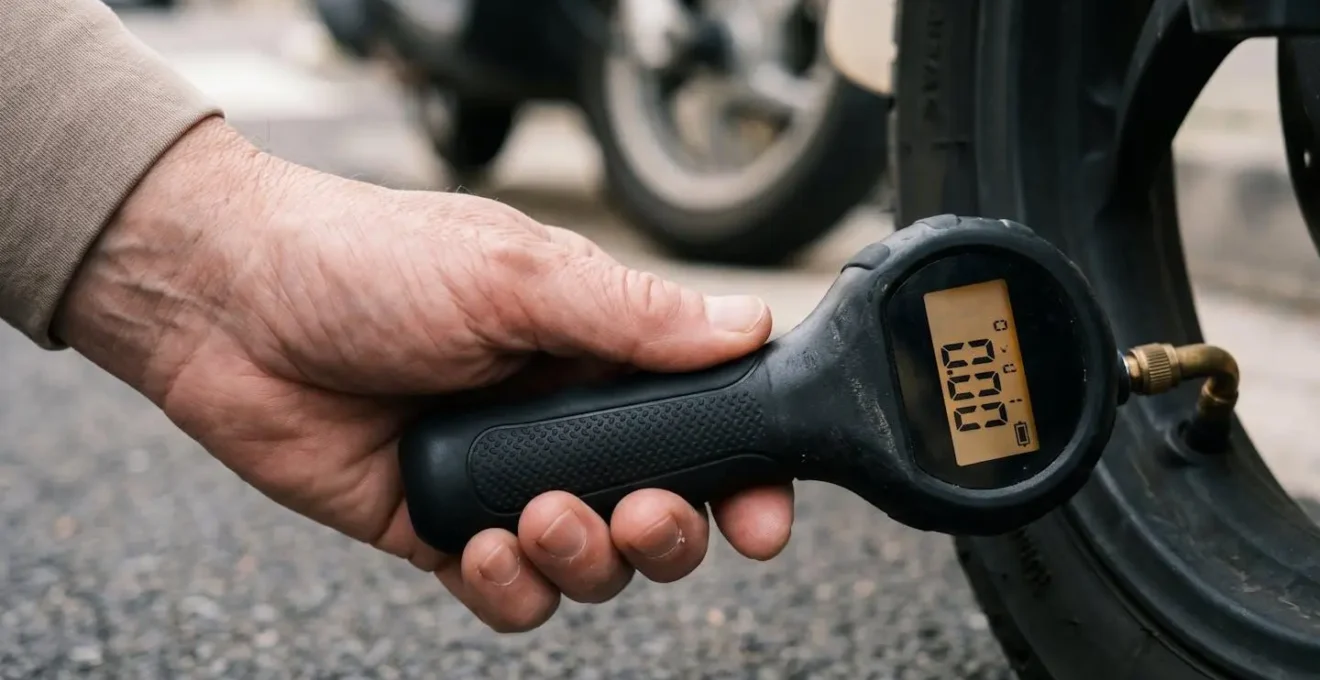
These devices, as shown above, feature large, backlit displays and comfortable grips, requiring minimal force to get an accurate reading. Regularly checking your PSI (ideally weekly) ensures you always have the optimal balance of comfort, grip, and, most importantly, maximum range from every charge.
Case Study: The TurboAnt V8 Range Test
A comprehensive study on the TurboAnt V8 electric scooter provided clear evidence of PSI’s effect on range. The same 175 lbs rider performed eight identical test runs, draining the battery from 100% to 0% at various tire pressures. The results unequivocally showed that under-inflated tires dramatically increased rolling resistance. This forced the motor to work harder, draining the battery and reducing the scooter’s maximum range by approximately 3% for every single PSI drop below the optimal pressure, confirming the direct economic cost of improper inflation.
The Vibration Test: Comparing Solid vs Air on Cobblestones
Imagine riding over a cobblestone street. With solid tires, every single edge, crack, and stone gap is transmitted as a sharp, high-frequency jolt through the frame and into your hands, feet, and spine. This is the « rattling » sensation that so many solid tire users report. A pneumatic tire, by contrast, behaves very differently. Its flexible casing and pressurized air allow it to deform and envelop these small, sharp imperfections. Instead of transmitting a jolt, it absorbs the energy, effectively erasing the micro-bumps from the ride experience. This ability to handle high-frequency vibrations is the core reason air-filled tires provide a superior ride for sensitive joints.
Interestingly, not all vibration is detrimental. The conversation around vibration and joint health is nuanced. While the harsh, jarring impacts from solid tires are clearly undesirable, some forms of vibration can be therapeutic. For instance, Whole-Body Vibration (WBV) therapy is a recognized treatment for certain conditions. A fascinating study on knee osteoarthritis showed that specific frequencies of vibration could actually help manage pain. The study found that a randomized controlled trial on knee osteoarthritis patients found that low-frequency vibrations in the 10-20 Hz range led to reduced joint pain after just three weeks of exposure.
This highlights a critical distinction: the low-frequency, controlled oscillations of therapy are vastly different from the chaotic, high-frequency, high-impact « noise » generated by a solid tire on an imperfect surface. The latter is what causes discomfort and aggravates arthritic conditions. Pneumatic tires excel at filtering out this harmful end of the vibration spectrum, providing a ride that is not just more comfortable, but actively less aggravating to sensitive joints.
Both low- and high-frequency WBV training significantly reduced pain, improved self-reported function and TUG test.
– Systematic Review Authors – PMC Medical Research Database, Effects of Whole-Body Vibration Therapy on Knee Osteoarthritis: Systematic Review and Meta-Analysis
Why Pneumatic Tires Offer Better Traction on Wet UK Pavements?
For riders in regions with frequent rainfall, like the UK, traction is not just a performance metric—it’s a critical safety feature. On wet surfaces, the difference in grip between pneumatic and solid tires becomes starkly apparent. The superiority of pneumatic tires lies in a simple principle of physics: the flexibility of the contact patch. An air-filled tire can deform under pressure, allowing its surface to mold to the micro-irregularities of the pavement. This creates a larger, more effective contact area, squeezing out the thin layer of water that causes slipperiness and maintaining a mechanical grip on the road.
Solid tires, due to their rigid construction, cannot do this. Their contact patch remains relatively fixed, meaning they are more likely to skate on top of the water film—a phenomenon similar to hydroplaning. This leads to a noticeable reduction in grip during acceleration, braking, and especially cornering, where stability is paramount. The risk of the wheels slipping out from under you is significantly higher with solid tires in wet conditions.
Furthermore, the grip of pneumatic tires can be fine-tuned. As controlled wet grip testing reveals that lower tire pressures increase wet grip, riders can make small adjustments to optimize for slick conditions. By slightly reducing the PSI, you increase the tire’s ability to deform, maximizing the contact patch and enhancing safety. This level of adaptability is simply not possible with solid tires.
| Tire Type | Wet Surface Traction | Dry Surface Traction | Contact Patch Flexibility |
|---|---|---|---|
| Pneumatic (Air-Filled) | Superior – deforms to mould around wet surfaces | Excellent – maintains grip during acceleration and braking | High – air pressure allows tire to conform to road irregularities |
| Solid Rubber | Reduced – rigid surface provides less grip on wet or slippery conditions | Good on smooth surfaces | Low – minimal deformation limits contact area |
The Best of Both Worlds? Pros and Cons of Infill Tires
In the quest to combine the comfort of pneumatic tires with the reliability of solids, a third category has emerged: infill or « airless » tires. These designs, most notably honeycomb tires, attempt to bridge the gap by replacing pressurized air with an engineered internal structure. Instead of a hollow tube, they feature a matrix of hexagonal or circular voids made of rubber or a similar polymer. The idea is that these voids will compress under load, mimicking the cushioning effect of a pneumatic tire while being completely immune to punctures.
The concept is brilliant, and visually, the technology is impressive. The internal structure is a feat of engineering designed to provide shock absorption without inflation. For many riders, this seems like the perfect solution—a true « set it and forget it » tire that still offers a degree of comfort.
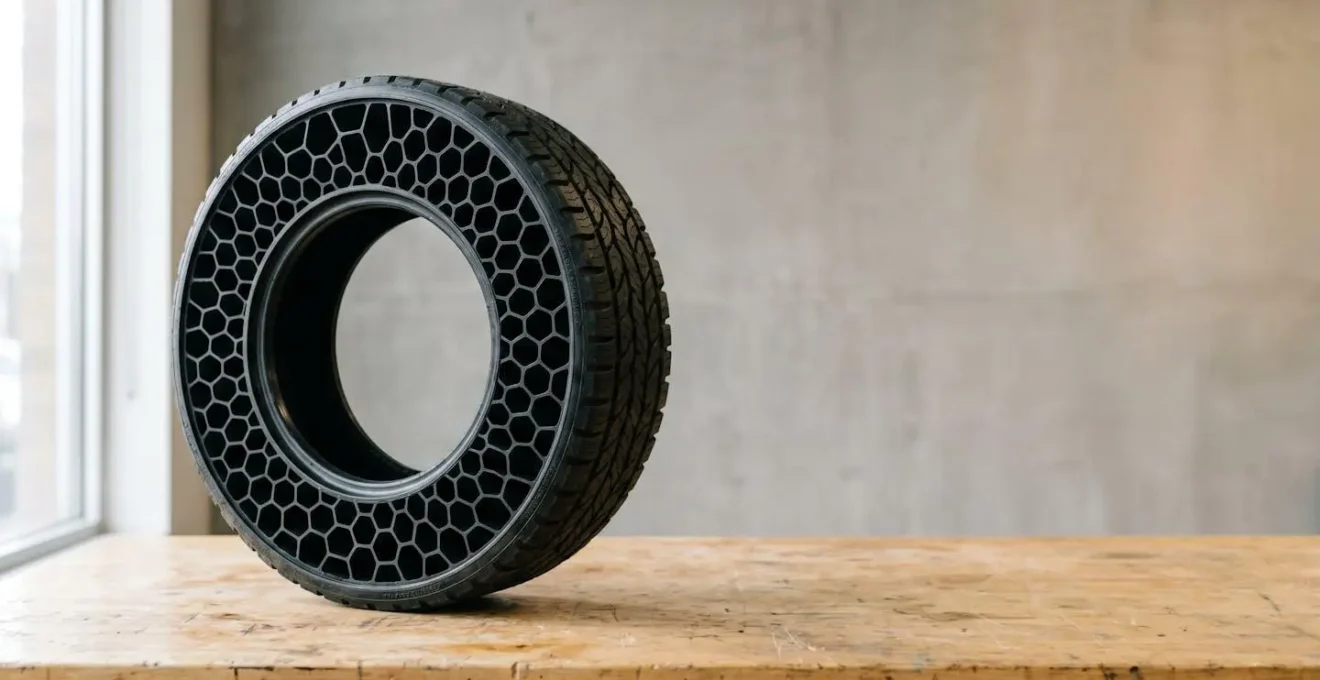
However, the reality is a story of compromise. While honeycomb tires are certainly more comfortable than their fully solid counterparts, they cannot fully replicate the nuanced damping of pressurized air. They tend to perform reasonably well on small bumps but can feel harsh on larger impacts. The engineered structure has a fixed level of compliance, unlike a pneumatic tire whose pressure can be tuned for rider weight and terrain. Over time, the polymer can also harden or lose its elasticity, leading to a gradual degradation in ride quality.
Furthermore, they are often heavier than both standard pneumatic and solid tires, adding to the unsprung weight of the scooter, which can negatively affect handling. While they successfully eliminate the risk of flats, they represent a middle ground in comfort—better than solid, but a noticeable step down from a properly inflated pneumatic tire. For a rider with sensitive joints, that step down can make all the difference. They are a viable option, but not the magical « best of both worlds » they are often marketed as.
Thread Depth: How to Know When Your Tires Are Too Bald for Off-Roading?
While this guide focuses on paved surfaces where arthritic joints are most affected, tire health, specifically tread depth, is a universal concern. The tread on your tires serves a primary purpose: to channel water, dirt, and debris away from the contact patch, maintaining grip. As a tire wears down, its ability to perform this function diminishes dramatically. A « bald » tire has very little to no tread depth, making it dangerously slippery on wet or loose surfaces.
For off-roading, deep, aggressive treads are essential to bite into soft ground. A bald tire would be useless. But even on pavement, tread is crucial for wet weather safety. As a tire wears, its performance profile changes. The tire wet grip mechanism analysis demonstrates that while rubber grip is the predominant mechanism of a new tire, both hydroplaning and rubber friction become equally important for worn tires. This means a worn tire is far more susceptible to losing contact with the road in the wet.
So, how do you know when your tires are too worn? Most scooter tires have « wear indicators »—small raised bars of rubber located inside the main tread grooves. When the surrounding tread has worn down to be level with these indicators, it’s a clear signal that the tire has reached the end of its safe operational life and must be replaced. Ignoring this can severely compromise your braking ability and cornering stability, especially when you need it most. When it’s time to replace them, the fundamental choice between comfort and convenience resurfaces, and experts consistently lean one way.
Pneumatic tires always provide the most comfortable ride as opposed to solid wheels that are manufactured from denser rubber.
– TGA Mobility Scooter Specialists Research Team, Puncture Proof Sealant for Mobility Scooter Tires
Key Takeaways
- For joint pain, the vibration-damping of pneumatic tires is superior to solid or honeycomb options.
- Proper tire pressure (PSI) is critical, impacting not just comfort but also battery range by up to 3% per PSI.
- A complete comfort system (« Comfort Trinity ») involves synergistic pairing of pneumatic tires, full suspension, and a shock-absorbing seat.
Why Solid Tires Need Suspension to Avoid Rattling Your Teeth?
Solid tires are built for one primary mission: to be indestructible. They are made of a dense, solid rubber or polymer compound that simply cannot go flat. This complete immunity to punctures is their single greatest advantage. However, this indestructibility comes at a steep price in terms of ride quality. Because there is no air to compress and absorb impacts, every single vibration and jolt from the road surface is transferred directly into the tire, through the wheel, and up into the scooter’s frame.
Without a mediating force, this energy continues its journey straight into the rider’s body. The result is a harsh, jarring ride that can feel punishing on anything but the smoothest of surfaces. As one review team aptly put it, the experience can be very telling on imperfect roads.
Everything other than the flattest of roads made the scooter shake quite a lot.
– EScooterNerds Technical Review Team, Pneumatic Tires vs Solid Tires For Your Electric Scooter
This is why pairing solid tires with a robust suspension system is not just a luxury—it’s an absolute necessity for anyone seeking a tolerable ride. The suspension (whether spring, hydraulic, or elastomer-based) becomes the primary and often only line of defense against road vibrations. It has to do all the work that a pneumatic tire would normally handle. Without suspension, the comparative ride quality analysis reveals that solid tires provide a harsher ride with absence of cushioning putting more stress on the scooter’s frame and rider’s body. This places immense strain not only on the rider’s joints but also on every weld, bolt, and electronic component of the scooter itself, potentially leading to premature wear and failure.
Why Full Suspension Is Critical for Users with Back Pain on Uneven Pavements?
We’ve established that pneumatic tires are the first line of defense against high-frequency vibrations. But what about larger impacts—potholes, curbs, and significant cracks in the pavement? This is where suspension becomes the hero of the system. For a rider with chronic back pain or conditions like osteoarthritis, a single, sharp jolt can cause immense discomfort and set back recovery. Full suspension (meaning both front and rear) is the most effective technology for absorbing this low-frequency, high-impact energy.
The science behind this is compelling. A meta-analysis of studies on whole-body vibration and knee osteoarthritis found that reducing pain was a key factor in improving physical function. Pain can cause « arthrogenic muscle inhibition, » a state where it literally prevents muscles from activating correctly, leading to weakness and instability. By effectively managing the impacts that cause pain, a good suspension system not only improves comfort but can also indirectly help maintain muscle function and confidence in movement. It breaks the vicious cycle of pain leading to fear of movement, which in turn leads to more stiffness and pain.
This brings us to the ultimate solution for riders prioritizing health and comfort: the « Comfort Trinity. » This is a holistic approach that recognizes that no single component works in isolation. The three elements work together to create the smoothest possible ride:
- Component 1: Pneumatic Tires. These act as the initial, sensitive filter, erasing the high-frequency « buzz » from textured surfaces before it can become irritating.
- Component 2: Full Suspension System. This is the heavy-hitter, managing the large, low-frequency impacts from bumps and drops, protecting the frame and the rider’s spine from major jolts.
- Component 3: Shock-Absorbing Seat Post. This is the final line of defense, adding a third layer of damping specifically for seated riders, isolating the spine from any residual vibrations that make it past the first two systems.
By combining these three elements and tuning them to your body weight and typical terrain, you create a synergistic system that offers unparalleled protection against the full spectrum of road-induced vibrations.
Your search for a comfortable scooter shouldn’t end with a spec sheet. The next step is to test ride models that incorporate this « Comfort Trinity » to feel the profound difference a systems-based approach to comfort can make for your joints and overall riding enjoyment.