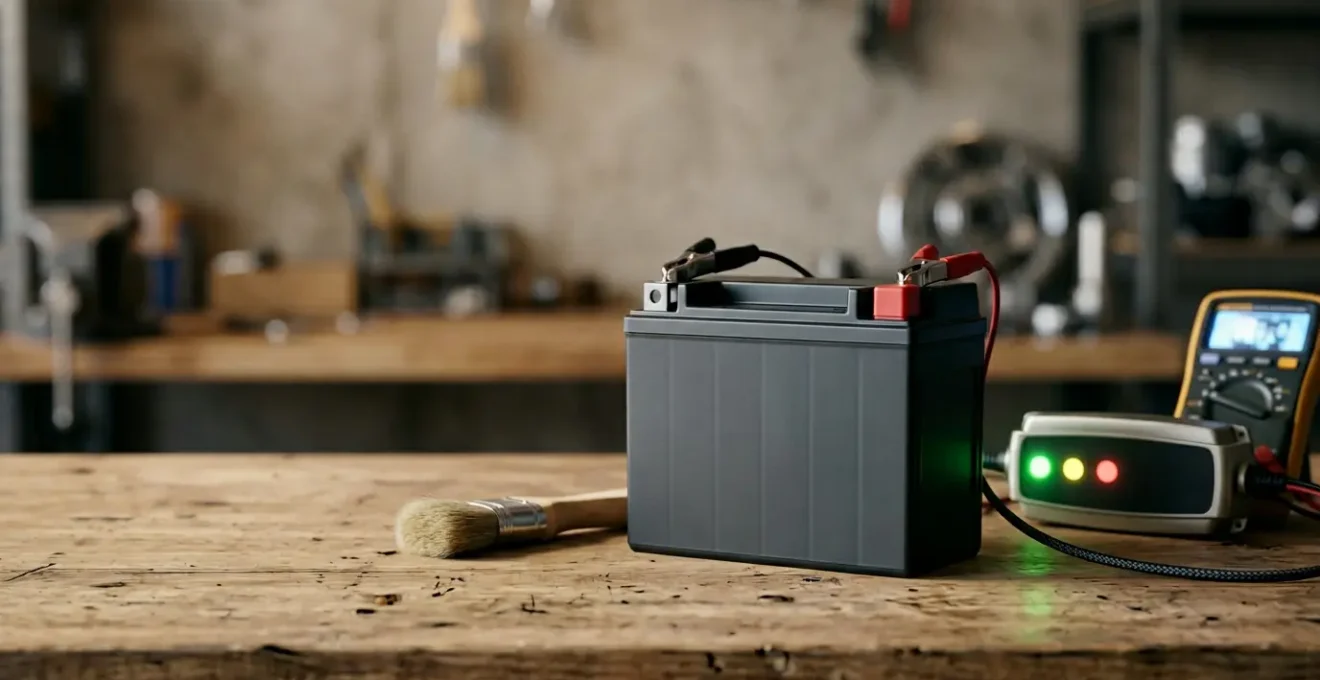
The single biggest factor in tripling your battery’s life is treating it like a financial asset, not a disposable part.
- Shallow charging cycles and avoiding extreme temperatures prevent irreversible « chemical stress » that shortens lifespan.
- Investing in the right technology—like a Gel battery or a smart charger—has a higher upfront cost but dramatically lowers your cost-per-year.
Recommendation: Stop guessing. Use a multimeter to actively monitor your battery’s voltage and a smart charger to automate its long-term health, turning a recurring expense into a reliable, long-term asset.
For many scooter owners, replacing the battery every 12 to 18 months feels like an unavoidable, frustrating cost. It’s a cycle of spending £40, £60, or even more, year after year. We’re often told to « charge it properly » or « don’t let it die, » but this vague advice does little to prevent the premature death of what is essentially the heart of your vehicle. The result is not just a drain on your wallet but also an unnecessary environmental burden, as old lead-acid batteries are hazardous waste.
The common wisdom on battery care barely scratches the surface. It often misses the critical details of charging science and the economic trade-offs between different battery technologies. What if the secret to longevity wasn’t just about avoiding mistakes, but about actively implementing a strategy? What if the difference between a one-year and a three-year lifespan wasn’t luck, but knowledge?
This is where we shift our perspective. This guide reframes battery maintenance from a chore into a clear financial strategy. By understanding the simple physics of how your battery works and degrades, you can take control. You’ll learn why certain habits cause hidden damage, how to make informed purchasing decisions that save you money in the long run, and which tools are essential for programming longevity into your battery. This isn’t about generic tips; it’s about giving you the technician-level knowledge to triple your battery’s life and break the cycle of annual replacement.
To help you navigate these cost-saving strategies, this article is structured to build your expertise from daily habits to long-term investments. Follow along to transform your battery from a recurring expense into a durable asset.
Summary: How to Extend Your Battery Lifecycle to 3 Years Instead of 12 Months?
- Partial vs Full Cycles: Which Habit Uses Up Your Battery Life Faster?
- Why Charging in a Freezing Shed Kills Your Battery Capacity?
- Is the Extra Cost of Gel Batteries Worth the Longer Lifecycle?
- The Monthly Top-Up: Maintaining Health During Inactivity
- Where to Dispose of Lead-Acid Batteries Legally in the UK?
- Lead vs Lithium: Is the 3x Cost Difference Justified by the Lifespan?
- Overcharge Protection: Why Cheap Chargers Are a Fire Hazard?
- Why Investing in a Smart Charger Saves You Money on Battery Replacements?
Partial vs Full Cycles: Which Habit Uses Up Your Battery Life Faster?
The most common myth about batteries is that you should drain them completely before recharging. For the lead-acid and lithium batteries in modern scooters, this is the fastest way to destroy your investment. The key to a long life is understanding the concept of Depth of Discharge (DoD). Think of your battery’s total energy like a well of water. A full discharge is like draining the well to the muddy bottom, causing stress and damage. A partial discharge is like only taking water from the top, leaving the well healthy.
Each time you deeply discharge your battery, you inflict significant « chemical stress, » which permanently reduces its ability to hold a charge. Consistently discharging to 90% or 100% might only give you a few hundred cycles. In contrast, by practicing « voltage discipline » and only discharging to 50% before recharging, you dramatically reduce this stress. In fact, a battery discharged to only 50% DoD might provide thousands more cycles than one constantly drained to empty. This single habit has the biggest impact on your battery’s lifespan.

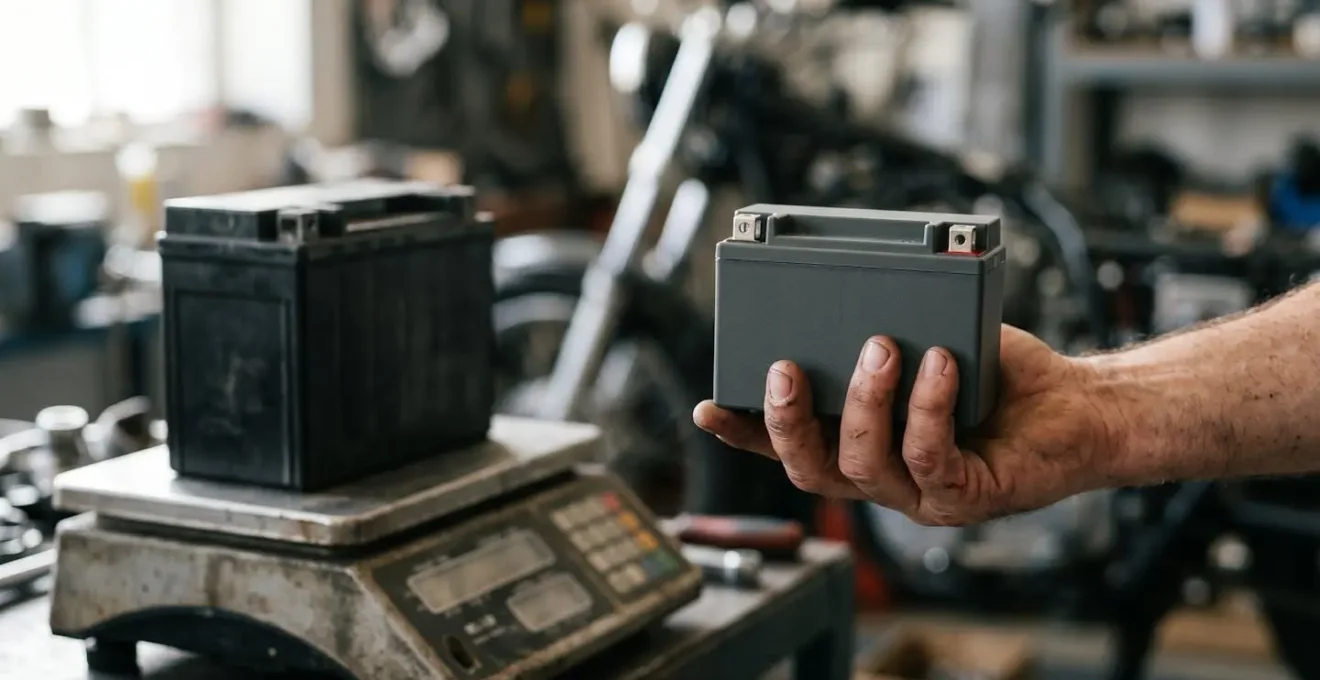
The image above illustrates this principle perfectly. The battery on the right, representing deep discharge, is visibly aged and stressed. The one on the left, representing shallow cycles, remains pristine. For a scooter owner, this translates into a simple, money-saving rule: recharge after short trips. Don’t wait for the battery warning light. Treating your battery this way is the difference between replacing it annually and having it last for years.
Why Charging in a Freezing Shed Kills Your Battery Capacity?
Storing your scooter in a cold, unheated shed or garage during winter seems harmless, but it can be a death sentence for your battery. While batteries lose efficiency in the cold, the real damage occurs when you try to charge them at or below freezing temperatures. At these temperatures, the chemical reactions required for charging cannot happen correctly. Instead of ions being smoothly absorbed, a process called « lithium plating » occurs in Li-ion batteries.
This plating is irreversible. It’s like a layer of metallic frost forming inside your battery, permanently blocking parts of the anode from accepting a charge. This leads to a sudden and significant loss of capacity. Every time you charge in sub-zero conditions, you are actively shrinking the total amount of energy your battery can ever hold again. As battery research confirms, lithium-ion batteries cannot be charged below 0°C (32°F) without causing this permanent degradation. The same principle applies to lead-acid batteries, where the electrolyte can freeze and cause physical damage to the internal plates.
A note from a battery technology forum highlights the danger in plain terms:
Below 32°F you can permanently damage the battery
– Battery technology forum discussion, Backpacking Light battery storage discussion
The solution is simple and costs nothing: if your scooter is stored in the cold, always remove the battery and bring it indoors to warm up to room temperature for a few hours before connecting the charger. This small habit protects it from the silent, capacity-killing damage of cold-charging and ensures your investment survives the winter.
Is the Extra Cost of Gel Batteries Worth the Longer Lifecycle?
When replacing a standard lead-acid battery, you’ll often see two main upgrade options: AGM (Absorbent Glass Mat) and Gel. While AGM is a solid, common choice, a Gel battery, despite its higher initial cost, represents a smart long-term investment for many riders. The key difference lies in how the electrolyte is stored. In a Gel battery, it’s a thick, putty-like substance, which makes it incredibly resistant to vibration and prevents leaks, even if the case is cracked.
This robustness translates directly into a longer lifespan, especially for a scooter that endures bumpy roads. More importantly, Gel batteries are far more tolerant of deep discharge—the very thing that kills standard batteries. While you should still avoid it, a Gel battery can recover from being drained more effectively than an AGM. This resilience means a longer service life, and industry comparisons show that the cycle life of a Genuine GEL battery can be at least double that of an AGM product, if properly maintained. This is a prime example of lifecycle economics: paying more upfront to save on multiple replacements later.
| Feature | AGM Battery | Gel Battery |
|---|---|---|
| Best Use Case | High-power starting applications, frequent cycling | High-vibration environments, deep discharge tolerance |
| Vibration Resistance | Good | Excellent – gel stabilizes internal components |
| Deep Discharge Recovery | Moderate | Superior – tolerates deep discharges better |
| Typical Cost | Lower upfront cost | Higher initial investment |
| Cycle Life (properly maintained) | Standard | Up to 2x longer than AGM |
| Mounting Flexibility | Multiple positions | Any position including sideways/inverted |
For a daily rider or someone who values reliability and a lower cost-per-year, the extra £20-£30 for a Gel battery is often justified. It provides peace of mind and, over three years, will almost certainly prove cheaper than replacing two standard AGM batteries.
The Monthly Top-Up: Maintaining Health During Inactivity
One of the most overlooked aspects of battery care is managing it during periods of inactivity. Leaving a scooter parked for a month or more, especially during winter, is a recipe for a dead battery. All batteries slowly lose charge over time, a process called self-discharge. However, the rate of loss varies dramatically. As battery research shows, a lead-acid battery loses approximately 5% of its charge per month, whereas a lithium-ion battery loses only 1-2%.
For a lead-acid battery, this 5% monthly loss is dangerous. If the voltage drops too low (below 12.4V), a destructive process called sulfation begins. Lead sulfate crystals form on the battery’s plates, and if left unchecked, they harden and permanently reduce the battery’s capacity. A few months of neglect can be enough to ruin a perfectly good battery. This is why a simple « monthly top-up » is critical.
Instead of guessing, you can take control with a cheap tool: a digital multimeter. By checking your battery’s voltage once a month, you can know exactly when it needs a top-up charge to prevent sulfation. This is proactive maintenance that costs pennies but saves pounds.
Your DIY Battery Health Voltage Scorecard
- Check Voltage: Connect a multimeter to the battery terminals.
- 12.7V or higher: Your battery is at 100% charge. It’s healthy and ready to go. No action needed.
- 12.4V: Your battery is at roughly 75% charge. It’s acceptable, but consider giving it a top-up charge soon to keep it in peak condition.
- 12.0V – 12.2V: This is the danger zone, indicating about 25% charge. Charge it immediately to prevent sulfation damage from setting in.
- Below 12.0V: Critically discharged. There’s a high risk of permanent capacity loss. A smart charger with a reconditioning mode might be able to save it, but damage has likely occurred.
This simple checklist transforms battery care from a mystery into a manageable task. A five-minute check once a month is all it takes to stop sulfation in its tracks and ensure your battery is ready to go when you are.
Where to Dispose of Lead-Acid Batteries Legally in the UK?
When your scooter battery finally reaches the end of its life, simply throwing it in the household bin is not only environmentally irresponsible but also illegal in the UK. Lead-acid batteries contain toxic materials, including lead and corrosive sulfuric acid, which can contaminate soil and water if sent to a landfill. As a responsible owner, ensuring it’s recycled correctly is a crucial final step.
Fortunately, disposing of them safely and legally is straightforward and free. You have several options available across the United Kingdom:
- Local Council Recycling Centres: Nearly all Household Waste Recycling Centres (HWRCs), often called « the tip, » have a dedicated collection point for car and motorcycle batteries. This is usually the most convenient option. Use your local council’s website to find your nearest centre and check its opening times.
- Retailer Take-Back Schemes: Any retailer that sells more than 32kg of batteries a year (which includes most automotive stores and garages) is legally obligated to offer a free take-back service for old batteries. This means you can often drop off your old battery at the same place you buy your new one, such as Halfords or a local motor factors.
- Scrap Metal Yards: Some licensed scrap metal dealers will also accept old lead-acid batteries, as the lead has recycling value. However, always ensure they are an Authorised Treatment Facility (ATF) to guarantee it will be processed correctly.
Before transporting the battery, it’s wise to place it in a heavy-duty plastic bag or sealed container to prevent any potential acid leaks. By using these official channels, you ensure the lead, plastic, and acid are all recovered and repurposed, minimising environmental harm and fulfilling your legal duty as a vehicle owner.
Lead vs Lithium: Is the 3x Cost Difference Justified by the Lifespan?
The biggest decision in battery economics is choosing between traditional lead-acid (including AGM and Gel) and modern lithium-ion (LiFePO4). On the surface, the choice seems obvious: a lithium battery can cost two to three times as much as a lead-acid equivalent. However, looking only at the upfront cost is a financial trap. The true measure of value is the cost per cycle over the battery’s entire life.
This is where lithium technology reveals its overwhelming advantage. While a typical lead-acid battery is rated for around 400 charge cycles under ideal conditions, the reality is often closer to 200-300 with normal use. In stark contrast, industry data reveals that lithium deep-cycle batteries are rated to last between 3,000 to 5,000 cycles. Even a conservative estimate of 2,000 cycles means a lithium battery will outlast 5-10 lead-acid batteries. The 3x initial cost suddenly looks like a bargain, potentially saving you hundreds of pounds in replacement costs over the life of your scooter.
Beyond the incredible lifespan, lithium batteries offer other significant benefits. They are typically 50-70% lighter, which can noticeably improve your scooter’s handling and performance. They also maintain a more stable voltage during discharge, providing more consistent power, and can be charged much faster. For any owner planning to keep their scooter for more than two years, the financial and performance case for investing in lithium is undeniable.
Overcharge Protection: Why Cheap Chargers Are a Fire Hazard?
Using a cheap, basic battery charger is like hiring a babysitter who falls asleep on the job—it might seem fine for a while, but it exposes you to serious risk. The single most important feature that separates a quality « smart » charger from a cheap « dumb » one is automatic overcharge protection. When a battery reaches 100% charge, it can no longer store any more energy. Continuing to force current into it causes a dangerous chemical reaction.
In a lead-acid battery, this « overcharging » causes the electrolyte to heat up and « gas, » producing explosive hydrogen gas. The water in the electrolyte boils away, exposing the lead plates and causing permanent damage. In a lithium-ion battery, the consequences are even more severe, leading to overheating, swelling, and in the worst cases, a dangerous event called « thermal runaway, » which can result in fire. Cheap chargers lack the sophisticated circuitry to detect when the battery is full.
A quality charger, on the other hand, constantly monitors the battery’s voltage and current. As a CTEK battery maintenance guide explains about their process:
Once fully charged, the device switches to maintenance mode to prevent overcharging
– CTEK battery maintenance guide, Essential Motorcycle Battery Care: Top Tips for Battery Maintenance
This « maintenance mode » (or float mode) is the critical safety feature. The charger stops the main charging process and provides only a tiny, intermittent current to counteract the battery’s natural self-discharge. This keeps it at a perfect 100% without the risk of overheating or damage. Investing an extra £30-£40 in a charger with this feature isn’t a luxury; it’s essential insurance against both battery destruction and a potential fire hazard.
Key takeaways
- Your daily charging habits are the #1 factor in battery life. Shallow discharges (recharging at 50-70%) dramatically extend cycle life compared to full discharges.
- Environmental factors matter. Never charge a battery in freezing temperatures, and always store it in a moderate climate to prevent permanent capacity loss.
- The tools you use are as important as your habits. A smart charger is a non-negotiable investment that automates safety and longevity by preventing overcharging and reconditioning the battery.
Why Investing in a Smart Charger Saves You Money on Battery Replacements?
A smart charger is the single most powerful tool for executing a long-term battery health strategy. It moves beyond the simple « power in » function of a basic charger and acts as an automated battery technician. Its primary function is to analyze the battery’s condition and deliver a tailored, multi-stage charging program that not only recharges it but actively repairs and maintains it. This programmed approach is what directly translates into a longer lifespan and significant cost savings.
Unlike a simple charger that delivers a constant current, a smart charger typically uses a process involving steps like desulfation, bulk charge, absorption, analysis, and maintenance. The desulfation phase, for example, uses electrical pulses to break down the harmful sulfate crystals that build up on a discharged lead-acid battery, actively restoring lost capacity. This can often revive a battery that a normal charger would deem « dead. »

Case Study: The CTEK CT5 POWERSPORT Multi-Stage Process
The CTEK CT5 POWERSPORT charger exemplifies this intelligent approach. It offers automatic programs for different battery types, including a ‘Lithium’ mode and a ‘Recond’ mode for deeply discharged lead-acid batteries. The Recond function actively works to reverse sulfation damage by mixing the battery acid and recovering energy. Once any battery reaches full charge, the system transitions to a maintenance (or float) mode. This crucial step prevents overcharging and can be left connected for months, ensuring the battery is always in peak condition. This automated care significantly extends longevity compared to conventional chargers that can « cook » a battery if left connected too long.
By investing £50-£80 in a quality smart charger, you are purchasing a device that protects your £60-£150 battery from all the most common failure modes: sulfation from undercharging, damage from overcharging, and neglect during storage. Over three years, a smart charger will easily pay for itself by preventing just one premature battery replacement.
By implementing these strategies, from daily habits to smart investments, you can take direct control over your scooter’s running costs. Start today by assessing your current battery’s health and investing in the right tools to ensure it serves you for years, not months.