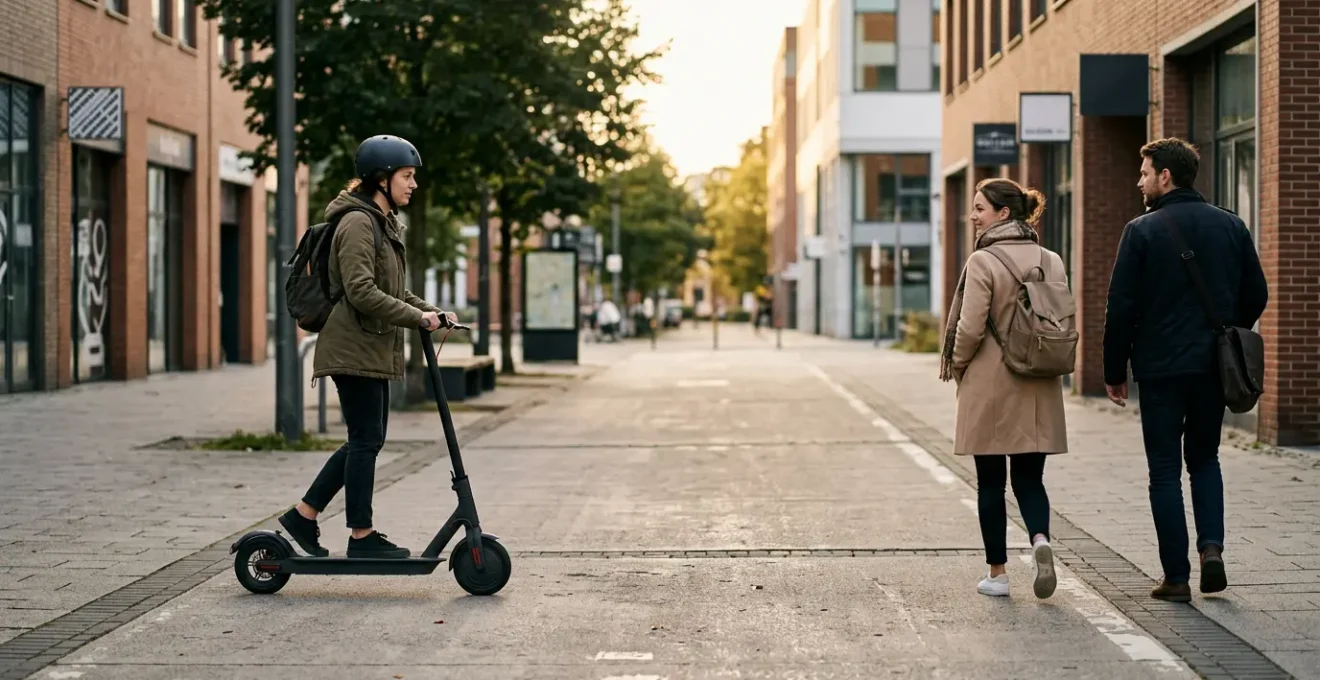
The key to avoiding conflict isn’t just knowing the rules; it’s mastering the art of predictability and proactive communication with pedestrians.
- Most tension arises from surprising pedestrians, not from speed alone. Signalling your intentions early is more effective than just slowing down.
- Responsible parking is about « spatial empathy »—considering how your scooter impacts others, especially those with mobility or visual impairments.
Recommendation: Adopt a « pedestrian-first » mindset. Always assume others are unaware of you and take full responsibility for creating a safe and predictable interaction.
The rise of e-scooters has brought incredible freedom, but it has also created a new source of tension on our pavements. As a new rider, you may feel a constant, low-level anxiety: Am I going too fast? Am I in the way? Will that person suddenly step in front of me? This uncertainty can lead to hesitant riding or, worse, unintentional conflicts that fuel pedestrian frustration. Many guides simply list rules, telling you to « be careful » or « give way, » but this generic advice often fails in the dynamic, unpredictable reality of a busy pavement.
The truth is, true scooter etiquette isn’t a rigid checklist. It’s a skill based on a deeper principle: making yourself predictable to those around you. It’s about shifting your mindset from simply claiming your space to actively managing the shared environment. This involves understanding the unwritten social contract of the path, using proactive de-escalation signals, and developing a sense of « spatial empathy » to see the world from a pedestrian’s point of view. Forget just following rules; the goal is to become a rider that people feel comfortable and safe around.
This guide will break down the most common conflict scenarios you’ll face. We will explore the nuances of interacting with pedestrians, cyclists, and the urban environment itself, providing you with the practical tools to ride not just legally, but with civic-minded courtesy. By mastering these principles, you can transform your daily commute from a source of stress into a seamless and positive part of city life.
Contents: A Guide to Pavement Etiquette for Scooter Riders
- Zebra Crossings: Do You Have the Same Rights as a Walker?
- Bell or Voice? How to Overtake a Walker Without Causing a Heart Attack
- Cyclists vs Scooters: Who Gives Way on a Shared Cycle Path?
- Blocking the Pavement: The Fine Line Between Parking and Obstruction
- Navigating Crowds: Why Avoiding Pedestrian Zones Isn’t Always Possible
- Pedestrians First: Who Has Right of Way on a Shared Path?
- High Street Chains vs Independents: Where Can You Actually Park Inside?
- Can You Drive in Town? Understanding UK Pedestrian Zone Regulations for Scooters?
Zebra Crossings: Do You Have the Same Rights as a Walker?
The short answer is no. A zebra crossing is a sanctuary designed for pedestrians, and as a scooter rider, you are operating a vehicle. Legally and ethically, you do not inherit the same absolute priority as someone on foot. Approaching a crossing as if you do is a primary source of conflict and is extremely dangerous. In fact, recent data shows that a significant number of incidents occur in these exact zones, as 19% of pedestrian-scooter incidents happen at crosswalks and intersections.
Your role here is to demonstrate unambiguous deference to pedestrians. This is a critical moment to build trust with other pavement users. The safest and most courteous protocol is to treat the crossing as a hard stop. Slow down significantly as you approach, making it clear you intend to yield. The gold standard is to dismount and walk your scooter across, especially if the crossing is busy. This single act removes all ambiguity and signals respect.
Even if the crossing is empty, you should slow to a near-stop and perform exaggerated visual checks before proceeding. This communicates to anyone nearby that you are cautious and aware. Remember, your goal is to be predictable. A scooter appearing to speed through a zebra crossing is highly unpredictable and alarming for everyone, from drivers to walkers. By yielding priority every time, you contribute to a safer, more harmonious shared environment.
Bell or Voice? How to Overtake a Walker Without Causing a Heart Attack
The simple act of overtaking a pedestrian is a delicate social interaction, and your choice of signal can either build goodwill or create instant animosity. Many new riders assume a bell is the correct tool, but it can be surprisingly counterproductive. It’s often perceived as an aggressive command rather than a polite notification. As one analysis notes, the sudden sound can cause a pedestrian to panic and move erratically, sometimes directly into your path. The goal is « auditory courtesy, » not auditory demand.
As experts at The Conversation point out in their guide to shared paths:
a bell is often perceived (or used) as an act of aggression in the same way as a car horn might be – or the pedestrian might think they’re in the way, and try to get out of the way, but instead move into the cyclist’s path
– The Conversation, Contested spaces: a user’s guide to shared paths
A calm, friendly voice is almost always superior. A simple « passing on your left » spoken from a safe distance gives the person time to process and react without feeling startled. The key is to make your announcement a piece of information, not an order. Combine this with slowing down and giving them as much space as physically possible—at least one meter is a good rule of thumb. This generous buffer is a non-verbal signal of respect that reinforces your verbal cue. After you pass, a simple nod or wave closes the interaction on a positive, human note.
Action Plan: The Polite Overtaking Method
- Announce Early: From 10-15 meters away, use a gentle bell tap or, preferably, a calm voice to signal your presence. This is an alert, not a command.
- Request to Pass: At about 5 meters, use a clear, polite phrase like « Passing on your left, please » to state your intention.
- Give Ample Space: Slow down and ensure there is at least 1 meter of clearance between you and the pedestrian as you overtake.
- Acknowledge with Courtesy: As you pass, a simple nod, wave, or a quiet « thank you » reinforces the positive social exchange and reduces any lingering tension.
- Assess and Adjust: If the pedestrian is wearing headphones or seems unaware, slow down even more and be prepared to wait. Never force an overtake.
Cyclists vs Scooters: Who Gives Way on a Shared Cycle Path?
When you move from a pedestrian-only pavement to a shared-use cycle path, the dynamics change. You’re no longer the fastest user; you now share the space with cyclists who may be moving at a significantly higher speed. The question of who gives way isn’t about which vehicle is « better, » but about applying a universal principle of shared spaces: the hierarchy of vulnerability.
This principle states that the more protected, faster, or heavier user has a greater responsibility to look out for the more vulnerable. On a shared path, a pedestrian is the most vulnerable, followed by a scooter rider, and then a cyclist. Therefore, when interacting with a cyclist, you must be prepared to yield. They may be traveling faster and have less maneuverability at speed. The golden rule, as stated by experts, is clear: « The person in the less vulnerable position should be mindful of the more vulnerable user. » While a cyclist is arguably less vulnerable than you, the principle of mutual awareness remains paramount.
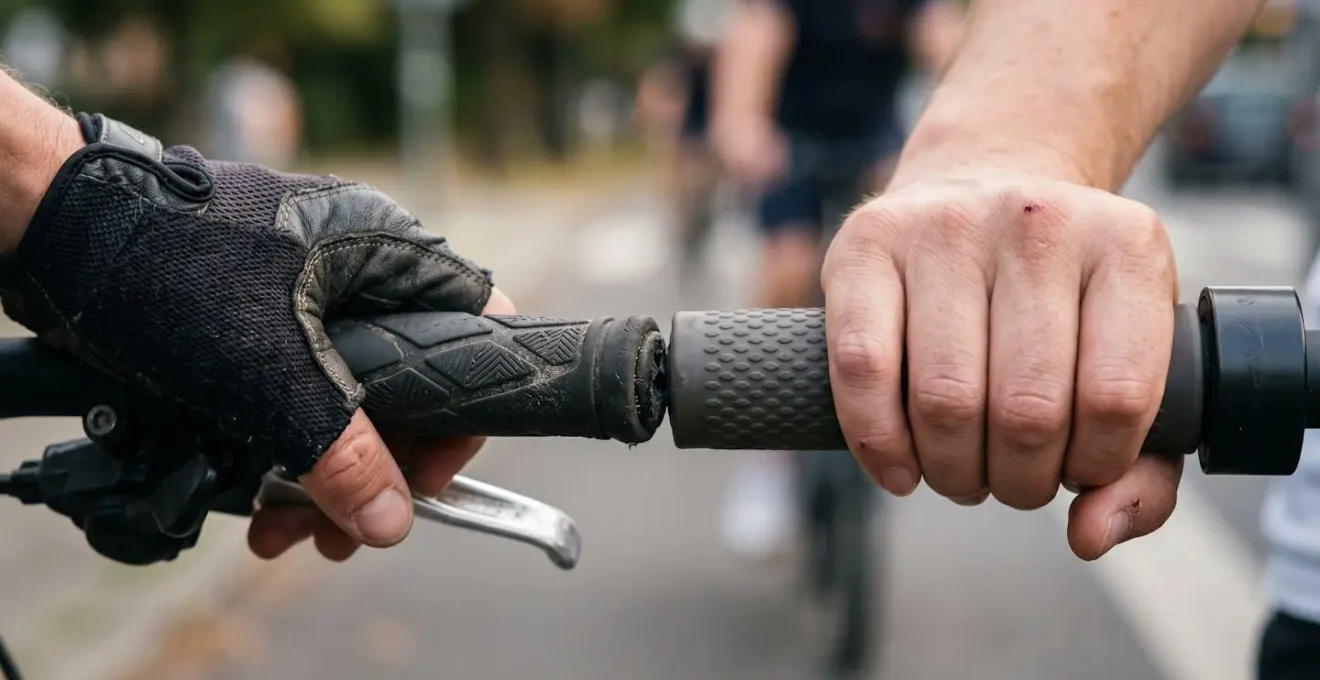
This paragraph introduces the complex interaction between cyclists and scooter riders. The image below captures the precise moment of negotiation and mutual awareness required on a shared path.
In practice, this means maintaining a predictable line, staying to your side of the path, and being prepared for cyclists to overtake you. Listen for their bells or verbal warnings and facilitate their pass by holding your course. When you need to overtake a cyclist, apply the same « auditory courtesy » you would with a pedestrian: announce your intention clearly and from a distance, ensuring they have ample time to acknowledge you before you make your move. It’s a dance of mutual respect built on communication.
Blocking the Pavement: The Fine Line Between Parking and Obstruction
Your responsibility as a civic-minded rider doesn’t end when your journey does. Where and how you park your scooter has a massive impact on the accessibility and safety of the pavement for others. A poorly parked scooter is not just an inconvenience; it is a genuine barrier for people using wheelchairs, parents with strollers, and a serious hazard for the visually impaired. This is where « spatial empathy » becomes a critical skill: before you walk away, you must visualize how your scooter affects the flow of the entire pavement.
The cardinal rule is to never block the main thoroughfare. Always place your scooter parallel to a wall, a tree, or in a designated bike or scooter rack. The goal is to leave a wide, clear channel for pedestrians. As a baseline, many accessibility regulations often require a minimum of 36 inches (about 90cm) of clear pavement width to allow for wheelchair access. Using this as your mental benchmark is a great starting point.
Furthermore, there are several absolute « no-go » zones for parking. You must be especially vigilant to avoid these critical areas:
- Never park on or blocking curb ramps, wheelchair access points, or any designated handicap zones.
- Avoid blocking building entrances/exits, emergency exits, driveways, and loading zones.
- Stay completely clear of fire hydrants, utility boxes, and public transit stops or stations.
- Crucially, never block tactile paving—the textured bumps and lines at crossings are essential navigation aids for visually impaired individuals. Parking on them renders them useless.
The best parking spot is one that makes your scooter seem almost invisible to the flow of foot traffic. By taking a few extra seconds to find a responsible spot, you prevent major accessibility issues and demonstrate your commitment to a truly shared public space.
Navigating Crowds: Why Avoiding Pedestrian Zones Isn’t Always Possible
Riding on a sidewalk or pavement, especially a crowded one, is one of the highest-risk activities for a scooter user. The environment is unpredictable, and the potential for a collision is high. In fact, sobering research found that nearly 60% of rider injuries occur on sidewalks, not roads. Whenever possible, using a designated bike lane is vastly safer. However, in many urban landscapes, a lack of connected infrastructure means that short stretches on a pavement may be unavoidable to complete a journey.
When you must navigate through a crowd, your primary goal is to minimize your speed and maximize your predictability. Your speed should be no faster than a brisk walking pace. This gives you ample reaction time and makes your presence far less intimidating to those around you. You must create and maintain a « predictability bubble »—a space around you where others can easily anticipate your movements. This means no sudden swerving, accelerating, or braking. Your movements should be smooth, deliberate, and telegraphed well in advance.
There is a clear point at which riding is no longer safe or courteous. According to the experts at Apollo Scooters, a clear guideline is to dismount:
When your ‘safety bubble’ is consistently less than 1.5 meters, or when you cannot travel in a straight line for more than 5 seconds, dismounting becomes necessary
– Apollo Scooters, Electric Scooter Etiquette: Sharing the Road Safely
This is a fantastic rule of thumb. If the density of the crowd forces you into constant, complex maneuvers, you are no longer a vehicle in transit; you are a hazard. At this point, the only responsible action is to dismount, fold your scooter if possible, and walk until the space opens up again. This act of self-regulation is the hallmark of an experienced and respectful rider.
Pedestrians First: Who Has Right of Way on a Shared Path?
On any path shared between pedestrians and wheeled users, the social contract is simple and absolute: pedestrians always have the right of way. This is the foundational principle of all shared-space etiquette. As a scooter rider, you are a guest in what is primarily a pedestrian environment. Your speed and wheels give you an advantage, but that advantage comes with the responsibility of ensuring the safety and comfort of those who are more vulnerable.
You must operate under the assumption that pedestrians are not, and should not be expected to be, looking out for you. They may be listening to music, engrossed in conversation, managing children, or simply lost in thought. Their unpredictability is a given, and it is your job to anticipate it. This means keeping your fingers on the brake levers, constantly scanning ahead, and managing your speed to match the conditions. As one expert on shared spaces advises, riders should « afford the same courtesies to pedestrians that they expect of drivers while sharing the road. »
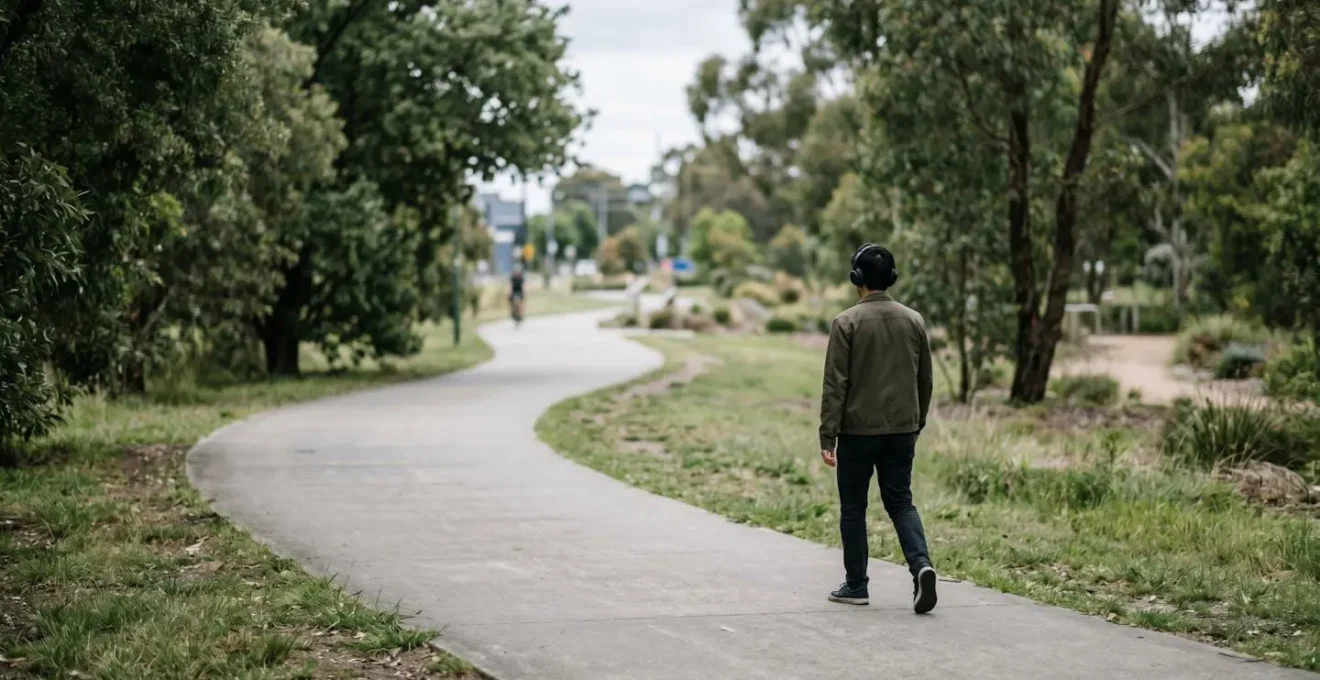
This image highlights a common scenario: a pedestrian with headphones, completely unaware of their surroundings. It’s your job to anticipate and manage this situation safely.
This « pedestrian-first » mindset transforms how you ride. Instead of feeling frustrated by a slow-moving group, you see it as an opportunity to practice patience. Instead of being annoyed by someone who steps out suddenly, you will have already anticipated it by maintaining a safe following distance and low speed. This isn’t about surrendering your right to use the path; it’s about actively upholding the social contract that makes sharing the path possible and pleasant for everyone involved.
High Street Chains vs Independents: Where Can You Actually Park Inside?
Sometimes you need to pop into a shop or cafe, and leaving your valuable scooter locked up outside isn’t an option. The question of whether you can bring it inside is complex and depends heavily on the type of establishment. There is no single rule, but a polite and strategic approach can greatly increase your chances of success. The key is the « Fold and Ask Protocol. »
This protocol is about minimizing your scooter’s presence and showing courtesy from the moment you enter. First impressions matter. Here are the steps:
- Fold Before Entering: If your scooter is foldable, always fold it up *before* you go inside. A folded scooter looks like luggage; an unfolded scooter looks like a vehicle trying to drive indoors. This simple change in form factor dramatically reduces the perceived disruption.
- Seek and Ask Politely: Immediately find a member of staff. Don’t just wheel your scooter to a corner and hope no one notices. Make eye contact, smile, and ask politely. A good phrase is, « Is it alright if I tuck my folded scooter here by my table? I’ll make sure it’s completely out of everyone’s way. »
- Be Prepared for « No »: You must be ready to accept a « no » gracefully. The decision is entirely the establishment’s to make.
Your success rate will vary based on the type of business. Large high street chains and supermarkets will almost always say no due to rigid corporate policies, liability concerns, and fire safety regulations. However, small, independent cafes, pubs, and shops are often much more flexible. If you are polite, the scooter is compact, and you are a paying customer, the owner will frequently be accommodating. Public buildings like libraries, banks, and post offices are typically a firm « no » for security and accessibility reasons. While some specific ‘mobility scooters’ have legal protections for access, personal e-scooters do not fall into this category, making politeness your only tool.
Key Takeaways
- Predictability Over Speed: Your top priority is to be predictable. Smooth movements, early signalling, and maintaining a safe « bubble » of space are more important than your actual speed.
- Practice Spatial Empathy: Always park your scooter as if you were a wheelchair user or a parent with a stroller trying to get by. Never block ramps, tactile paving, or main pedestrian paths.
- Communicate with Courtesy: Use your voice (« Passing on your left! ») as a polite request for awareness, not a demand. A bell can be perceived as aggressive; a calm voice rarely is.
Can You Drive in Town? Understanding UK Pedestrian Zone Regulations for Scooters?
Understanding local regulations is a crucial part of responsible scooter use, as the rules can vary dramatically from one city or country to the next. What is permitted in one area may be strictly forbidden in another. Using the United Kingdom as a case study provides an excellent example of how specific regulations are often put in place to manage the interaction between vehicles and pedestrians in busy town centres.
In many parts of the UK, the use of private e-scooters on public land (including pavements and roads) remains technically illegal, with exceptions for government-approved rental trials. However, « mobility scooters » operate under a different and very clear set of rules. For these approved devices, the law explicitly balances the user’s need for access with pedestrian safety. For instance, in pedestrian-only zones, official UK government rules limit scooters to a maximum speed of 4mph (approximately 6.4 km/h).
This « walking pace » speed limit is a perfect real-world application of the principles we’ve discussed. It acknowledges that wheeled vehicles can coexist with walkers, but only when their speed differential is minimal. The 4mph limit effectively removes the element of surprise and intimidation, making the scooter feel like just another, slightly faster, pedestrian. It forces the rider to adopt a mindset of sharing and awareness, rather than one of transit efficiency. While this rule applies specifically to mobility scooters in the UK, it serves as a universal benchmark for courteous riding in any densely populated pedestrian area, regardless of local law. If you are riding among walkers, matching their pace is the ultimate sign of respect.
By applying these principles of predictability, communication, and spatial empathy, you move beyond simply following rules. You become a proactive, courteous, and community-minded rider, contributing to a city where everyone feels safer and more comfortable sharing the space. Your journey is not just about getting from A to B; it’s about being a positive part of the public fabric along the way.