
In summary:
- You can legally use a Class 2 mobility scooter (max 4mph) on pavements, but pedestrians always have priority.
- Speed must be adjusted to the environment; the 4mph limit is not a target, especially indoors or in crowds.
- The Equality Act 2010 requires shops to make « reasonable adjustments » for access, but you can be refused entry if you pose a safety risk.
- At zebra crossings, you have the same rights as a pedestrian, but you must approach with caution and ensure you are seen.
- Blue Badges do not apply to mobility scooters for parking purposes; you must not cause an obstruction.
The freedom and independence a mobility scooter provides are transformative. Yet, for many users, navigating a bustling town centre can be a source of significant anxiety. The constant uncertainty – Am I allowed here? Am I going too fast? What if someone complains? – can undermine the very confidence the scooter is meant to provide. Many guides will state the basic rules, such as the 4mph pavement speed limit, but this information is often insufficient for real-world situations.
True compliance and safe operation go beyond memorising a single speed. It involves a deeper understanding of the legal principles and social etiquette that govern shared public spaces. The key is not simply to know the rules, but to grasp the rationale behind them. Why is 4mph the limit? Who really has the right of way on a crowded path? What are your specific rights when entering a shop?
This guide moves beyond the basic checklist. It adopts the perspective of a compliance officer, dissecting the regulations to reveal the underlying framework of risk management, pedestrian priority, and legal responsibility. By understanding these core principles, you can transform your approach from one of hesitant rule-following to confident, proactive navigation. This article will systematically break down the critical regulations and scenarios, equipping you with the knowledge to operate your scooter not just legally, but with the courtesy and awareness that ensures safety for everyone.
This comprehensive guide breaks down the essential rules and provides practical advice for navigating every part of a pedestrianised zone. Explore the sections below to master the legal and social requirements for safe scooter use.
Contents: UK Mobility Scooter Regulations
- The Tortoise Switch: Why You Must Limit Speed on Pavements Legally?
- Pedestrians First: Who Has Right of Way on a Shared Path?
- Can a Shopkeeper Legally Refuse Entry to Your Scooter?
- Blue Badges: Do You Need One to Park a Scooter on Double Yellow Lines?
- The ‘Silent Vehicle’ Problem: How to Alert Walkers Without Scaring Them?
- Zebra Crossings: Do You Have the Same Rights as a Walker?
- 2mph Settings: Why 4mph Is Still Too Fast for a Supermarket Aisle?
- Pavement Etiquette: Giving Way and Speed Rules for Scooter Users
The Tortoise Switch: Why You Must Limit Speed on Pavements Legally?
The legal requirement to limit a mobility scooter’s speed on a pavement is not an arbitrary rule; it is a critical safety measure rooted in accident prevention. The core regulation distinguishes between two classes of mobility scooter. Class 3 vehicles, which can reach up to 8mph, are designed for road use and are prohibited from pavements. Only Class 2 scooters, which are electronically limited to a maximum speed of 4mph, are permitted for pavement use. This distinction is the cornerstone of pedestrian safety in shared spaces.
The urgency of this speed limitation is underscored by worrying statistics. Recent Department for Transport data reveals a 37% increase in killed or seriously injured mobility scooter users since the pandemic. While many incidents involve roads, a significant number occur in pedestrian areas where the speed difference between a scooter and a walker becomes a major risk factor. The 4mph limit is designed to align the scooter’s speed more closely with a brisk walking pace, giving both the user and surrounding pedestrians adequate time to react.
From a legal compliance standpoint, the rule is unambiguous. As the official government guidance states, your responsibility is absolute:
You can only drive on the pavement if your mobility scooter has a maximum speed of 4mph
– UK Government (GOV.UK), Official mobility scooter guidance for pavement use
Engaging the speed limiter, often marked with a tortoise symbol, is not just a suggestion; it is a legal prerequisite for entering any pedestrian footpath. Failure to do so places you in breach of the law and, more importantly, creates an environment of unnecessary risk for yourself and others. This fundamental rule forms the basis of all other pavement etiquette and regulations.
Pedestrians First: Who Has Right of Way on a Shared Path?
On a pavement or shared-use path, the legal and ethical principle is simple: pedestrians always have priority. As a mobility scooter user, you are considered a guest in a space primarily designed for walking. This concept of a ‘spatial hierarchy’ is crucial for safe navigation. It means you must actively yield to people on foot, rather than expecting them to move for you. This principle is not just a matter of courtesy; it is codified in the UK Highway Code.
The reasoning behind this rule is based on vulnerability and expectation. Pedestrians, particularly children, the elderly, or those with sensory impairments, do not anticipate fast-moving, silent vehicles on the pavement. The responsibility—or ‘duty of care’—falls squarely on the operator of the more powerful and heavier vehicle to anticipate hazards and prevent incidents. This requires a constant state of awareness, scanning ahead for potential conflicts and proactively slowing down or stopping to let people pass comfortably.
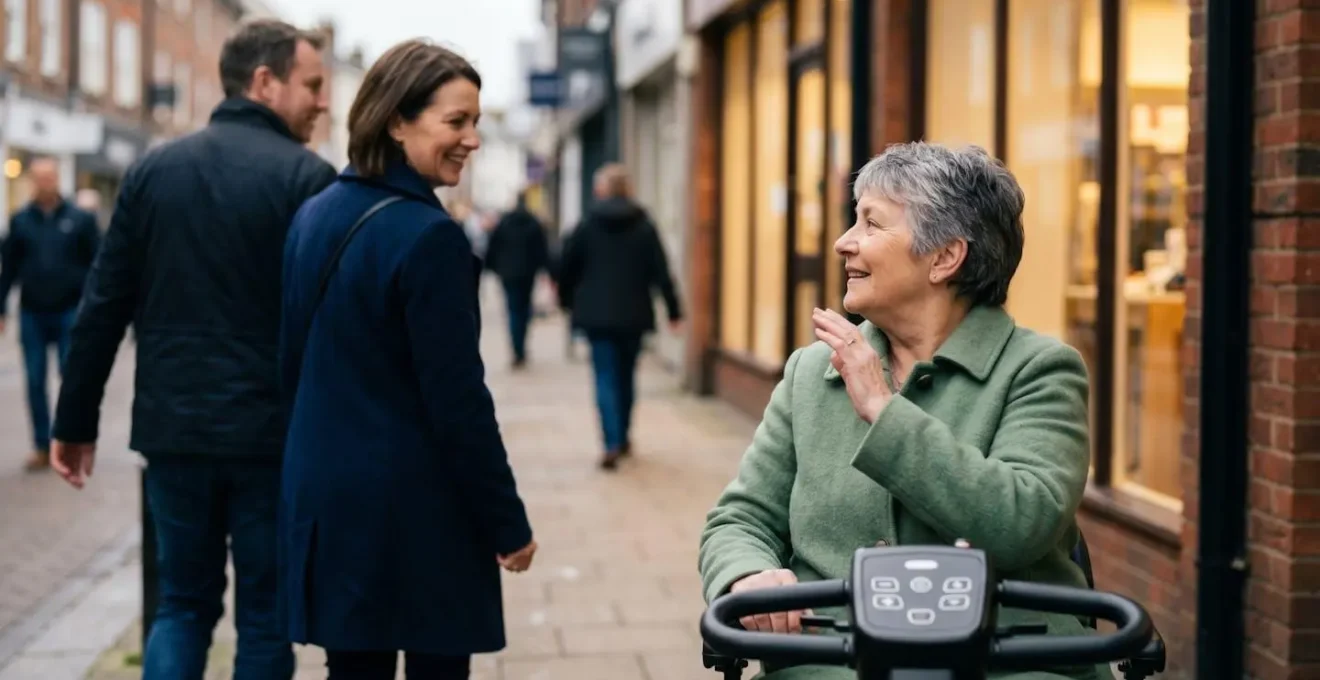
The Highway Code makes this duty explicit, leaving no room for interpretation. Your presence must not force pedestrians to alter their course or feel intimidated. Rule 38 states:
You should give pedestrians priority and show consideration for other pavement users, particularly those with a hearing or visual impairment who may not be aware that you are there
– UK Highway Code Rule 38, Highway Code for powered wheelchairs and mobility scooters
Therefore, navigating a busy high street requires you to adopt a defensive and considerate driving style. This means maintaining a safe following distance, anticipating sudden stops, and being prepared to wait patiently behind slower walkers without using your horn or intimidating them from behind. Mastering this ‘pedestrians first’ principle is the single most important skill for harmonious co-existence in shared spaces.
Can a Shopkeeper Legally Refuse Entry to Your Scooter?
The question of access to shops and private premises is a common point of confusion and conflict. The legal framework governing this is the Equality Act 2010. This act places a duty on service providers, including retailers, to make « reasonable adjustments » to ensure that disabled individuals are not at a « substantial disadvantage » compared to non-disabled people. A mobility scooter is legally recognised as a mobility aid, akin to a wheelchair.
Under the Act, a blanket ban on all mobility scooters is almost certainly illegal. A shopkeeper cannot refuse you entry simply because you are using a scooter. However, the key term is « reasonable. » A shopkeeper can legally refuse entry if your scooter’s presence would pose a genuine and unavoidable health and safety risk. For example, if the shop aisles are extremely narrow and your scooter physically blocks fire exits or makes it impossible for other customers to navigate, the owner could argue that allowing entry is not a reasonable adjustment. This creates a grey area where negotiation and clear communication are vital.
As the law dictates, the onus is on the business to accommodate you where possible. The Equality Act 2010 specifically protects your rights:
Shops must make reasonable adjustments to ensure that individuals with disabilities, including those who use mobility scooters, have access to their services
– Equality Act 2010, UK accessibility rights legislation for mobility scooter users
If you are ever refused entry, it is crucial to remain calm and handle the situation methodically. An aggressive confrontation is unlikely to resolve the issue. Instead, a structured, informed approach will be far more effective in asserting your rights while acknowledging the shopkeeper’s legitimate safety concerns. Knowing the correct steps to take can de-escalate a difficult situation and often lead to a positive outcome.
Your action plan for handling shop entry refusal
- Stay Calm & Inquire: Remain polite and ask the manager for the specific reason for the refusal. Understanding their concern (e.g., aisle width, safety) is the first step.
- Clarify & Educate: Calmly explain that your scooter is a necessary mobility aid, not a recreational vehicle, and gently reference the shop’s duty to make « reasonable adjustments » under the Equality Act 2010.
- Propose Solutions: Offer practical compromises. Ask if there is an alternative, wider entrance, or suggest shopping during a quieter period to minimise disruption. This shows you are being cooperative.
- Document & Escalate (If Needed): If the manager remains uncooperative, do not argue. Note down the manager’s name, the date, and the time. You can then contact the Equality Advisory and Support Service (EASS) or Citizens Advice for further guidance and support.
Blue Badges: Do You Need One to Park a Scooter on Double Yellow Lines?
A frequent and dangerous misconception among new mobility scooter users revolves around the Blue Badge scheme. It is critically important to understand that a Blue Badge is strictly for motor vehicles like cars and vans and has absolutely no legal standing when you are using a mobility scooter. You cannot use a Blue Badge to park your scooter on double yellow lines, in a disabled parking bay, or anywhere else. Attempting to do so is a misuse of the scheme and will not protect you from parking enforcement.
The rules for parking a mobility scooter are governed by a different principle: the prevention of obstruction. Whether on a pavement or a road, you must not leave your scooter in a place where it could impede or endanger others. This includes blocking doorways, access ramps, dropped kerbs, or pedestrian thoroughfares. According to the Office for National Statistics, there are over 9.8 million disabled people in the UK, and ensuring clear access routes is paramount for everyone’s safety and mobility.
The definitive guidance from mobility experts is unequivocal on this point. As leading supplier Monarch Mobility clarifies, the two systems—Blue Badges for cars and scooter parking rules—are entirely separate:
You cannot use a blue badge when parking on your mobility scooter, as they only apply to cars and other motor vehicles
– Monarch Mobility, Mobility scooter UK law and regulations guide
The practical takeaway is to always think in terms of obstruction, not permission. There are no designated « parking spots » for mobility scooters in the way there are for cars. When you need to leave your scooter, your sole responsibility is to find a location where it is completely out of the way of pedestrians and other vehicle traffic. This might be in a dedicated scooter parking area if one is provided (e.g., at a supermarket), or tucked into an alcove or against a wall where it does not narrow the usable path. Never assume the rights granted by a Blue Badge in a car can be transferred to your scooter.
The ‘Silent Vehicle’ Problem: How to Alert Walkers Without Scaring Them?
One of the most challenging aspects of pavement navigation is the ‘silent vehicle’ problem. Mobility scooters are very quiet, which means pedestrians, especially those with hearing impairments, using headphones, or who are simply distracted, may be completely unaware of your approach from behind. While most scooters are fitted with a horn, using it can be startling and perceived as aggressive, escalating a situation rather than resolving it. The key is to communicate your presence, not demand right of way.
The primary strategy should always be patience. In a crowded or slow-moving environment, your default action should be to slow down to the pace of the people in front of you. If you need to pass, wait for a natural opening in the crowd. If you must alert someone to your presence, a loud horn should be the absolute last resort. A gentle, verbal « excuse me, please » spoken from a safe distance is far more effective and courteous. This gives the person time to register your presence and react without being frightened.

This issue of awareness is a serious safety concern, highlighted by experts in the field. The risk of even a low-speed collision should not be underestimated. As Professor Duncan Guest, a cognitive psychology expert involved in the Safer Mobility Campaign, warns, the consequences can be severe:
Even a minor collision can have life-changing consequences. We need better awareness, clearer guidance and safer environments to reduce these risks
– Professor Duncan Guest, Cognitive psychology expert at Nottingham Trent University, Safer Mobility Campaign
Other non-aggressive alerting techniques include using a gentle bicycle bell instead of a harsh electronic horn, or positioning your scooter slightly to one side in a person’s peripheral vision before you get too close. The goal is to create a ‘soft’ awareness. You want the pedestrian to notice you naturally, not as a sudden and stressful event. Ultimately, the responsibility for being seen and heard rests with you, the driver of the vehicle.
Zebra Crossings: Do You Have the Same Rights as a Walker?
Yes, when using a zebra crossing, a mobility scooter user has the same rights and priorities as a pedestrian. This is a crucial point of clarification derived directly from the Highway Code’s principle of dual identity. The code establishes that your legal status changes depending on your location. When on the road, you are a vehicle. When on the pavement, you are effectively a pedestrian. Therefore, as you approach a zebra crossing from the pavement, you are entitled to the same right of way as any other walker.
However, having the right of way does not absolve you of the responsibility to act with caution. Drivers may not be anticipating a vehicle moving at 4mph to emerge from the pavement. Your lower profile can also make you less visible than a standing adult, especially to drivers of larger vehicles or in busy conditions. You must never proceed onto the crossing without first ensuring that approaching traffic has seen you and is slowing to a stop. Making eye contact with the driver is the most effective way to confirm they are aware of your intention to cross.
The Highway Code provides the overarching principle that dictates your status and behaviour depending on the surface you are on. This is the foundation for all your interactions at crossings:
When you are on the road you should obey the guidance and rules for other vehicles; when on the pavement you should follow the guidance and rules for pedestrians
– UK Highway Code Rule 36, Highway Code for powered wheelchairs and mobility scooters
To exercise your rights safely, you should adopt a strict protocol for every crossing:
- Approach Slowly: Reduce your speed to a slow walking pace well before you reach the kerb. This gives drivers maximum time to see you and react.
- Position Correctly: Use the dropped kerb and position your scooter so you are approaching the crossing at a right angle, making your intentions clear.
- Establish Eye Contact: Wait until you have made direct eye contact with the driver of any approaching vehicle before you move onto the black and white stripes.
- Remain Vigilant: Be aware that turning vehicles or those in a second lane may not have seen you. Proceed across the road at a steady pace, continually checking for traffic.
2mph Settings: Why 4mph Is Still Too Fast for a Supermarket Aisle?
While the legal maximum speed for a Class 2 scooter on a public pavement is 4mph, this speed is often dangerously fast for indoor environments like supermarkets, shopping centres, and libraries. The principle of ‘contextual speed’ is paramount: the safe and appropriate speed is determined by your surroundings, not by the scooter’s maximum capability. In the confined, unpredictable, and often crowded aisles of a shop, even 4mph can lead to collisions and injuries.
The prevalence of pavement scooters makes this an important issue; a Rica survey found that 57% of UK mobility scooter users own these types of Class 2 devices. Inside a store, you must contend with trolleys changing direction without warning, small children darting out from behind displays, and other shoppers who are focused on shelves, not on traffic. Here, a speed equivalent to a slow walking pace—typically 1-2mph—is the only responsible option. Many scooters have a variable speed dial that allows you to set a much lower maximum speed for these situations, a feature that should always be used indoors.
This is not just a recommendation; it is often a condition of entry. Many private businesses enforce their own health and safety policies that supersede the general pavement rules. Failure to comply can result in you being asked to leave the premises.
Case Study: Major UK Supermarket ‘Walking Pace Only’ Policies
Major UK supermarkets, including Tesco and Sainsbury’s, universally enforce a ‘walking pace only’ policy as a core component of their in-store health and safety regulations. This private property rule legally requires mobility scooter users to reduce their speed significantly below the 4mph pavement limit, typically to a crawl of approximately 2mph or less. The policy is designed to ensure the safety of all shoppers in confined spaces where movements are unpredictable, particularly around children and other vulnerable customers. While this is not a national law, it is an enforceable condition of entry, and failure to comply can result in staff asking the scooter user to leave the store.
Therefore, the 4mph limit should be seen as the absolute ceiling, reserved for open, clear pavements. The moment you cross the threshold into a building, your mindset must shift. You are no longer just a pedestrian; you are the operator of a vehicle in a dense, complex environment. Your speed must be reduced accordingly to protect both yourself and those around you.
Key Takeaways
- The 4mph speed limit for pavements is a legal maximum, not a target. Always adjust your speed to the conditions.
- Pedestrians have absolute priority in all shared spaces. Your duty is to yield, wait, and show consideration.
- The Equality Act 2010 protects your right of access to shops, but you must operate your scooter safely and cooperatively once inside.
Pavement Etiquette: Giving Way and Speed Rules for Scooter Users
Mastering the legal rules is only half the battle. Navigating town centres successfully also requires a firm grasp of pavement etiquette—the unwritten social rules that ensure smooth and conflict-free interactions. This is especially true when things go wrong and you are confronted by an annoyed or frightened pedestrian. How you respond in these moments defines the experience for everyone and can prevent a minor misunderstanding from escalating into an unpleasant incident.
The most common source of conflict is a perception of speed or a feeling of being crowded. A pedestrian who has to jump out of the way will feel threatened, regardless of whether you were technically within the 4mph limit. The best etiquette is proactive: leave ample space when passing, slow down significantly when approaching people from behind, and always be ready to stop. If a confrontation does occur, the key is de-escalation. Do not argue about your right to be on the pavement. Your first priority is to diffuse the tension.
A calm, assertive response that acknowledges the other person’s perspective is far more effective than defensiveness. Simple phrases can make a world of difference:
- « You’re right to be cautious, my apologies. I’ll give you more space. » (This acknowledges their feeling without admitting fault).
- « I understand your concern. The law requires me to use the pavement, but I’m trying to be as careful as possible. » (This educates politely).
- « I can wait here while you pass if that makes you more comfortable. » (This offers a solution and hands control back to them).
The overarching principle is to manage your space and speed in a way that makes others feel safe. By combining legal compliance with a deep understanding of social etiquette, you cease to be seen as an obstruction or a threat, and instead become just another person navigating the high street. This responsible approach is the true mark of a competent and considerate scooter user.
By consistently applying these legal principles and etiquette, you ensure that your mobility scooter remains a tool for freedom and integration, allowing you to navigate any town centre with confidence, safety, and the respect of those around you.