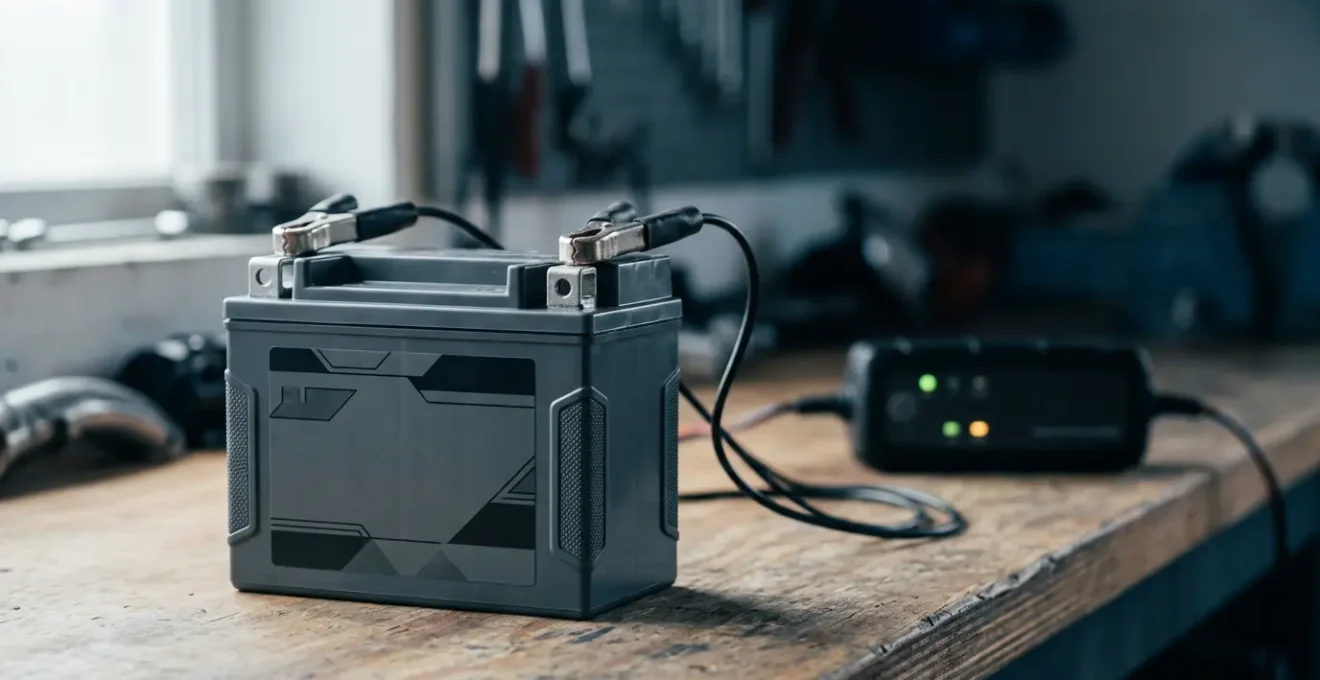
A smart charger is not merely a power source; it is an active battery maintenance system that can double your battery’s lifespan and prevent costly failures.
- It actively reverses the primary cause of battery death—sulfation—using high-frequency electronic pulses to dissolve lead sulfate crystals.
- It uses intelligent, temperature-compensated maintenance and float modes to prevent degradation during long-term storage, unlike basic trickle chargers.
Recommendation: To avoid the hidden £200/year cost of premature battery failure, invest in a quality smart charger that matches your battery’s capacity (C-rate) and offers multi-stage charging algorithms.
For any scooter or motorcycle owner, the « click of death » is a dreaded sound. You turn the key, hit the starter, and are met with a pathetic click or a dimming of the lights. Your battery is dead. The common advice is often simplistic: « use a trickle charger, » or « don’t let it sit for too long. » While well-intentioned, this advice barely scratches the surface of the complex electrochemical processes happening inside your battery. It treats the battery like a simple bucket of electricity, when in reality, it’s a dynamic chemical system vulnerable to permanent degradation.
The real enemy isn’t just a loss of charge; it’s a physical degradation process called sulfation, where lead sulfate crystals form on the battery plates, choking its ability to hold a charge. What most owners don’t realize is that cheap, basic chargers can ignore this process or even accelerate it through improper charging voltages and a lack of thermal management. The difference between a £20 charger and a £70 smart charger isn’t just marketing; it’s a fundamental difference in power electronics engineering.
This article will dissect the engineering principles that make a smart charger a sound financial investment. We will move beyond the marketing claims to explore the core technologies—desulfation pulses, intelligent maintenance modes, C-rate management, and failsafe protections. You will understand not just *that* a smart charger saves you money, but precisely *how* its advanced algorithms actively combat the physical decay that sends countless batteries to an early grave, saving you hundreds in replacement costs over the life of your vehicle.
This comprehensive guide breaks down the essential technologies and safety features that differentiate a premium smart charger from a basic power supply. Explore the technical details below to understand how these features directly translate into longer battery life and significant cost savings.
Summary: Why a Smart Charger is a Smart Investment for Your Battery
- Can a Smart Charger Really Revive a ‘Dead’ Battery?
- Leave It Plugged In: How Maintenance Mode Protects During Winter?
- Silence in the Hallway: Choosing a Fanless Charger for Night Charging
- XLR Plugs: Ensuring the Pin Polarity Matches Your Scooter Brand
- Overcharge Protection: Why Cheap Chargers Are a Fire Hazard?
- Can a Smart Charger Revive a Deeply Discharged Battery?
- The Fire Risk: Do You Need a New Charger for Bigger Batteries?
- Deep Discharge: The Battery Mistake That Costs Owners £200 a Year?
Can a Smart Charger Really Revive a ‘Dead’ Battery?
The term « dead battery » is often a misnomer. More accurately, the battery is likely severely sulfated. Sulfation occurs when a lead-acid battery is left in a discharged state, causing lead sulfate crystals to form and harden on the negative plates. These crystals act as insulators, reducing the active surface area available for the chemical reaction that produces electricity. In its early stages, this is reversible. However, if left unchecked, the crystals grow and harden, leading to permanent capacity loss. In fact, sulfation is the number one cause of early battery failures and is the primary reason why batteries that seem « dead » can no longer accept or hold a charge.
This is where a smart charger’s « desulfation » or « reconditioning » mode comes into play. Unlike a conventional charger that applies a constant voltage, a smart charger uses a sophisticated algorithm. It detects the high internal resistance of a sulfated battery and applies a series of low-amperage, high-frequency electronic pulses. These pulses are engineered to resonate with the sulfate crystals, gently breaking them down and allowing them to dissolve back into the electrolyte solution. This process effectively cleans the battery plates, restoring the active surface area and reviving the battery’s ability to function.
It’s crucial to have realistic expectations, as this technology is governed by the laws of chemistry, not magic. As the Battery Tender Technical Team wisely points out, this process has its limits:
Desulfation is not a miracle cure: it can recover batteries with moderate sulfation but cannot restore severely sulfated batteries that have permanent plate damage.
– Battery Tender Technical Team, Smart Battery Charger Features Explained: ISM, Desulfation & More
In essence, a smart charger provides a form of preventative medicine and early-stage treatment for your battery. By regularly using a smart charger with a reconditioning phase, you are actively fighting the primary aging mechanism, significantly extending the battery’s service life beyond what would be possible with a basic charger.
Leave It Plugged In: How Maintenance Mode Protects During Winter?
One of the most valuable features of a smart charger, especially for owners who store their vehicles during winter, is the intelligent maintenance charge mode. This is a significant engineering leap from the old « trickle chargers, » which provided a continuous, low-level current. While better than nothing, a constant trickle can still lead to overcharging, electrolyte boil-off, and gradual battery damage over weeks or months. A smart charger, by contrast, operates like a life-support system for your battery, actively monitoring and adapting to its needs.
When a smart charger enters « maintenance » or « float » mode, it stops the primary charging cycle. Instead, it continuously monitors the battery’s terminal voltage. As the battery naturally self-discharges over time, its voltage will slowly drop. Once the voltage falls below a predetermined threshold (e.g., 12.6V), the charger initiates a very small, precise charging current to bring it back to a fully charged state (around 13.2V-13.6V). Once topped up, the current is cut off completely. This cycle repeats only as needed, ensuring the battery is always at 100% state of charge without ever being overcharged.
Advanced models take this a step further with temperature compensation. They use an internal or external sensor to measure the ambient temperature and adjust the float voltage accordingly. In colder temperatures, a slightly higher voltage is needed to maintain a full charge, while in warmer conditions, the voltage is reduced to prevent gassing and water loss. This automated adjustment prevents damage and maximizes battery health across changing environmental conditions, a task impossible for a simple trickle charger.

This intelligent, hands-off process means you can connect your battery at the beginning of the off-season and have complete confidence that it will be in optimal condition when you’re ready to ride again in the spring. It eliminates the risk of sulfation from undercharging and the risk of plate damage from overcharging, turning long-term storage from a liability into a fully managed, safe procedure.
Silence in the Hallway: Choosing a Fanless Charger for Night Charging
For many scooter and motorcycle owners, especially those living in apartments or shared spaces, battery maintenance happens indoors. Bringing a heavy battery inside to connect it to a charger in a hallway, kitchen, or utility closet is a common reality. In this context, a seemingly minor detail—the presence of a cooling fan—becomes a major factor in usability. The constant, high-pitched whine of a small fan can be an intrusive and annoying source of noise, particularly during overnight charging.
This is where the engineering of a fanless smart charger demonstrates its value. These chargers are designed from the ground up for superior thermal management. Instead of relying on active air cooling, they use passive heat dissipation. This is achieved through more efficient power electronics that generate less waste heat, combined with larger internal heatsinks and casework designed with fins or a larger surface area to radiate heat into the surrounding air silently. This silent operation allows for unobtrusive overnight charging, a critical quality-of-life feature for indoor use.
However, silence is only half the equation. The charging rate is equally important. In fact, expert testing confirms that a safe charging rate range between 1-2 amps is recommended for most motorcycle batteries. Charging too quickly generates excessive heat, which can warp the battery’s internal plates and drastically reduce its lifespan. A quality smart charger respects this principle, delivering a low and slow current that prioritizes battery health over charging speed. The ability to maintain a battery indoors, silently and safely, has a direct impact on its longevity. Consistent maintenance, made easy by a convenient charger, is the key to unlocking the full service life of a battery, often doubling or even tripling it compared to a battery left to fend for itself.
XLR Plugs: Ensuring the Pin Polarity Matches Your Scooter Brand
While many motorcycle batteries use standard ring terminals or alligator clips, the world of electric mobility scooters often utilizes XLR-style connectors for onboard charging. These multi-pin plugs offer a convenient, robust connection, but they also introduce a critical variable: pin polarity. Unlike a simple two-terminal connection, there is no universal standard for which pin is positive and which is negative. One scooter brand might use Pin 1 for positive and Pin 2 for negative, while another brand does the exact opposite.
Connecting a charger with mismatched polarity to a battery is a recipe for disaster. With a cheap, basic charger that lacks protective circuitry, this mistake can have immediate and severe consequences. At best, you could blow a fuse on the scooter or the charger. At worst, the uncontrolled flow of current could cause irreparable damage to the battery’s sensitive cells, the charger’s internal components, or even the scooter’s own electronics. This is a simple mistake that can easily lead to a costly repair or the need for a new battery and charger.
This is another area where the investment in a smart charger pays dividends in the form of intelligent safety features. A well-engineered smart charger includes reverse polarity protection. Before initiating any significant current flow, the charger’s microprocessor sends a tiny, diagnostic signal to check the connection. If it detects that the polarity is reversed, it simply refuses to start the charging process. Typically, an error light will illuminate on the charger’s display, alerting the user to the problem without any current flowing or any damage being done.
Better smart chargers will simply refuse to start charging if connected incorrectly, acting as a crucial failsafe that cheap chargers lack through reverse polarity protection features.
– MCN Testing Team, Best motorcycle battery chargers 2026
This failsafe turns a potentially catastrophic user error into a harmless, correctable inconvenience. It’s a fundamental safety layer that protects your expensive battery and scooter from a simple but common mistake, providing peace of mind every time you plug it in.
Overcharge Protection: Why Cheap Chargers Are a Fire Hazard?
The single most critical safety feature of any battery charger is its ability to prevent overcharging. Once a battery reaches its full capacity, continuing to force current into it does not add more energy; it instead triggers dangerous and destructive chemical reactions. The excess energy is converted into heat and gas. In a lead-acid battery, this process, known as « gassing, » involves the electrolysis of water in the electrolyte, producing explosive hydrogen and oxygen gas. In lithium-ion batteries, the consequences can be even more severe, potentially leading to a condition called thermal runaway, where a rapid, unstoppable increase in temperature causes the battery to vent, catch fire, or even explode.
Cheap, unregulated chargers are a significant fire hazard precisely because they lack the sophisticated circuitry to prevent this. They may be little more than a transformer and a rectifier, providing a constant voltage without any feedback mechanism to know when the battery is full. Leaving a battery connected to such a device is a gamble. A smart charger, in contrast, is built around a microprocessor that constantly monitors the charging process. It follows a multi-stage charging algorithm (e.g., bulk, absorption, float) and, most importantly, it watches for the subtle voltage and current signatures that indicate the battery is fully charged. Once this point is reached, it automatically terminates the main charging current, preventing overcharge and its associated dangers.
The risk is not theoretical. As personal mobility devices have become more common, so have the fires associated with their charging. Alarming data from fire safety research documents that in 2023, there were 268 reported fires, 150 reported injuries, and 18 fatalities involving lithium-ion battery devices in New York City alone, many linked to faulty or non-certified charging equipment. Investing in a quality charger with proven overcharge protection and safety certifications (like UL, CE, or ETL) is not just about protecting your battery; it’s about protecting your property and your personal safety.

The stark difference in safety is a primary justification for the cost of a smart charger. You are paying for the engineering and quality control that ensures the charging process terminates safely every single time, eliminating one of the greatest risks associated with battery ownership.
Can a Smart Charger Revive a Deeply Discharged Battery?
While a « dead » battery often refers to a sulfated one, a « deeply discharged » battery presents a different and more immediate challenge for a charger. From a power electronics perspective, this is a battery whose voltage has fallen so low that it may no longer be recognized as a battery by a standard charger. According to industry standards, battery engineering standards define a deep discharge as occurring when voltage drops below 10.5V for a 12V battery. At this point, hard sulfation begins to set in rapidly, and many conventional chargers will simply fail to initiate, displaying an error because they cannot detect a valid battery connection.
This is where a smart charger’s advanced « recovery » or « force » mode is essential. When a smart charger is connected to a battery with extremely low voltage (e.g., below 8V or even 5V), its microprocessor can often identify that a battery is present, albeit in a critical state. Instead of giving up, it initiates a special recovery protocol. This typically involves applying a very small, controlled current (milliamps) to gently « wake up » the battery. The goal is to slowly raise the terminal voltage to a level where the charger’s main algorithm can take over without causing damage.
Once the voltage is raised above a minimum threshold, the charger may then transition into a pulse-based desulfation mode to begin breaking down any hard sulfate crystals that have formed during the deep discharge state. This highly specific, multi-step process is a delicate operation that requires precise control. The Battery Skills Technical Team outlines a clear procedure for this scenario:
For batteries showing 5-10V, connect to a charger with pulse repair mode for 24-48 hours. This gently breaks down sulfate crystals without overheating, followed by slow charge phase at 2-4 amp charging for another 24 hours.
– Battery Skills Technical Team, Can My Smart Charger Actually Repair a Dead Battery?
This ability to recognize and gently recover a deeply discharged battery is a hallmark of a high-quality smart charger. It can mean the difference between saving a £100+ battery and sending it to the recycling heap, making the charger’s initial cost a small price to pay for its recovery capabilities.
The Fire Risk: Do You Need a New Charger for Bigger Batteries?
Not all batteries are created equal, and neither are their charging requirements. A common mistake owners make, particularly when upgrading their vehicle or battery, is assuming their old charger will suffice. Using a charger that is undersized for the battery it’s connected to is a significant fire risk. The key engineering principle at play here is the relationship between the charger’s amperage output and the battery’s capacity, measured in Amp-Hours (Ah). An undersized charger will be forced to operate at its maximum output for an extended period, far longer than it was designed for. This continuous high-load operation causes its internal components, like transformers and transistors, to overheat, which can lead to component failure, melting of the charger’s casing, and potentially a fire.
The safe and efficient charging current for a battery is often referred to by its C-rate. While the specific recommendations can vary, a general rule is to charge at a rate between 0.1C (10% of capacity) and 0.25C (25% of capacity). As a result, the size of your battery directly dictates the appropriate charger size. According to industry guidelines, most motorcycle batteries are under 20 AH, requiring 750 mA to 1-Amp chargers, while larger batteries found in some touring bikes or mobility scooters may be in the 21-30 AH range and need correspondingly higher amp chargers.
Choosing the correct charger is a matter of simple calculation, but it’s a critical safety step. Failing to match the charger to the battery not only creates a fire hazard but also leads to inefficient charging and can shorten the life of both the charger and the battery. It’s imperative to verify your battery’s capacity and select a charger rated to handle that load safely.
Action Plan: Calculating Your Safe Charging Rate (C-Rate)
- Identify Battery Capacity: Locate your battery’s capacity in Amp-Hours (Ah). This is typically printed on the battery’s label or can be found in your vehicle’s owner’s manual.
- Calculate Safe Current Range: Multiply your battery’s Ah rating by 0.10 (for a minimum charging current) and by 0.25 (for a maximum charging current). For a 10Ah battery, this would be 1.0A to 2.5A.
- Match Charger Amperage: Select a smart charger whose primary amperage output falls within this calculated range. A charger that is too weak will run hot and for too long, creating a fire risk.
- Verify BMS for Lithium: If you have a lithium battery, ensure the charger’s voltage profile is compatible with the battery’s internal Battery Management System (BMS) to prevent thermal runaway.
- Avoid Automotive Chargers: Never use a high-amperage automotive charger for small motorcycle or scooter batteries. The excessive current can overwhelm the battery’s safety systems and trigger dangerous overheating.
Key Takeaways
- A smart charger is an active maintenance tool that fights sulfation, the #1 cause of battery failure, by using high-frequency pulses to dissolve damaging crystals.
- Intelligent maintenance/float modes with temperature compensation safely keep a battery at 100% charge during long-term storage, preventing both sulfation and overcharge damage.
- Matching the charger’s amperage to the battery’s capacity (C-rate) is critical for preventing the charger from overheating and becoming a fire risk.
Deep Discharge: The Battery Mistake That Costs Owners £200 a Year?
The true cost of poor battery maintenance is not just the price of a single replacement. It’s a recurring, preventable expense that quietly drains hundreds of pounds from owners’ pockets over the life of a vehicle. The core of this financial drain is the premature death of batteries due to neglect, primarily through the insidious process of deep discharge and the resulting sulfation. When a battery’s life is cut in half, your replacement costs are effectively doubled.
The data on this is clear. A comparative lifespan analysis reveals that the average motorcycle battery lasts between 1.5 to 2.5 years when left unmaintained, but this lifespan extends to 3-5 years when a proper maintenance charger is used. Consider a battery that costs £80 to £100. Replacing it every two years instead of every four or five represents a significant, ongoing financial leak. Over six years, an unmaintained battery could cost you £300 in replacements, while a maintained one might only cost £100-£150. The smart charger pays for itself after preventing just one premature replacement cycle.
Case Study: The Hidden Costs of Battery Failure
Deep discharge conditions cause far more than just direct battery replacement costs. They create a cascade of cascading expenses that are often overlooked. A « motorcycle won’t start » scenario can lead to the need for expensive tow truck services, the stress and cost of missed appointments, or even lost time at work. This transforms a simple, preventable maintenance issue into a recurring financial and logistical burden. Smart chargers with a dedicated maintenance mode are specifically engineered to prevent these scenarios by keeping the battery in an optimal state of readiness during any period of non-use, effectively insuring against these hidden costs.
Therefore, investing in a smart charger should not be viewed as an optional accessory, but as a fundamental piece of an economic maintenance strategy. It is an upfront investment that provides a clear and demonstrable return by directly combating the number one cause of premature battery failure. By doubling the effective service life of your battery, it cuts your long-term replacement costs in half and provides invaluable peace of mind, knowing your vehicle is ready to go when you are.
The next logical step is to assess your own battery’s specifications (Ah capacity) and your typical usage patterns to select a smart charger that doesn’t just replenish power, but actively works to preserve your investment and prevent costly future failures.