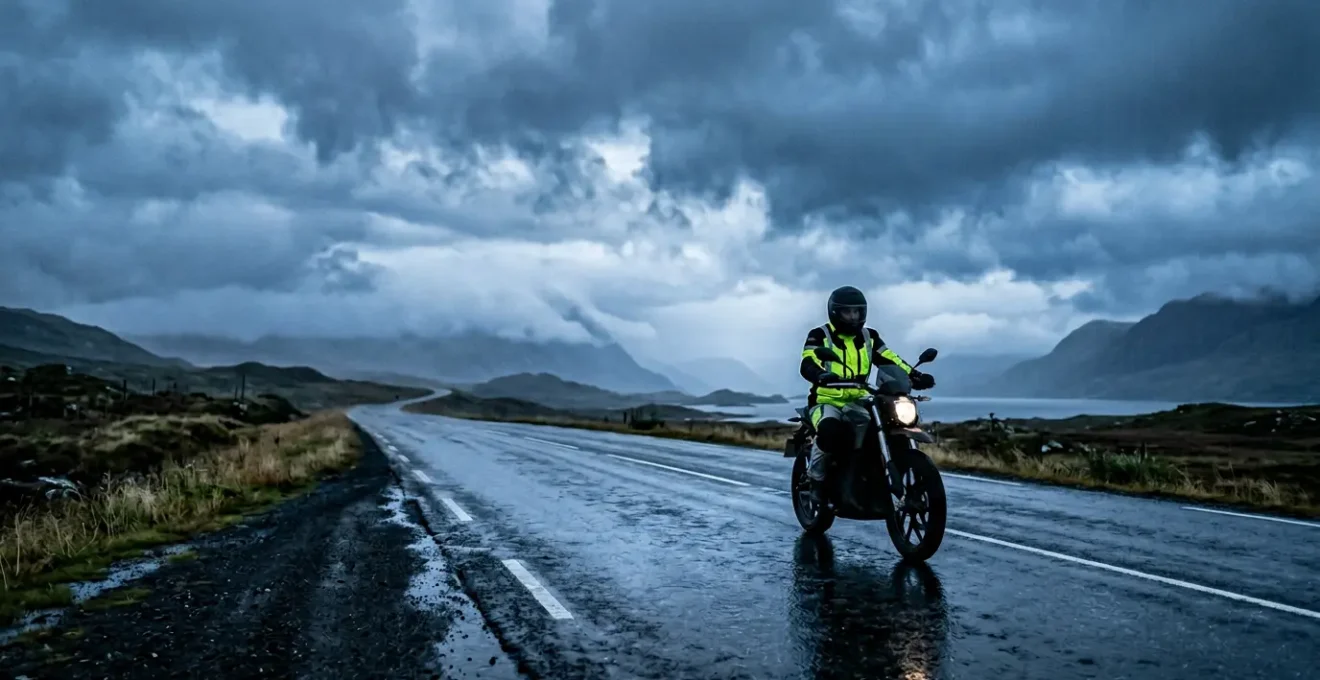
To prevent accidents in bleak UK weather, making yourself visible goes far beyond wearing a fluorescent jacket; it requires a strategic, multi-layered system that actively hacks a driver’s perception.
- Passive brightness (fluorescence) fails in low-contrast conditions; active visibility relies on retro-reflection and motion.
- Your scooter’s side profile is its most vulnerable point at junctions; this is where strategic tape placement is critical.
- The human eye is hardwired to detect biological motion, making reflectors on moving parts (wheels, ankles) exponentially more effective than static ones.
Recommendation: Stop thinking about being a bright object and start building a ‘visual signature’ using a combination of colour contrast, strategically placed retro-reflective materials, and motion-based reflectors to ensure you are not just seen, but instantly recognised as a vulnerable road user.
The persistent, soul-sapping grey of a British sky. The drizzle that mists everything into a uniform shade of damp. For a scooter rider, this isn’t just a mood; it’s a threat. In this low-contrast world, you and your machine can simply vanish into the background, becoming invisible to the very drivers you’re depending on to see you. The common advice is always the same: « wear a high-vis vest ». While well-intentioned, this advice dangerously oversimplifies a complex problem. Relying solely on a fluorescent jacket is like bringing a whistle to a rock concert and hoping to be heard.
The reality is that on a gloomy day, yellow can fade into the background just as easily as black. True safety, the kind that prevents the dreaded « Sorry Mate, I Didn’t See You » (SMIDSY) incident, isn’t about passive brightness. It’s about active presence. It’s about understanding the psychology of perception and using a layered system of gear that forces a driver’s brain to not just see a flicker of light, but to register, identify, and react to *you*. This isn’t just about adding more lights; it’s about creating a distinct visual signature that screams « motorcycle » from every angle, in any weather.
This guide will deconstruct the science of being seen. We will move beyond the platitudes and explore how to strategically use contrast, height, motion, and advanced materials to build a fortress of visibility around you and your scooter. We’ll examine why some reflectors work better than others and how to maintain your own ability to see when the weather turns against you. It’s time to take control of your conspicuity.
To navigate this crucial topic, this article is structured to build a complete system for your safety. Each section tackles a different layer of visibility, providing you with a comprehensive understanding and actionable steps to make yourself undeniable on the road.
Summary: A scooterist’s guide to strategic visibility in poor weather
- Fluorescent on the Chair: Why Wearing Dark Coats Makes You Invisible?
- Side Visibility: Where to Stick Tape to Avoid Junction Collisions?
- Height Matters: Do Safety Flags Really Stop Vans from Reversing into You?
- Plastic Windows in Rain: Keeping Clear Visibility When Covered Up
- Motion Eye-Catching: Why Spoke Reflectors Work Better Than Static Ones?
- Black Reflective Tape: Stealth by Day, Glowing by Night
- Candlepower vs Lumens: How Bright Must Your Headlight Be for Road Use?
- Beyond Stock Lights: Upgrading Lights and Reflectors for Maximum Safety
Fluorescent on the Chair: Why Wearing Dark Coats Makes You Invisible?
The core principle of daytime visibility is not brightness itself, but contrast. Your body on the scooter seat forms the highest point of your visual silhouette. When you wear a dark coat, you create a blob of low contrast that blends perfectly with shadows, the interior of cars, and the road surface itself. You are effectively camouflaged. Fluorescent materials work by converting invisible UV light into visible light, making them appear to glow, which radically increases their contrast against almost any natural background.
However, not all bright colours are equal. The effectiveness of a fluorescent colour depends entirely on the background it is viewed against. On a bright, sunny day, almost any bright colour stands out. But on an overcast UK day, the ambient light is diffuse and grey. This is where the specific shades of fluorescent yellow-green (often called ‘lime’ or ‘volt’) and orange excel. These colours sit at a peak wavelength for the human eye’s sensitivity, especially in daylight and twilight.
As traffic safety research confirms, it’s about maximising this difference to trigger recognition in a driver’s brain. As human factors researcher John Lloyd, PhD, states in his work on motorcycle conspicuity:
Brighter colors, especially high-vis yellow or orange, are more likely to create a greater contrast and therefore be more recognizable.
– John Lloyd, PhD, Conspicuity of Motorcycles and Rider Visibility – Human Factors Research
The takeaway is clear: the single most effective daytime visibility improvement is to ensure your torso—the largest and highest part of your body—provides the maximum possible contrast with the environment. A dark jacket, no matter how stylish, is an invisibility cloak you can’t afford to wear.
Side Visibility: Where to Stick Tape to Avoid Junction Collisions?
While forward and rear visibility are important, a scooter’s greatest point of vulnerability is its side profile, especially at junctions. To a driver looking out their side window, a scooter can present a target less than a metre wide, moving surprisingly fast. This is the classic scenario for a SMIDSY crash. While fluorescent clothing helps, at night or in heavy rain, it’s retro-reflective material that does the heavy lifting. Unlike fluorescent gear, it doesn’t need UV light; it needs a driver’s headlights to explode with brightness.
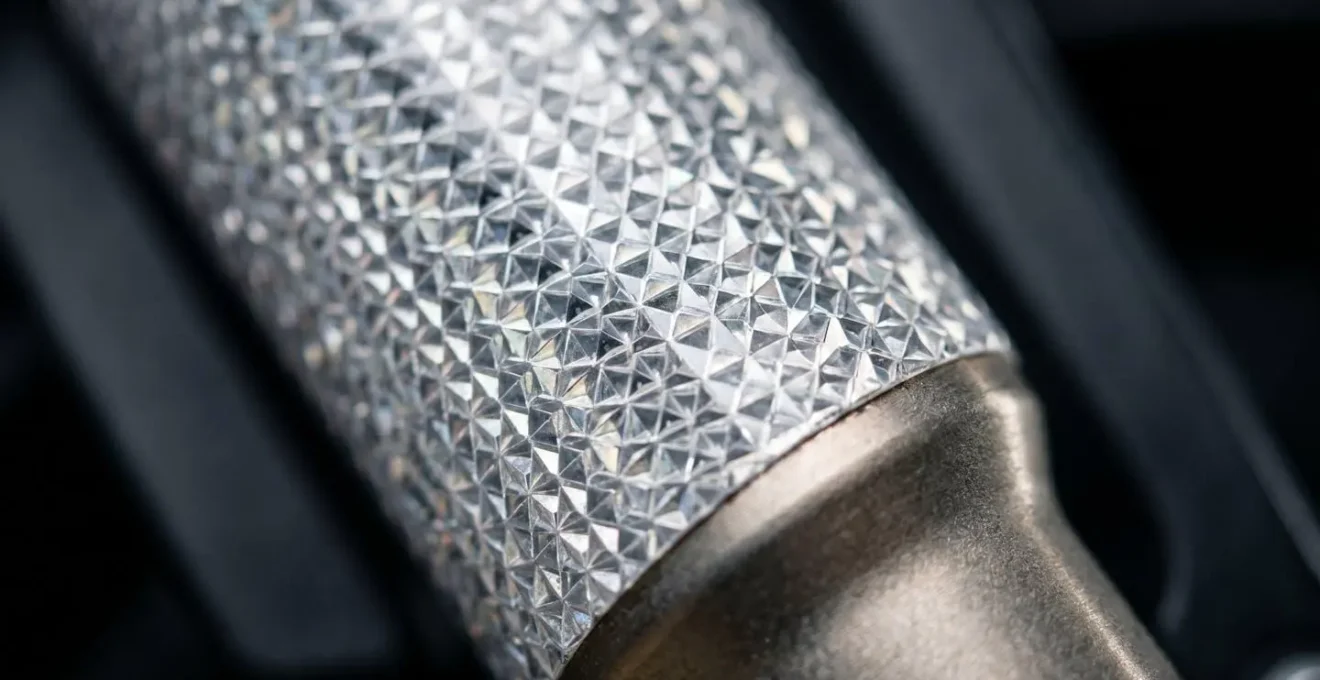
The key is strategic placement. You need to apply tape to create a « visual signature » that is instantly recognisable as a vehicle. Think about the key structural and moving parts of your scooter. Critical areas for application include: the front fork legs, the sides of the front and rear mudguards, the edges of hard panniers or top boxes, and the rear of your helmet. The goal is to outline your shape and add points of light where a driver wouldn’t expect them.
Case Study: The Power of Side-Mounted Retro-Reflectives
The effectiveness of this strategy is not just theoretical. A Malaysian road safety study involving 38 drivers found that retro-reflective tapes placed on the side body of motorcycles significantly improved detection distance and speed at night. The study concluded that this simple, low-cost measure was particularly effective for reducing junction-area crashes, as it allowed other drivers to detect and identify the motorcycle from much further away, giving them more time to react.
When choosing tape, opt for high-quality, prismatic or micro-prismatic material (often rated as Type IV or higher). This type of tape contains tiny, precisely-angled prisms that reflect a huge percentage of light directly back to its source, making it far more brilliant than cheaper glass-bead tapes, especially when viewed from an angle—exactly the situation at a T-junction.
Height Matters: Do Safety Flags Really Stop Vans from Reversing into You?
In a world of SUVs, delivery vans, and lorries, a scooter is a low-profile vehicle. This is never more apparent than in car parks or slow-moving traffic, where your machine can easily disappear below the window line or into the blind spots of larger vehicles. While a fluorescent helmet helps, we can also think vertically. The concept of a safety flag, borrowed from recumbent bicycles and off-road vehicles, is to break the horizontal plane and place a high-contrast visual marker above the roofline of most cars.
Does it work? While it may feel a little undignified, a tall, flexible whip pole with a bright orange or yellow pennant is undeniably conspicuous. It provides a point of reference that is constantly in motion, catching the eye of a van driver checking their mirrors before reversing out of a parking bay. Its effectiveness lies in its novelty and its height; it’s a visual signal in a place where drivers don’t expect to see one, forcing a double-take.
This isn’t just about preventing trivial bumps. The fundamental vulnerability of a motorcyclist is extreme. According to the National Highway Traffic Safety Administration (NHTSA), although motorcycles make up a small fraction of vehicles on the road, their riders face a disproportionately high risk. In fact, official NHTSA data reveals that the 6,228 motorcyclists killed in 2024 represented a staggering 15% of all traffic fatalities. This statistic underscores the need to consider every possible tool, no matter how unconventional, to increase your presence.
A safety flag is not a solution for motorway riding, but for the urban commuter navigating dense traffic, delivery zones, and multi-storey car parks, it’s a low-cost, high-impact tool. It’s a proactive measure that addresses a specific vulnerability—your lack of vertical presence—in the environments where that vulnerability is most likely to be exploited.
Plastic Windows in Rain: Keeping Clear Visibility When Covered Up
Being seen is only half the battle; you also have to be able to see. Your helmet visor or scooter windscreen is your window to the world, and in a UK downpour, it can quickly become an opaque wall of water, distortion, and fog. A compromised view dramatically reduces your ability to spot hazards, read the road surface, and anticipate the actions of others. Maintaining optical clarity is not a matter of comfort, it is a non-negotiable tenet of rider safety.
Fogging on the inside of the visor is caused by the temperature difference between your warm, moist breath and the cold outer surface. Rain sheeting on the outside, rather than beading and rolling off, creates a distorted, blurry view, especially at night when oncoming headlights create starbursts and glare. Thankfully, both of these issues can be systematically managed with the right techniques and products. Treating your visor with the same care as a camera lens is essential.
Neglecting your visor is like choosing to ride with your eyes half-closed. Optical degradation from micro-scratches and chemical damage is a gradual process, but it has a severe impact on your ability to process visual information, especially in low-light or wet conditions. A pristine, well-maintained visor is your first and best line of defence.
Your action plan: Preserving optical clarity on your visor and screen
- Avoid micro-scratches: Use only dedicated microfiber cloths for cleaning optical surfaces. A dirty cloth or paper towel will embed fine scratches that create glare and starbursts from lights at night.
- Treat the exterior: Apply a quality hydrophobic coating (such as Rain-X for Plastic, not the glass version) to the outside of your visor. This forces water to bead up and roll away, maintaining clarity.
- Defeat interior fog: Install a Pinlock anti-fog insert. This system creates a double-glazed effect with a sealed pocket of air, insulating the inner surface and preventing condensation from forming.
- Clean correctly: Use only pH-neutral soap and lukewarm water. Avoid ammonia-based window cleaners, which can make the plastic brittle and damage any factory coatings.
- Know when to replace: A visor is a consumable item. Replace it every 2-3 years, or immediately if it has deep scratches. A new visor is one of the cheapest and most effective safety upgrades you can buy.
Motion Eye-Catching: Why Spoke Reflectors Work Better Than Static Ones?
Static reflectors on the frame of your scooter are good. Reflectors that move are exponentially better. This is due to a powerful feature of human visual processing known as biological motion perception, or biomotion. Our brains are exquisitely tuned to detect and interpret patterns of movement that signify a living creature. Think of how you can recognise a friend from a hundred yards away just by their walk. A few points of light on the ankles, knees, and wrists are all it takes for our brains to construct the image of a person running in the dark.
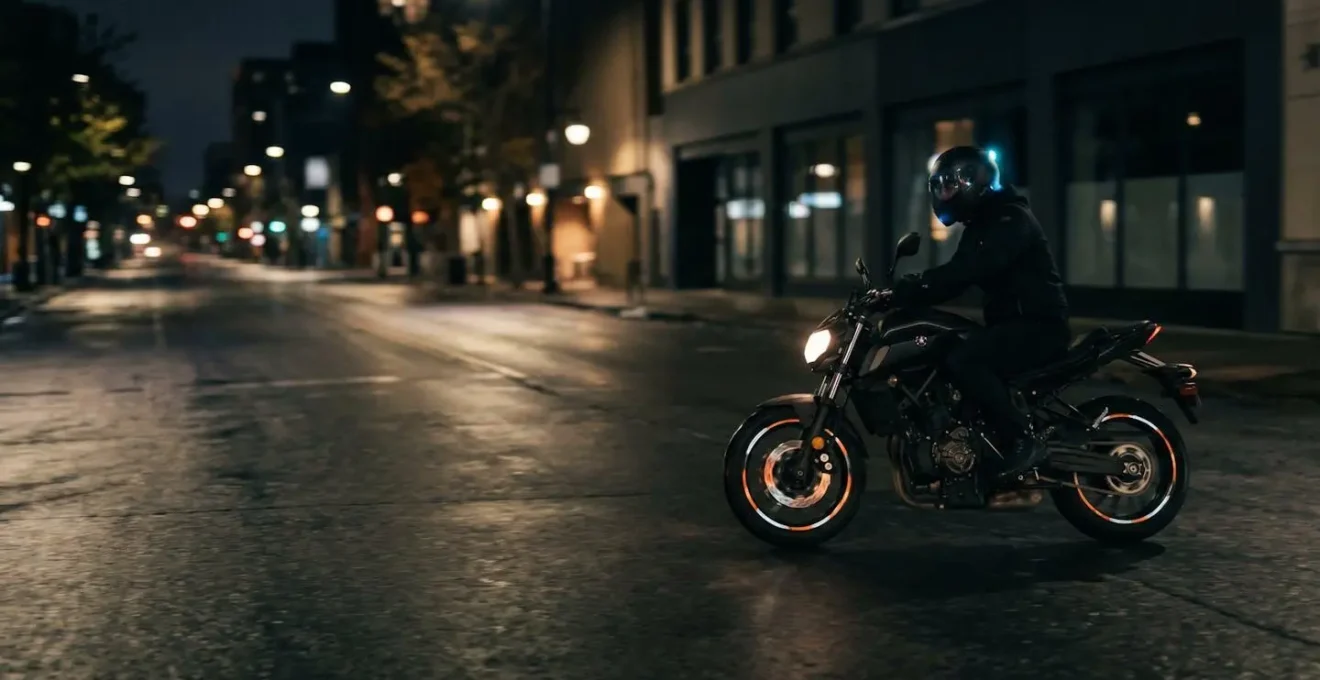
We can hack this system for safety. A static reflector is just a point of light. But a reflector on a spinning wheel, or on your ankle as you move your foot, creates a dynamic, oscillating pattern that is impossible for the human brain to ignore. It triggers a primal, pre-attentive alert in a driver’s mind, forcing them to notice you long before they would a simple, static light. As the experts at Motohut note:
Biomotion beats static reflection. It turns out our eyes are super tuned to recognize human motion, a concept called biological motion or biomotion.
– Motohut Safety Research Team, Motorcycle Night Visibility Gear: How Reflective Jackets Boost Safety
How can you apply this? The easiest wins are reflective wheel-rim tape or clip-on spoke reflectors. As the wheels spin, they create large, impossible-to-miss circles of light. For personal gear, reflective straps or patches on your ankles or the back of your gloves add more dynamic points of light to your visual signature. The key is to place reflective material on any part of you or your scooter that moves. This transforms you from a passive, static object into a dynamic, living presence that actively commands attention.
Black Reflective Tape: Stealth by Day, Glowing by Night
Let’s be honest: not everyone wants to ride a machine plastered in fluorescent yellow. For riders who value a more subdued, classic aesthetic, the idea of hi-vis can be a major turn-off. We know from research that bright colours work; for instance, a landmark New Zealand study found that wearing a white helmet was associated with a 24% lower crash risk compared to a black helmet. But what if you could have stealth and safety at the same time?
Enter black retro-reflective tape. This ingenious material uses the same micro-prismatic technology as high-visibility silver tape, but with a crucial difference. A special filtering layer makes the tape appear matte black or dark grey in daylight, blending almost seamlessly into dark bodywork or a black helmet. It’s virtually invisible when you don’t need it.
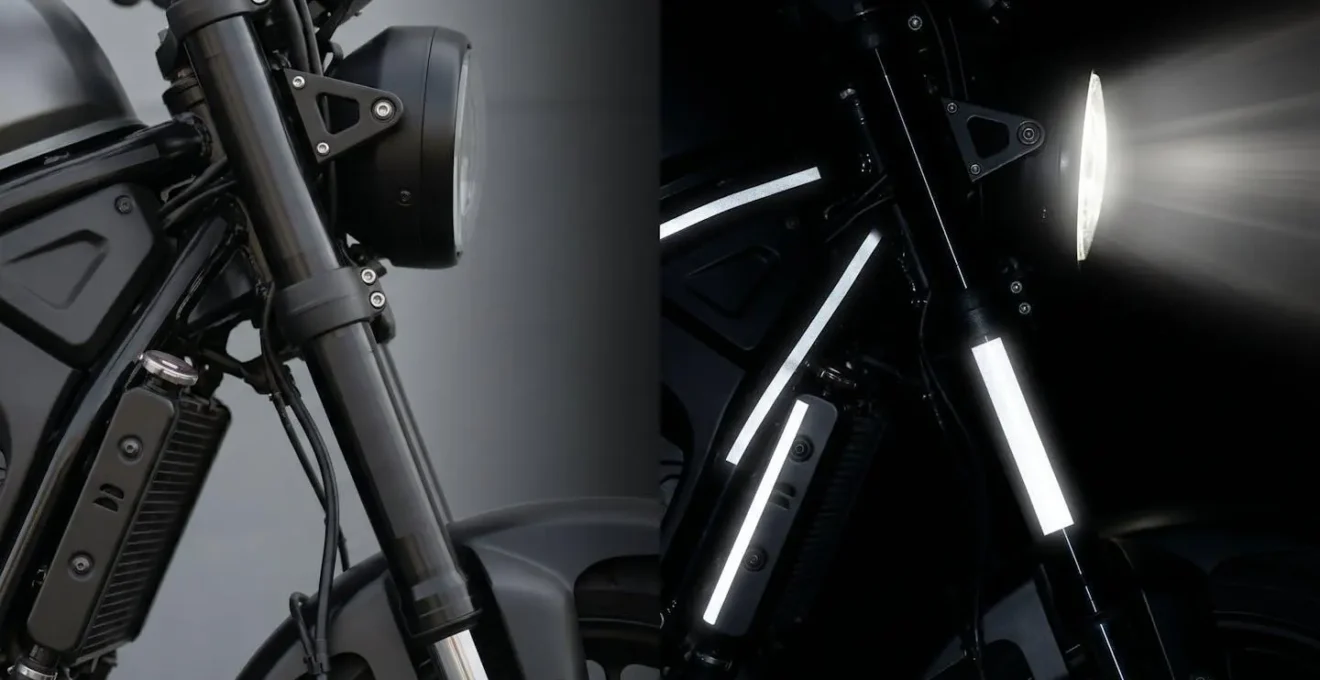
At night, however, when hit by a car’s headlights, the magic happens. The light passes through the filter, hits the prismatic layer, and is fired directly back at the driver. The tape explodes with a brilliant white or silver light, just as bright as traditional reflective tape. It’s the ultimate « Jekyll and Hyde » of conspicuity gear.
This allows for a subtle, strategic approach. You can add significant reflective surface area to your scooter’s frame, panniers, or forks without compromising its daytime look. You can create custom shapes and patterns on a black helmet that are invisible until a headlight beam sweeps across them. It allows you to build a powerful night-time visual signature without looking like a traffic cone during the day. It’s a perfect example of using modern material science to solve a classic rider dilemma: the conflict between style and safety.
Candlepower vs Lumens: How Bright Must Your Headlight Be for Road Use?
Your headlight has two jobs: to help you see, and to help you be seen. In the context of gloomy UK weather, the second job is arguably the more important one. Running your headlight during the day is a proven safety measure. Solid research demonstrates that daytime headlight use leads to a 27% reduction in crash-related injury for motorcyclists. It’s a simple, effective way to increase your frontal contrast.
But when considering upgrades, riders are often bamboozled by technical jargon. The two key terms are Lumens and Candela (or Candlepower). Lumens measure the total amount of light a bulb produces in all directions. It’s a measure of raw output. Candela, on the other hand, measures the intensity of that light in a specific direction. It’s a measure of focused brightness.
Why does this matter? A bulb can have a very high lumen rating but a poor reflector and lens design, scattering that light uselessly and creating very low candela. This results in a dim, unfocused beam that doesn’t reach far down the road. Conversely, a well-designed headlight can take a more modest lumen output and focus it into a powerful, high-candela beam pattern that is highly effective. For visibility, candela is the more important metric. You want a bright, focused beam that punches through the gloom and grabs the attention of oncoming drivers, not a diffuse glow that gets lost in the haze.
When upgrading, don’t just chase the highest lumen number. Look for lights that specify a strong candela rating and, crucially, a sharp « cut-off » pattern for the low beam. This projects a powerful beam onto the road without dazzling oncoming traffic—a key aspect of responsible and safe road use. An effective headlight makes you visible without making you a menace.
Key takeaways
- Effective visibility is a multi-layered system, not a single piece of gear. You must combine contrast, retro-reflection, and motion.
- The human brain is hardwired to notice motion (biomotion). Reflectors on moving parts like wheels and ankles are far more effective than static ones.
- Side-on visibility at junctions is your greatest risk. Strategic use of high-quality retro-reflective tape on your scooter’s profile is critical for night and poor-weather safety.
Beyond Stock Lights: Upgrading Lights and Reflectors for Maximum Safety
We’ve established that the gear you wear and the materials you add to your scooter can dramatically increase your visibility. The final piece of the puzzle is enhancing your scooter’s own lighting system. Stock lights are built to a price and to meet minimum legal standards, not to provide maximum real-world safety. Creating a truly layered visibility system means going beyond what came from the factory.
This means thinking in 360 degrees. Auxiliary driving lights mounted low on the forks can create a triangular pattern with your main headlight, a signature that is unique to motorcycles and makes it easier for other drivers to judge your speed and distance. Adding extra brake lights, especially ones that flash briefly before staying solid, dramatically increases the chances of a following driver noticing you are slowing down. LED strips can be used to add side-on illumination that makes your vulnerable profile more visible at night.
This isn’t about vanity or turning your scooter into a « Christmas tree. » It’s a rational response to a terrifying reality. According to the NHTSA, when measured per mile travelled, motorcyclists are profoundly more at risk than their counterparts in cars. The latest NHTSA data shows that there is a nearly 27 times higher fatality rate per vehicle mile traveled for motorcyclists versus passenger car occupants. This stark statistic demands that we take every reasonable step to mitigate that risk.
Building a comprehensive visibility strategy—combining a high-contrast torso, biomotion reflectors, a fully outlined retro-reflective profile, and an upgraded, multi-point lighting system—is the most powerful action you can take. It transforms you from a passive victim of circumstance into an active participant in your own safety, creating a visual presence that is simply too powerful to ignore.
Your next ride is an opportunity to put this into practice. Start by auditing your own ‘visual signature’ from the front, side, and rear, both day and night. Identify one weak point and choose one upgrade from this guide to fix it this week. It is the single most important and empowering investment you can make in your own safety on the road.